
 16-Jul-2026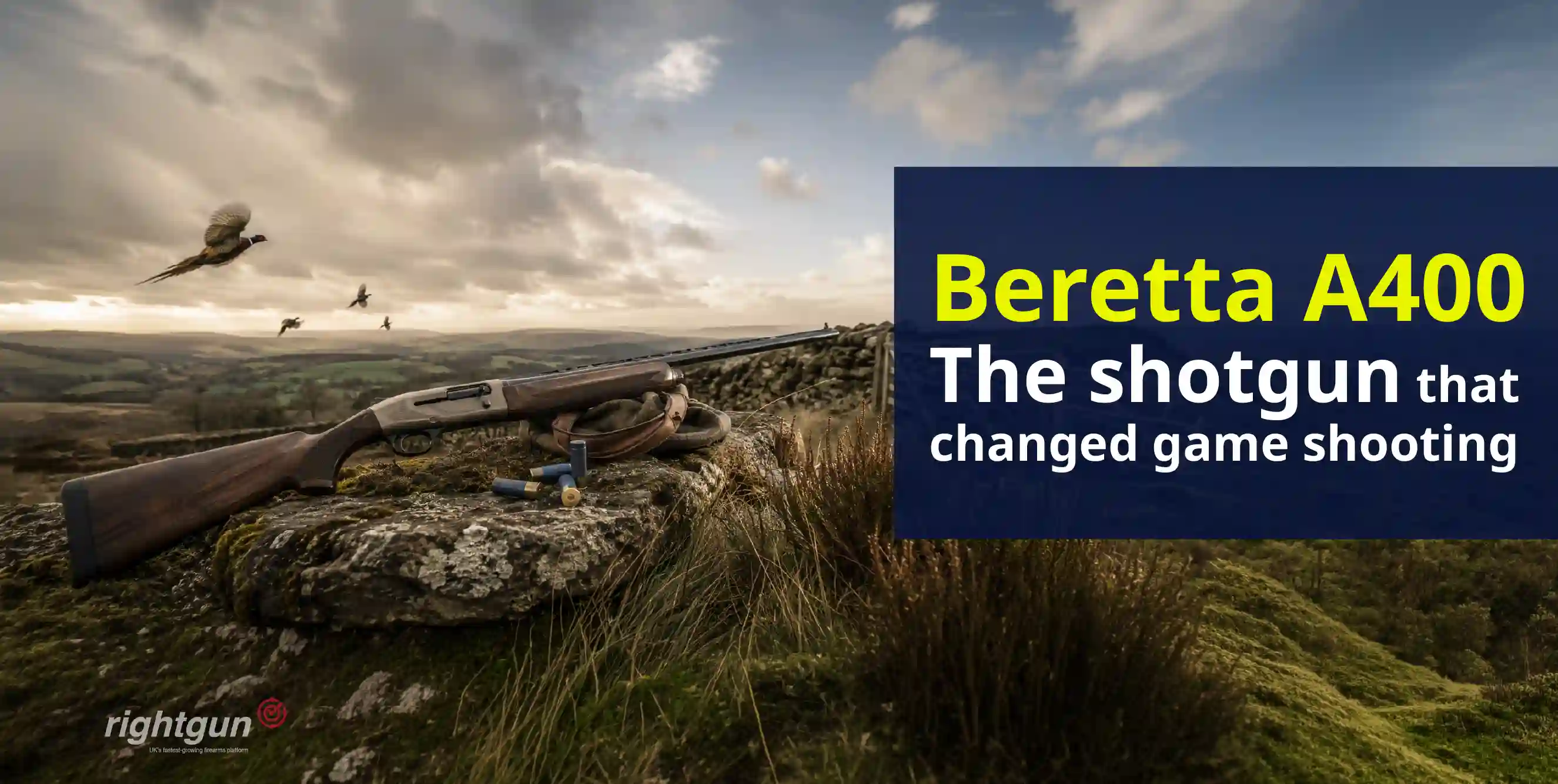
For decades, semi-automatic shotguns occupied an awkward position in British game shooting. They were practical tools for wildfowling and pigeon shooting, certainly, but they carried a faint whiff of the utilitarian, something you used when conditions demanded it rather than chose for pleasure. The Beretta A400 changed that perception almost single-handedly. When it arrived in 2011, it brought a level of refinement, reliability, and shooting comfort that made serious game shots reconsider everything they thought they knew about semi-automatics. Today, the A400 is one of the most commonly seen semi-autos on driven shoots, pigeon hides, and clay grounds across the UK, and its influence on the market has been profound. If you are thinking about a Beretta semi-auto, understanding how the A400 got here and what makes it tick will help you make a far better buying decision.
The road to the A400: From A301 to A391
Beretta's semi-automatic shotgun lineage stretches back further than many shooters realise. The Beretta A301, introduced in the late 1970s, was the company's first gas-operated semi-automatic and established many of the design principles that would carry forward through subsequent generations. It was a solid, reliable gun, if somewhat heavy and agricultural in its aesthetics. The A301 sold well in the UK among wildfowlers and rough shooters who valued its ability to cycle reliably in foul conditions and its softer felt recoil compared to fixed-breech alternatives.
The A303 followed in the mid-1980s, refining the gas system and improving the overall fit and finish. It was a genuinely good gun that earned a loyal following, and clean examples still command respectable prices on the second-hand market. The A390 and subsequently the A391 continued the evolutionary process through the 1990s and 2000s, with each generation bringing incremental improvements to the gas system, stock ergonomics, and barrel quality. The A391 in particular was a strong seller in the UK and remains a popular choice for budget-conscious buyers looking for a proven Beretta semi-auto without the A400's price tag. But it was the A400 that represented a genuine step change rather than merely another incremental improvement.
The blink gas system
At the heart of the A400's performance is Beretta's Blink gas operating system, which the company claims is the fastest-cycling semi-automatic action ever produced. Whether or not that specific claim matters to you, and for most game shooters it probably does not, the engineering behind it is genuinely impressive. The Blink system uses a self-compensating gas valve that automatically adjusts the volume of gas bled from the barrel to match the power of the cartridge being fired. Heavy wildfowling loads and light 21-gram game loads cycle with equal reliability, and the system does not require manual adjustment.
The practical benefit of this for UK shooters is significant. If you shoot driven game in the morning with 30-gram loads and then switch to 28-gram cartridges for an afternoon on the clays, the A400 handles the transition without any fiddling. The cycling speed also contributes to reduced felt recoil, since the bolt begins moving rearward fractionally earlier than in slower-cycling designs, spreading the recoil impulse over a longer period. The result is a gun that is noticeably more comfortable to shoot through a long day than most of its competitors.
Kick-off recoil reduction
Beretta's Kick-Off system, fitted to many A400 variants, takes recoil management a step further. It comprises a hydraulic damper built into the stock that absorbs a substantial portion of the rearward force before it reaches your shoulder. The system uses two interconnected pistons that compress under recoil and then return to their resting position, and Beretta claims it reduces felt recoil by up to 70 per cent compared to a fixed stock.
In practice, the difference is immediately noticeable. Shooting a Kick-Off-equipped A400 back to back with a conventional semi-auto or over-and-under of similar weight reveals a marked reduction in shoulder punishment, particularly with heavier loads. For older shooters, those recovering from injury, or anyone who shoots high volumes, pigeon shooters regularly firing 200 or more cartridges in a session spring to mind, Kick-Off can be the difference between enjoying your shooting and enduring it. The system does add a small amount of weight and a slightly different feel to the stock, and some purists prefer the more direct feedback of a non-Kick-Off model, but for most practical purposes the benefits overwhelmingly outweigh the compromises.
Self-cleaning piston and maintenance
One of the quieter engineering achievements in the A400 is its self-cleaning gas piston. Gas-operated semi-automatics have traditionally required regular cleaning of the gas system to maintain reliable cycling, particularly when shooting dirty or heavily-residued cartridges. The A400's piston is designed to scrape carbon deposits from the gas cylinder wall with each cycle, substantially extending the interval between deep cleans.
This matters in the UK context because British game shooters often use the gun hard through a season and then put it away, and the shooting conditions, rain, mud, cold, are exactly the sort that encourage fouling. The A400 will tolerate a remarkable amount of neglect before it starts to misbehave, though this should not be taken as an invitation to abandon basic maintenance entirely. A wipe-down after each outing, a periodic strip and clean of the gas system, and sensible storage will keep a Beretta A400 running reliably for tens of thousands of rounds. The gas system is straightforward to disassemble without tools, and the components are robust enough that ham-fisted reassembly is unlikely to cause damage.
Optima bore HP barrels
The A400 uses Beretta's Optima Bore HP barrel system, which features a slightly overbored internal diameter and a lengthened forcing cone. The combined effect is to reduce shot deformation as the charge travels down the barrel, improving pattern quality and consistency. The Optima HP choke system uses flush-fitting chokes that are interchangeable across most of Beretta's current shotgun range, and the selection of constrictions available covers everything from full cylinder to extra full.
For game and clay shooting in the UK, most owners find that half and three-quarter choke combinations serve them well for the majority of situations, with the option to swap to tighter or more open chokes for specific conditions. The barrel finish on the A400 is excellent, and the chrome-lined bore resists corrosion and cleans easily. Barrel lengths of 26, 28, and 30 inches are available depending on the model, with 28 inches being the most popular choice among UK game shooters for its balance of handling speed and pattern development.
Models in the range
Xplor Action
The A400 Xplor Action is Beretta's game-focused model, designed for walked-up and driven shooting. It features a lightweight alloy receiver, Kick-Off recoil reduction, and a semi-gloss walnut stock. The Xplor is the model most commonly seen on UK game shoots, and its balance of weight, handling, and recoil management makes it an excellent all-round choice. It is the gun that most first-time A400 buyers gravitate toward, and with good reason, it does everything well without excelling to the point of impracticality in any single discipline.
Xcel Sporting
The A400 Xcel is Beretta's clay-shooting variant, featuring a heavier barrel profile, a wider ventilated rib, and a stock geometry optimised for sustained target shooting. It is a popular choice on UK Sporting clay courses, where its soft recoil and fast cycling allow shooters to maintain their rhythm through long competitions. The Xcel also sees use among pigeon shooters who value its ability to handle high-volume sessions without punishing the shoulder, and a few game shots use it for driven days where volume is high and bird presentation consistent.
Xtreme Plus
The A400 Xtreme Plus is built for the harshest conditions and the heaviest loads. Chambered for 3.5-inch magnum cartridges, it is the choice of serious wildfowlers who need a gun that will function reliably in freezing temperatures, driving rain, and salt-laden environments. The Xtreme features an oversized bolt handle, an enlarged loading port, and a synthetic stock that shrugs off the conditions that would ruin walnut. For UK wildfowling below the high-water mark, where three-inch and 3.5-inch steel loads are the norm, the Xtreme is purpose-built for the task.
Semi-auto advantages for UK game shooting
The case for a semi-automatic over a traditional over-and-under in a UK game shooting context is stronger than many traditionalists care to admit. The reduced felt recoil, a product of both the gas-operated action and, in the A400's case, the Kick-Off system, makes a semi-auto significantly more comfortable to shoot through a full driven day. When you are firing 200 or more cartridges at pheasant, partridge, or grouse, that comfort translates directly into better shooting as fatigue diminishes.
For wildfowling, the semi-auto's advantages are even more pronounced. The ability to carry a third cartridge in the magazine is a genuine practical benefit when you may only get one chance at a skein of geese, and the gas system's absorption of recoil makes heavy steel loads far more manageable than they are through a fixed-breech gun. The A400 Xtreme's ability to handle 3.5-inch magnums opens up load options that are simply not available with a standard over-and-under. The semi-auto format also tends to be lighter than equivalent over-and-unders, which matters when you are walking miles across marshland or foreshore.
Buying a used A400
The second-hand market for A400s is well-established, and good examples are available across Rightgun and through dealers nationwide. When inspecting a used A400, begin with the gas system, remove the forend and check the gas piston and cylinder for excessive carbon build-up or scoring. A dirty gas system is not necessarily a deal-breaker, since these parts clean up well, but heavy scoring suggests long-term neglect that may have caused wear elsewhere.
Check the barrel bore for pitting, particularly near the chamber and at the muzzle. Examine the bolt face and extractor for wear, and cycle the action by hand to feel for smooth, consistent operation. The Kick-Off system, if fitted, should compress smoothly and return crisply; any mushiness or failure to return suggests the dampers may need servicing. Look at the stock and forend for cracks around the wrist and forend iron, and check that the recoil pad is intact and not perished. A well-maintained A400 with a reasonable round count represents excellent value on the used market, and the gun's durability means that cosmetic wear often outpaces mechanical deterioration by a considerable margin.
Reliability and the long-term record
The Beretta A400 has now been on the market for well over a decade, and its long-term reliability record is impressive. UK dealers and gunsmiths consistently report that the A400 is one of the most trouble-free semi-automatics they encounter, with genuine mechanical failures being rare. The most common issues tend to be user-related, failure to clean the gas system, use of reloaded or sub-standard ammunition, or incorrect reassembly after stripping, rather than inherent design flaws.
The gun's ability to digest virtually any factory ammunition without adjustment is a significant practical advantage, and its tolerance of adverse conditions has earned it a strong following among shooters who use their guns hard and expect them to perform regardless. Beretta's parts availability and service network in the UK are well-established, and any component you might need is readily obtainable. For a gun that you intend to use seriously over many seasons, the A400's combination of performance, durability, and support infrastructure makes it one of the safest choices in the semi-automatic market.
Read next:
