
 15-Jul-2026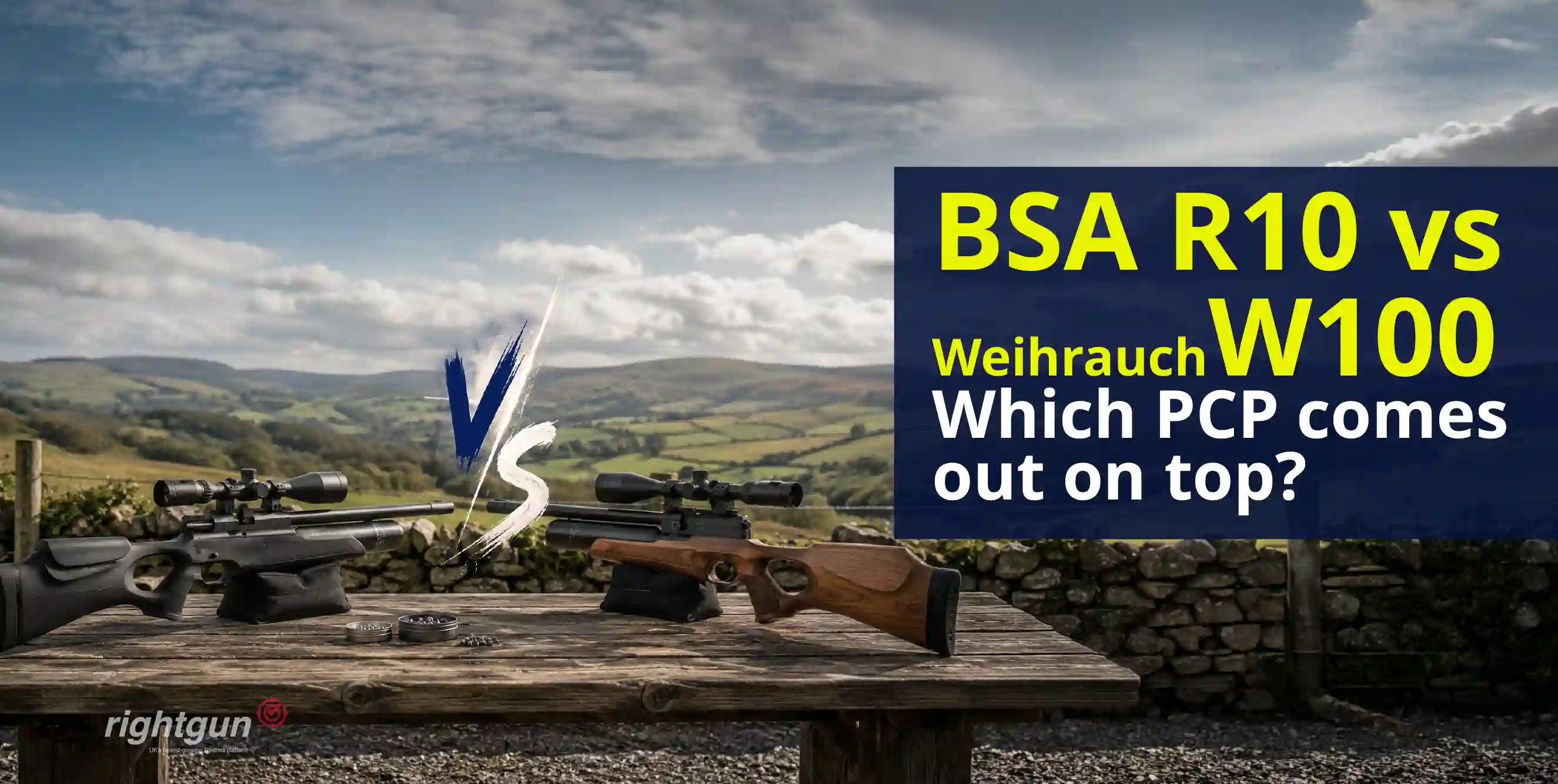
The debate between the BSA R10 and the Weihrauch HW100 has been running in UK airgun circles for years, and it shows no sign of being settled any time soon. Both rifles sit at the top of the sub-12 ft-lb PCP market, both have fiercely loyal followings, and both are genuinely excellent tools for hunting and target shooting. Choosing between them is not a matter of picking the good rifle over the bad one. It is a matter of understanding what each does best and deciding which set of strengths matters most to you.
This comparison covers the areas that actually influence your shooting experience: accuracy, build quality, trigger performance, shot count, noise, stock options and aftermarket support. By the end, you should have a clear picture of which rifle deserves a place in your cabinet and which shooting disciplines each one suits best.
PCP technology: A quick overview
Both the R10 and HW100 are pre-charged pneumatic air rifles, meaning they use compressed air stored in an onboard reservoir to propel the pellet. Unlike spring-powered rifles, PCPs have virtually no recoil and no forward lunge when fired, which makes them inherently easier to shoot accurately. The trade-off is that you need a way to fill them, whether that is a diving bottle, a stirrup pump, or a dedicated compressor.
At the sub-12 ft-lb power level that applies to UK air rifles used without a firearms certificate, both rifles operate comfortably within legal limits while maximising the energy available. The regulated actions in both platforms deliver consistent shot-to-shot velocity, which translates directly into consistent point of impact. This is the fundamental advantage of a quality PCP over a springer: you get the same performance from the first shot of a fill to the last usable shot, with no need to compensate for power curves.
Build quality: German precision vs British engineering
The Weihrauch HW100 is manufactured in Mellrichstadt, Germany, by a company with a reputation for engineering that borders on obsessive. Pick up an HW100 and the first thing you notice is the fit and finish. The metalwork is beautifully blued, the machining tolerances are tight, and every component feels as though it was made to last decades rather than years. Weihrauch has been building air rifles since 1899, and that heritage shows in every detail.
The BSA R10, particularly in its current Mk2 form, is designed in the UK and represents the pinnacle of BSA's airgun range. The build quality is excellent, though the character is subtly different from the Weihrauch. Where the HW100 feels like a precision instrument, the R10 feels more like a working tool, still beautifully made, but with a slightly more purposeful, less decorative approach to its construction. The R10's action is clean and well-engineered, and BSA's use of a bolt-action cocking mechanism gives it a solid, positive feel.
Both rifles will last a lifetime with basic care. Seals will eventually need replacing on any PCP, but both platforms use readily available O-rings and have straightforward strip-down procedures. If you are the type of shooter who likes to maintain your own equipment, neither rifle will give you problems.
Accuracy: Where it matters most
This is the category most people care about, and it is also the one where the differences are smallest. Both the R10 and HW100 are capable of producing sub-half-inch groups at thirty yards with good pellets, and in practical hunting situations, you would be hard pressed to notice any meaningful difference in precision. At the sub-12 ft-lb level, pellet choice and the individual barrel's preference usually have more influence on group size than the rifle's inherent mechanical accuracy.
The Weihrauch HW100 has a slight edge in the eyes of many target shooters, partly because of its exceptionally consistent barrel quality and partly because the Weihrauch action seems to wring every last fraction of accuracy from each shot. The R10 Mk2 is no slouch, though, and BSA's barrel quality has improved markedly in recent generations. Some R10 owners report stunning accuracy straight from the box, while others find that a particular barrel prefers a specific pellet before it really shines.
The practical difference is this: if you are shooting at quarry within normal hunting ranges of twenty-five to forty yards, either rifle will put the pellet exactly where you point it. If you are shooting benchrest competitions where fractions of a millimetre matter, the HW100 has a marginally stronger reputation, but individual barrel variation means that generalisation does not always hold.
Trigger performance
This is where the two rifles start to diverge more noticeably. The Weihrauch Rekord trigger is widely regarded as one of the finest air rifle triggers ever made. It is a two-stage unit that breaks cleanly and predictably, with minimal creep and a let-off that you can set to be as light or as firm as you prefer. The Rekord has been refined over decades and is a genuine pleasure to use. Many shooters cite the trigger as the primary reason they chose the HW100 over everything else.
The BSA trigger fitted to the R10 is a perfectly competent unit that has improved significantly in the Mk2 version. It offers a clean two-stage pull with adjustable weight, and most shooters find it entirely satisfactory for both hunting and target work. That said, placed side by side with the Rekord, it lacks the same crispness and refinement. The break is slightly less defined, and the travel between stages is a touch less precise.
For hunting, where you are typically shooting from field positions with cold fingers and adrenaline, the difference is marginal. For target shooting, where trigger feel directly affects your ability to release the shot without disturbing the aim, the HW100's Rekord gives it a genuine advantage. It is one of those areas where both are good, but one is measurably better.
Shot count per fill
Shot count matters practically because it determines how often you need to refill during a session. A higher shot count means more time shooting and less time pumping or reaching for the bottle. Both rifles deliver respectable numbers, but the specifics differ.
The BSA R10 Mk2 typically delivers between 180 and 220 consistent shots per fill in .177, and slightly fewer in .22, usually around 150 to 180. The regulated action keeps velocity stable across that range, with a clear drop-off when the reservoir pressure falls below the regulator's working range. The R10's air cylinder is removable on some variants, which means you can carry a spare pre-filled cylinder and swap it in the field for virtually unlimited shooting.
The Weihrauch HW100 offers a similar shot count in most configurations, typically around 150 to 200 shots in .177 depending on the specific model and fill pressure. The HW100's regulator is factory-set and delivers excellent consistency, though some owners choose to have it adjusted by a specialist tuner to optimise the balance between shot count and power output. Both rifles are efficient enough that running out of air during a normal hunting session is unlikely unless you are having an exceptionally busy day.
Noise levels
Neither rifle is loud by firearms standards, but noise matters when you are hunting in gardens, on permissions close to houses, or in situations where disturbing other wildlife would compromise your session. The HW100 has a reputation for being one of the quieter PCPs on the market, producing a modest crack that dissipates quickly. The R10 is similarly quiet, though some shooters find it very slightly louder at the muzzle.
Both rifles accept aftermarket moderators, and fitting a good silencer reduces the report to little more than a mechanical click. If noise is a particular concern, either rifle will be quiet enough with a moderator fitted, and the difference between them without one is marginal enough that it should not drive your decision.
Stock options and ergonomics
The HW100 is available in several stock configurations, including a traditional sporter in walnut, a thumbhole walnut stock, and synthetic options. The walnut stocks are typically well-figured and finished to a high standard, which you would expect from a German manufacturer at this price point. The thumbhole version is particularly popular with target shooters because it locks your grip into a consistent position for every shot.
The BSA R10 also comes in walnut sporter and thumbhole configurations, as well as a tactical-style synthetic stock aimed at shooters who want a more modern look. BSA's walnut is generally good quality, though the figuring tends to be slightly plainer than what you see on the Weihrauch. The R10's stock geometry suits a slightly wider range of builds, which makes it easier to fit comfortably without adjustment for many shooters.
Both manufacturers offer left-handed versions, which is worth noting because left-handed PCPs are not universally available. If you shoot from the left shoulder, having the bolt handle and stock cheekpiece on the correct side is a meaningful advantage over simply using a right-handed rifle the wrong way round.
Aftermarket support and tuning
The UK has a thriving aftermarket scene for both rifles, with specialist tuners offering everything from regulator adjustments and power optimisation to custom stocks, barrel swaps and trigger upgrades. The HW100 arguably has the edge here simply because its longer time in production and wider European distribution have created a larger ecosystem of parts and expertise. Companies across the UK offer full strip-down and tune services for the HW100, and there is a wealth of online knowledge available from the enthusiast community.
The R10's aftermarket is strong too, particularly within the UK where BSA's domestic market presence means that parts availability is excellent and many gunsmiths are familiar with the platform. BSA's customer service has a good reputation for supporting owners with spare parts and technical advice, which matters when you are dealing with a precision pneumatic system that occasionally needs attention.
Value for money
At the time of writing, both rifles sit in a similar price bracket, with new examples typically ranging from around £700 to over £1,000 depending on the stock option and any additional accessories. The HW100 tends to command slightly higher prices both new and on the second-hand market, reflecting its brand cachet and the perceived quality premium of German manufacturing. The R10 often represents marginally better value in terms of what you get for your money, particularly in the Mk2 specification where BSA addressed many of the minor criticisms levelled at earlier versions.
On the used market, both rifles hold their value well. A well-maintained HW100 will sell quickly and for a strong price, while a clean R10 Mk2 is equally sought-after. If you are buying second-hand, check the seal condition by listening for leaks when the rifle is pressurised, inspect the barrel crown for damage, and test the trigger for any roughness or inconsistency. Both platforms are robust, but neglect and heavy use will show up in these areas first.
Which rifle suits which shooter?
If you prioritise trigger refinement, build finish and the reassurance of a brand with deep engineering heritage, the Weihrauch HW100 is the rifle to choose. It is a beautifully made tool that excels at target shooting and performs superbly in the field. The Rekord trigger alone justifies serious consideration, and the overall package is one that rewards experienced shooters who appreciate fine mechanics.
If you want a rifle that is equally accurate in practical terms, slightly more utilitarian in character, and potentially better value for money, the BSA R10 Mk2 deserves your attention. It is a genuine all-rounder that handles hunting and informal target work with equal composure, and BSA's UK-based support infrastructure gives you confidence that parts and service will always be accessible.
You can find both the BSA R10 and the Weihrauch HW100 listed on Rightgun, along with a wide range of other air rifles for every budget and discipline.
Filling equipment: A practical note
Whichever rifle you choose, you will need a way to fill it. A diving bottle, typically a 3-litre or 7-litre cylinder filled to 232 or 300 bar, is the most popular option and will provide hundreds of fills before needing a refill from a dive shop. A stirrup pump is cheap and portable but physically demanding, particularly if you shoot regularly. A dedicated compressor is the most convenient option but represents a significant additional investment, typically £250 to £500 for a unit capable of filling to the pressures these rifles require.
Both the R10 and HW100 use standard Foster or probe-type fill adaptors, so compatibility with filling equipment is not an issue. Factor the cost of filling equipment into your budget when comparing rifles, because it is a necessary expense that catches some first-time PCP buyers off guard.
Read next:
