
 04-Jul-2025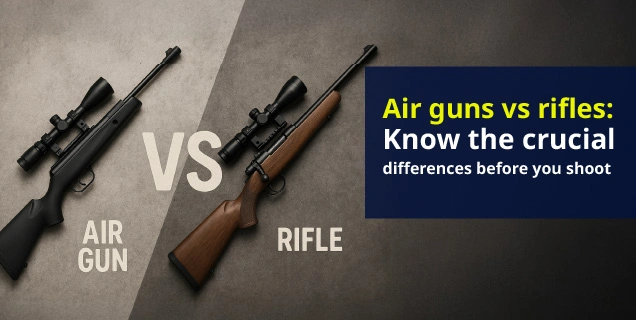
If you’re new to shooting or exploring which firearm best suits your needs, it’s important to understand the difference between air guns and rifles. While they may look similar, these two types of guns operate very differently and are suited for different shooting disciplines.
In this blog, we break down the key differences between air guns and rifles — covering how they work, what they’re used for and which is best depending on your shooting goals.
What is an air gun?
An air gun is a type of gun that uses compressed air or gas to fire pellets or BBs. Unlike traditional rifles that rely on the ignition of gunpowder, air guns operate without any explosive propellant.
There are several types of air guns:
Spring-powered
Gas-ram (or gas piston)
Pre-charged pneumatic (PCP)
CO2-powered
Air guns are popular for:
Target shooting and plinking
Small pest control (e.g. rats or pigeons)
Introduction to shooting sports
Backyard shooting (subject to UK laws)
What is a rifle?
A rifle is a firearm that uses cartridges containing gunpowder to fire bullets at high velocity. Rifles typically have a long barrel with spiral grooves (rifling) that stabilise the bullet in flight.
There are different types of rifles, including:
Bolt-action
Semi-automatic
Lever-action
Straight-pull
Rifles are commonly used for:
Deer stalking and large game hunting
Long-range target shooting
Professional and military use
Competitive precision shooting
Key differences between air guns and rifles
Power source
Air Guns: Compressed air, gas or spring
Rifles: Gunpowder in cartridges
Ammunition
Air Guns: Pellets or BBs
Rifles: Bullets in brass-cased ammunition
Noise level
Air Guns: Relatively quiet
Rifles: Louder, often requires hearing protection
Legislation (UK)
Air Guns: Easier to obtain (some under 12 ft/lbs)
Rifles: Requires Firearms Certificate (FAC)
Effective range
Air Guns: Shorter (20–50 metres)
Rifles: Longer (100+ metres depending on calibre)
Cost to shoot
Air Guns: More affordable (ammo + maintenance)
Rifles: Higher cost (ammo, licensing, maintenance)
Maintenance
Air Guns: Minimal upkeep
Rifles: Regular and thorough cleaning required
Legal considerations in the UK
In the UK, air guns under 12 ft/lbs (for rifles) or 6 ft/lbs (for pistols) can be owned without a firearm certificate (FAC), as long as the shooter is over 18 and uses them responsibly. However, high-powered air rifles, as well as any traditional rifle, require an FAC.
Storage laws, safe handling and landowner permission also apply — so it’s important to stay up to date with current UK firearms legislation.
Which should you choose?
Choose an air gun if you:
Are just getting started with shooting
Want to shoot in your garden (where legally permitted)
Need a quieter, low-cost option
Are targeting small pests
Choose a rifle if you:
Want to hunt larger game such as deer or fox
Plan to shoot at longer distances
Are interested in competitive or precision shooting
Are prepared to go through the FAC application process
Final thoughts
While air guns and rifles may share a similar form, they are fundamentally different in how they work and what they’re used for. Understanding these differences is crucial whether you’re choosing your first gun, expanding your collection or simply curious about the sport.
At Rightgun.uk, we offer a wide range of both air guns and rifles, along with expert guidance to help you make the right choice for your shooting needs.
Must read:
