
 10-Nov-2026
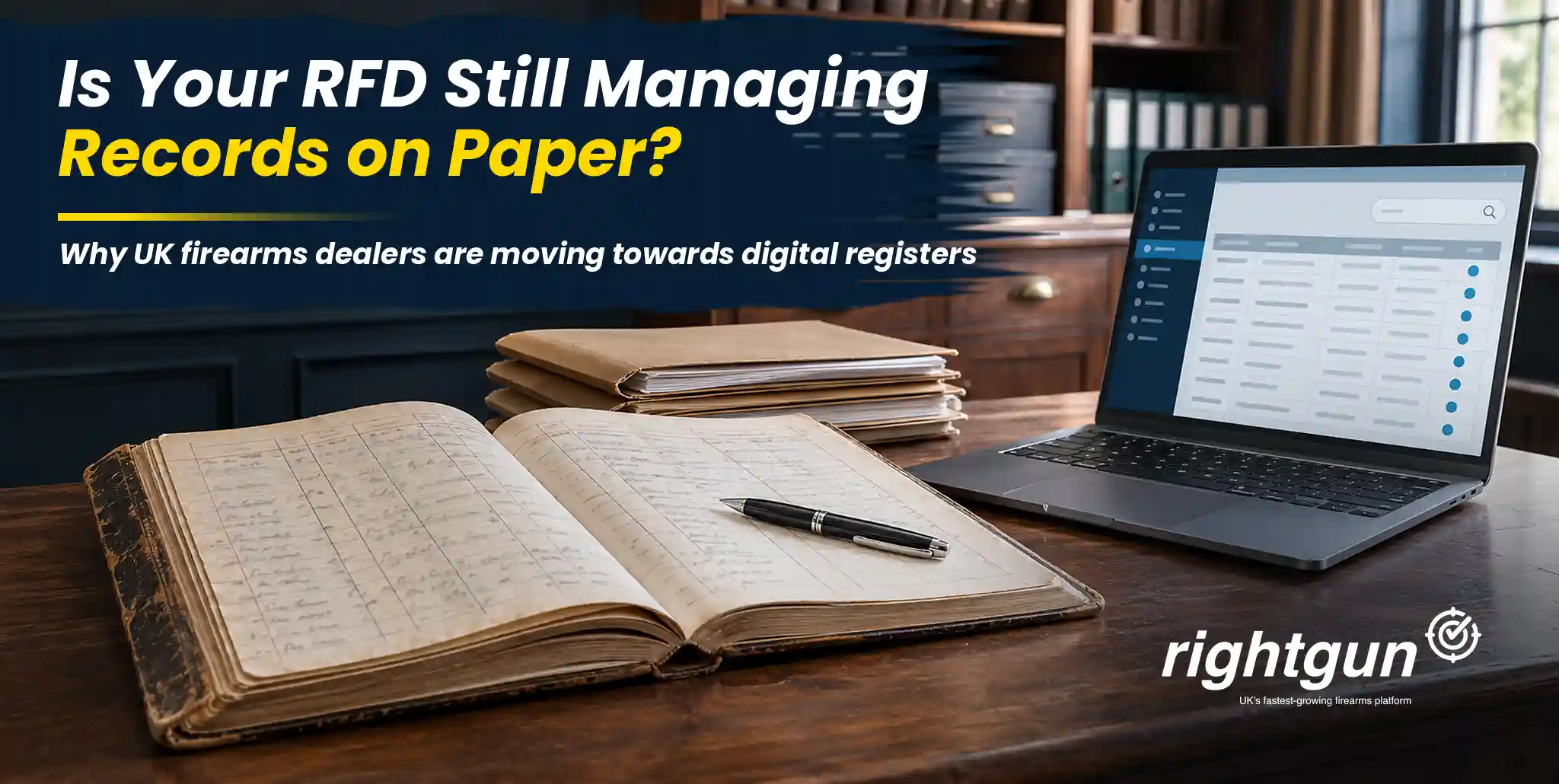
For decades, the dealer’s register has been a hardback book on a shelf behind the counter. Every gun in, every gun out, every box of Section 1 ammunition, written up by hand and kept ready for the next visit from the firearms licensing team. That book is on its way out. Policing is rebuilding its licensing systems around digital records, the law has shifted several times this year alone, and dealers of every size are asking the same question: is it time to move the register online?
For most RFDs, the answer is now yes. This guide explains what the law actually requires of your register, why the paper book is running out of road, what changed in 2026 and what a good digital register should do for you.
This is general information for the UK shooting trade, not legal advice. Your conditions of registration and your local force’s practices can differ, so speak to your police firearms licensing department if you are unsure how a rule applies to your business.
What the law actually asks of your register
Section 40 of the Firearms Act 1968 requires anyone who manufactures, sells or transfers firearms, shotguns or Section 1 ammunition by way of trade to keep a register of transactions, and Schedule 4 of the Act sets out the particulars that must go in it. Police Scotland’s guidance for dealers puts it plainly: your records may be kept on paper or electronically, as long as they capture everything Schedule 4 requires.
In practice that means a register entry within 24 hours of a transaction, a notification to the police within seven days where a sale or transfer requires one, and an annual stocktake of the firearms and ammunition you hold for sale. Section 2 shotgun cartridges and air gun pellets do not go in the register, but almost everything else that crosses your counter does.
So the law has never insisted on a book. What it insists on is complete, accurate and legible records that a licensing officer can inspect. That is exactly where paper starts to struggle.
Browse: Rightgun pricing for dealers · RFD support hub · UK gun dealer directory · Shotguns for sale · Rifles for sale
Why the paper book is on borrowed time
The biggest change is happening on the police side. The National Firearms Licensing Management System, which has run since the mid-2000s, is being replaced. The Police Digital Service, working with the National Police Chiefs’ Council and the Home Office, is rolling out a new national system across forces in England and Wales from the middle of 2026, with the old system due to be switched off by the middle of 2027. The new platform will cover firearms, shotgun and explosives licensing.
The Police Digital Service has also told forces not to build their own separate licensing systems and to align with the national project instead. The direction of travel could not be clearer: one modern, digital picture of firearms licensing across the country. Shooting organisations have pushed for the same thing for years, and the Countryside Alliance has long called for a fully digitised and centralised approach.
A dealer whose records live in a handwritten book is increasingly out of step with the people who inspect them. Illegible entries, missing certificate numbers, transposed serial numbers and lost pages are exactly the problems a digital register removes, and they are exactly the problems that make an inspection drag on.
Browse: Firearms register for RFDs · Declaring a gun disposed or lost · Find gun dealers and shops · Handguns for sale · Air guns for sale
2026 has already changed what goes in the register
If you needed proof that a register has to keep up with the law, this year has supplied it.
23 March 2026: the Firearms (Amendment and Revocation) Rules 2026 replaced the application form for registering as a firearms dealer. The new form asks about neuro-developmental conditions and time spent abroad.
4 June 2026: the Firearms (Variation of Fees) Order 2026 raised the fee for registration as a firearms dealer from £466 to £480.
29 June 2026: section 44 of the Crime and Policing Act 2026 came into force, taking sound moderators and flash suppressors out of the definition of a firearm. Dealers are no longer required to record moderator transactions, although a certificate is still needed to possess a moderator for a Section 1 firearm.
29 September 2026: the Firearms (Amendment) Rules 2026 introduced a revised Form 201 for grants and renewals, with old-style applications accepted only until 29 October. The change is indirect for dealers, but your customers will be asking about it.
A paper register cannot update itself when the law moves. Good software can, which means the fields you see are always the fields you need, and the items that no longer belong in the register stop appearing in it.
Browse: Sound moderators for sale · Gun safes and cabinets · Gun parts and accessories · Thermal and optics
What a good digital register should do for you
Not all registers are equal. Whatever system you choose, it should do at least the following:
Capture every Schedule 4 particular in structured fields, so nothing is skipped and nothing is unreadable.
Generate the paperwork at the point of sale, including Form 11 and customer receipts, rather than leaving you to write them up later.
Keep a full audit trail of every action on every item: bought, sold, lent, repaired, stored, disposed of.
Export cleanly so you can share records with the police on request.
Handle ammunition alongside firearms, with quantities and stocktakes.
Back itself up, so a fire, flood or lost book cannot wipe out years of records.
Work wherever you work, whether that is the shop counter, the back office or a stand at a game fair.
Browse: List a gun for sale · List ammunition for sale · Ammunition for sale · Gun valuation calculator
Why RFDs are choosing Rightgun
Rightgun was built for the UK trade from the start, with the register and the marketplace in one place. Every gun you book into your Armoury is a register entry and, when you are ready, a live listing in front of UK buyers. Every sale updates your register, generates your Form 11 and keeps the audit trail intact.
It is also priced to make the switch an easy decision. The Lite account is free and includes Form 11 generation. The Professional plan, with the full Firearms Register for RFDs, unlimited listings and bulk uploads, costs £27 a month, or the equivalent of £23 a month (£276 a year) on annual billing. Larger operations can step up to the Arms Dealer plan for API access, EPOS and e-commerce integrations, and full business tools.
Police firearms licensing teams are increasingly pointing dealers towards Rightgun, and our ammunition and explosives register has been updated to reflect the 2026 changes in law, so you are recording what the law asks for today rather than what it asked for last year.
Browse: Compare Rightgun plans · Account pricing overview · Yearly pricing benefits · Rightgun API for dealers
If your register still lives in a book, now is the time to move it. Set up a free Rightgun account, book your current stock into the Armoury and see how much time your next inspection, and every sale between now and then, saves you.
Further reading: Why every UK gun dealer needs a digital RFD firearms register, How to maintain a firearm register, Firearms licensing fees are going up and How digital platforms are changing the UK shooting trade.
