
 04-Sep-2026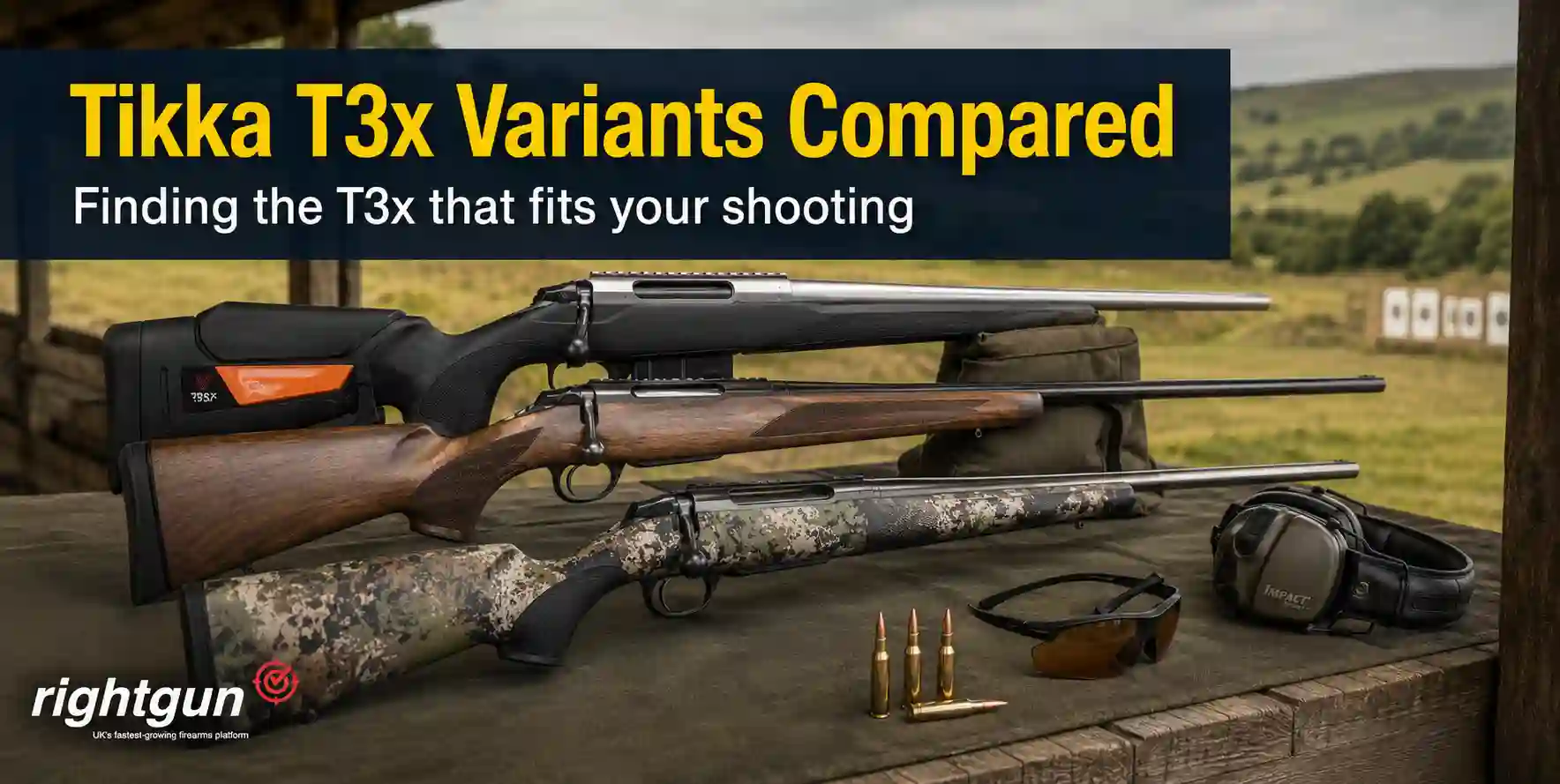
The Tikka T3x has become something close to the default UK stalking rifle. It shoots better than its price suggests, the actions are famously smooth, and the aftermarket is deep enough that you can take a T3x in almost any direction you like. That popularity has produced a problem for buyers: the T3x isn’t one rifle; it’s a family of a dozen or more, and the naming doesn’t always make it obvious what separates a Lite from a Superlite or a Varmint from a Roughtech.
Here’s a practical breakdown of the main variants and what each is actually good at, aimed at UK deer stalkers, foxers and target shooters rather than at spec-sheet collectors.
What every T3x has in common
All T3x rifles share the same core: a smooth three-lug bolt with a short 70-degree lift, a single-stage trigger adjustable across a useful range without stripping the rifle, a detachable magazine, and a receiver with an integral dovetail plus the option of picatinny bases.
The T3x generation brought a handful of improvements over the earlier T3: a wider ejection port, a metal bolt shroud, a modular stock system that takes interchangeable grips, and a redesigned recoil lug. Practically, the differences between variants come down to three things: stock material and profile, barrel contour and finish, and weight. Almost everything else is shared.
If you’re weighing a T3x against Tikka’s rimfire, our T3x vs T1x comparison covers that decision, and Mauser M12 vs Tikka T3x looks at the cross-brand alternative.
T3x Lite: The default choice
The Lite is the volume seller and, for most UK stalkers, the right answer. Synthetic stock, slim sporter-contour barrel, blued or stainless, and a weight that makes it genuinely pleasant to carry up a hill. It’s the rifle most people picture when they say “a Tikka”.
The synthetic stock is the point: it doesn’t mind Scottish weather, it doesn’t shift with humidity, and if you scratch it on a fence, you don’t wince. The Stainless version is worth the premium if you shoot in genuinely wet conditions regularly.
Buy a Lite if: you stalk deer, shoot foxes, or want one rifle that does both without fuss. It’s the sensible default, and it holds its value well.
T3x Superlite: For the hill
The Superlite takes the Lite concept further with a fluted barrel and a lightened stock, shaving meaningful weight for anyone whose shooting involves long walks with the rifle on their back. Highland stalking, hill foxing and anyone who has ever regretted their rifle’s weight at 800 metres of ascent.
The trade-off is real: a lighter rifle is a livelier rifle. Recoil is more noticeable, and a very light barrel heats faster, so it’s not the rifle for a long-range session. For one shot at the end of a long stalk, it’s ideal.
Buy a Superlite if: you carry your rifle a long way for few shots.
T3x Hunter: The wood-stocked classic
The Hunter is the walnut-stocked T3x. Same action, same barrel quality, but in a traditional oiled wood stock that many shooters simply prefer to hold and to look at. It’s heavier than the Lite and needs a little more care in wet weather, but there’s no performance penalty.
Buy a Hunter if: you want a rifle that looks like a rifle. For estate work, driven boar, and anyone who takes pleasure in the object as well as the outcome, it’s an easy choice.
T3x Varmint: For accuracy over carrying
The Varmint moves in the opposite direction to the Superlite: a heavy, semi-bull barrel and a wider fore-end designed for shooting off bipods, bags, and rests. The extra mass steadies the rifle, keeps point of impact consistent across a string of shots, and soaks up recoil.
It’s a poor hill rifle and an excellent high-seat, ambush or range rifle. Popular for fox control from vehicles and static positions, and for anyone who wants to wring the best groups out of a factory Tikka.
Buy a Varmint if: you shoot from a rest far more often than you walk.
T3x Roughtech: Grip and durability
The Roughtech is essentially a Lite or Varmint with a textured, rough-finish stock that gives genuinely better purchase in wet or gloved hands, usually with a slightly upgraded stock profile and often fluting on the barrel. Variants such as the Roughtech Ember and Roughtech Veil bring different finishes.
Buy a Roughtech if: you shoot in bad weather and value grip, or you simply prefer the look.
T3x TAC A1 and CTR: The tactical and target end
The CTR (Compact Tactical Rifle) is a threaded, heavier-barrelled T3x with a picatinny rail and a larger magazine, a practical bridge between a stalking rifle and a target rifle, and a good pick for anyone shooting steel at distance who still wants to carry the rifle occasionally.
The TAC A1 is the full chassis rifle: aluminium chassis, folding adjustable stock, AR-pattern grip, full-length rail. It’s a target and precision competition rifle, heavy and highly adjustable, and it’s a very different proposition to a Lite.
Buy a CTR or TAC A1 if: your shooting is at ranges and competitions rather than in the field. For a broader look at the category, see our best hunting rifles UK stalker’s guide.
Which calibre?
Across the T3x range, the UK mainstream is .243 Win, 6.5mm Creedmoor, .270 and .308 Win, with .223 Rem widely used for fox and smaller deer species where legal for the species and country you’re shooting in. Deer legislation differs between England, Wales, Scotland and Northern Ireland, so confirm the minimum calibre and energy requirements for the species and jurisdiction you’ll be stalking in before choosing.
For most UK stalkers doing a mixture of roe, muntjac and the occasional larger deer, .243 and .308 remain the two most straightforward answers, with 6.5mm Creedmoor increasingly common among those who also shoot at longer ranges. Our explainer on rimfire vs centrefire is worth a read if you’re new to centrefire rifles.
Scope, moderator and setup
A T3x is only as good as what you put on it. Most UK stalking rifles end up with a variable scope in a modest magnification range; our guide to choosing the right scope for deer stalking covers the trade-offs, and a moderator, which is near-universal for UK stalking. Many T3x variants come threaded from the factory; check the individual rifle.
If you’re chasing accuracy claims, our explainer on what MOA means in shooting will help you read manufacturer and seller descriptions critically.
Frequently asked questions
What is the difference between a Tikka T3 and a T3x? The T3x is the updated generation: wider ejection port, metal bolt shroud, modular stock with interchangeable grips and a revised recoil lug. The core action and barrel quality carried over, which is why used T3s remain good buys.
Which Tikka T3x is best for deer stalking in the UK? The T3x Lite for most people, or the Superlite if you cover a lot of ground on foot. The Hunter is the same rifle in walnut if you prefer wood.
Is the T3x Varmint too heavy for stalking? For walked-up hill stalking, generally yes. For high seats, static fox control and range work, the weight is an advantage.
Are Tikka T3x rifles accurate out of the box? They have a strong reputation for factory accuracy relative to price, which is a large part of why they’re so common in UK gun cabinets. Actual results depend on ammunition, the individual rifle, and the shooter.
Do Tikka T3x rifles hold their value? They tend to hold value well on the UK second-hand market because demand is consistently strong across all the main variants and calibres.
Find your T3x
The T3x range is wide enough that there’s almost certainly one built for the shooting you actually do. Browse new and used Tikka T3x rifles on Rightgun.uk, compare it against the Tikka T1X if you’re after a rimfire, or look at the Sako range from Tikka’s stablemate if you’re shopping a step upmarket.
Read next:
