
 13-Apr-2026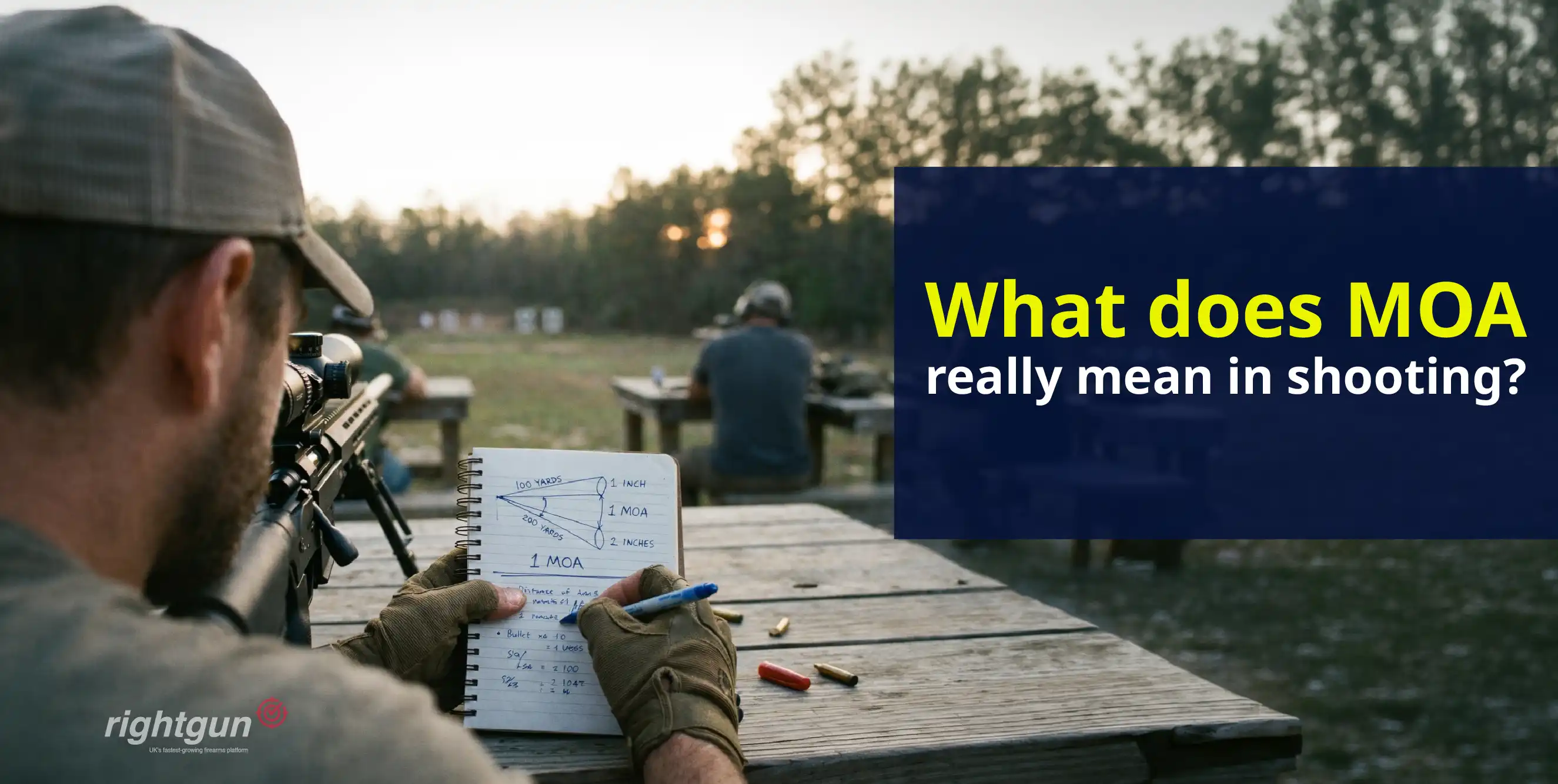
In the world of rifle shooting and stalking, few terms are thrown around as often as “MOA” and “sub-MOA”. For anyone buying their first centre fire rifle or upgrading an air rifle, understanding exactly what these measurements mean is the difference between confident, ethical shots and unnecessary doubt in the field. Here is a clear, practical guide to MOA, sub-MOA, and the real-world rifles that actually achieve each level.
What does MOA actually mean?
MOA stands for Minute of Angle. It is an angular measurement: one minute is 1/60th of a degree. At 100 yards, 1 MOA equals roughly 1.047 inches on the target. In everyday language, shooters round it to “one inch at 100 yards” because the difference is negligible for field use.
Accuracy is always expressed as the average size of five- or ten-shot groups measured centre-to-centre at a given distance. A rifle that prints 1.5-inch groups at 100 yards is therefore a 1.5 MOA rifle. The smaller the number, the tighter the groups.
Sub-MOA simply means better than 1 MOA – groups consistently smaller than one inch at 100 yards. Anything under 0.75 MOA is considered excellent for a hunting rifle; 0.5 MOA or less is precision-rifle territory.
Why MOA matters for UK stalkers and hunters
A clean, ethical kill depends on placing the bullet exactly where it needs to go. At 100 yards a 1 MOA rifle will keep all shots inside a 25-pence piece. At 200 yards that same rifle opens up to a 50-pence piece. For roe or muntjac in woodland, or foxes at night, 1–1.5 MOA is more than enough. For longer shots on the hill or open ground, sub-MOA becomes a genuine advantage because it gives you extra margin for wind, range estimation and shooter error.
Different accuracy levels and the rifles that achieve them
1.5–2 MOA: Entry-level and workhorse rifles
These are the rifles most new stalkers start with and many seasoned keepers still trust.
Typical examples:
CZ 457 or CZ 527 in .223 or .308
Howa 1500 and Weatherby Vanguard
Older Remington 700 ADL or 788
Most budget air rifles (Weihrauch HW100, Air Arms S510 when tuned)
They will group 1.5–2 inches at 100 yards with good ammunition. Perfectly adequate for driven boar, woodland stalking under 150 yards, and general pest control. They are also the most affordable to feed and maintain.
1–1.25 MOA: The sweet spot for most UK stalkers
This is where the majority of serious sporting rifles live. Manufacturers now guarantee this level straight out of the box.
Typical examples:
Tikka T3x and T3x Superlite
Sako 85 and Sako 90
Ruger American and Hawkeye
Bergara B14 and B15
Most quality PCP air rifles (Daystate, FX Impact, Brocock Commander) at 30–50 yards
These rifles will keep five shots inside a one-pound coin at 100 yards with match-grade ammunition. They are the go-to choice for roe stalking, foxing and deer control across the UK.
Sub-MOA (under 1 MOA): Premium factory rifles
Once you step into this bracket, you are buying guaranteed performance and the confidence that comes with it.
Typical examples:
Blaser R8 (including the new Ultimate Silence Blackout in .300 AAC Blackout) – routinely 0.75 MOA or better
Sako 85 Finnlight and Sako CarbonWolf
Accuracy International AX and AT models (when set up for hunting)
Christensen Arms Ridgeline and Mesa
Custom or semi-custom rifles built on Remington 700 or Mauser actions
These rifles will print groups inside a 20-pence piece at 100 yards with the right load. Ideal for long-range foxing, Scottish hill stalking, or anyone who simply wants the best factory accuracy available.
0.5 MOA and below: Precision and custom rifles
Reserved for competition shooters, long-range specialists and professional pest controllers who demand the ultimate.
Typical examples:
Full custom rifles on Barnard, Defiance or Impact actions
Accuracy International Chassis rifles with match barrels
Benchrest rifles in 6BR or 6.5 Creedmoor
Top-tier air rifles such as the Daystate MK4 or regulated FX Crown in .22 or .25 when shot at 35–45 yards
At this level the rifle is rarely the limiting factor – ammunition selection, rest technique and environmental conditions take over.
Air rifle considerations
Air rifles behave differently because effective range is shorter. A good PCP that prints 0.5-inch groups at 35 yards is the air-rifle equivalent of sub-MOA. Many modern pre-charged pneumatics (FX, Daystate, Air Arms, BSA R10) will do this consistently, making them ideal for rats, pigeons and rabbits in confined spaces where centre fire rifles are impractical.
Choosing the right MOA-level for you
For most UK stalking and hunting, 1 MOA is the practical sweet spot. It offers excellent real-world performance without the premium price tag. Sub-MOA rifles are worth the investment only if you regularly take shots beyond 150 yards, compete, or simply want the reassurance of factory-guaranteed precision.
Whatever level you choose, remember that consistent ammunition and proper barrel break-in matter far more than chasing decimal places. A well-tuned 1.25 MOA rifle in the hands of a practised stalker will always outperform a sub-MOA rifle with poor technique.
If you are in the market for a new rifle and want honest advice on which models actually deliver their claimed accuracy on the range and in the field, the Rightgun team can match you to the right platform for your calibre, terrain and budget.
Must read:
