
 03-Sep-2026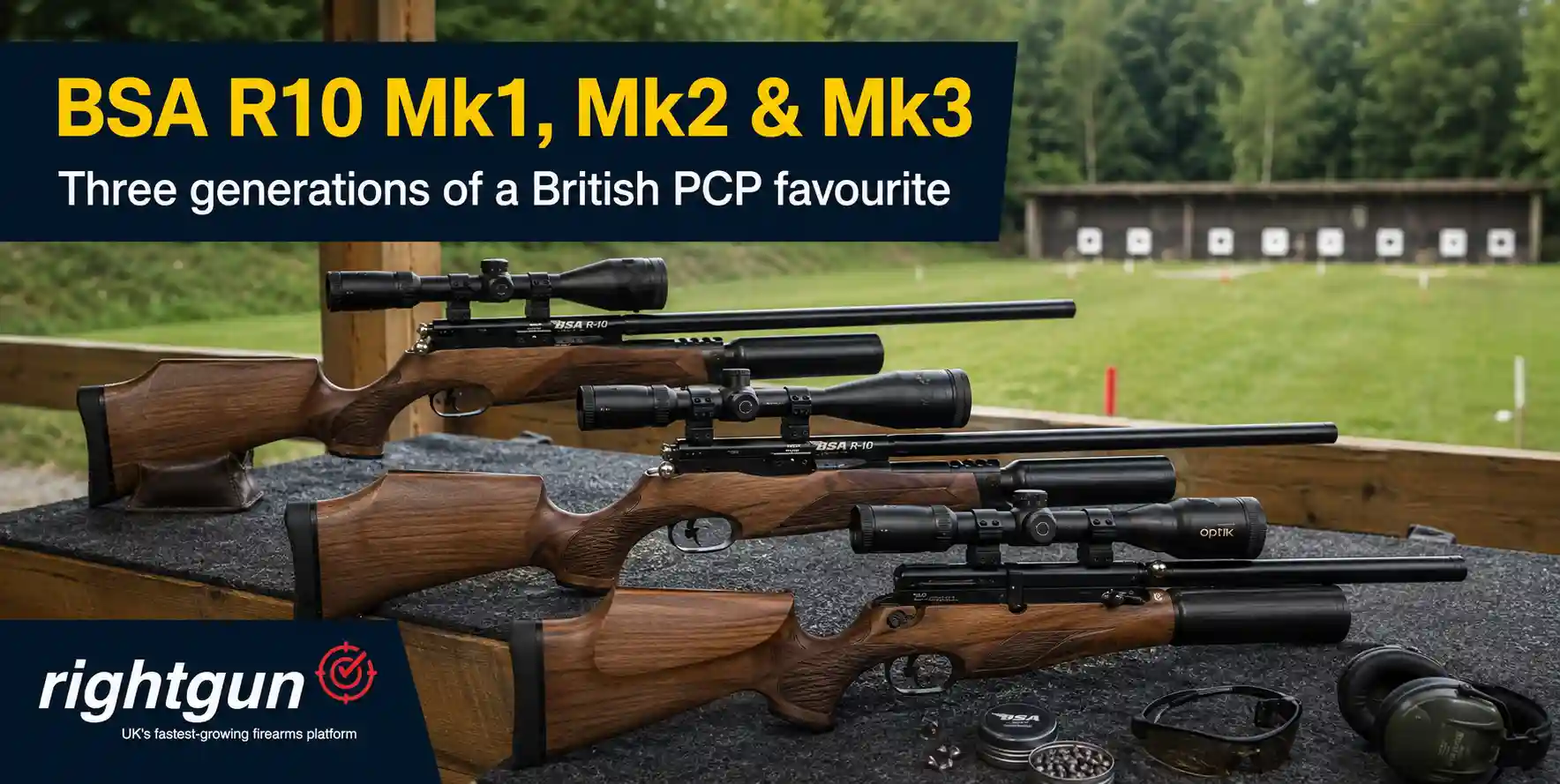
The BSA R10 has been one of the most consistently searched-for PCP air rifles on the UK second-hand market for well over a decade, and it is currently the single most viewed air rifle model on Rightgun.uk. That popularity creates a problem for buyers: “BSA R10” covers several distinct generations of rifle, sold over many years, and a listing that simply says “BSA R10” tells you far less than you need to know.
If you are weighing up an R10 Mk1 against an Mk2, an Mk3 or one of the SE variants, this guide sets out what actually changed between them, what each generation is like to live with, and which one makes most sense for the kind of shooting you do.
Where the R10 sits in the BSA range
BSA built its modern reputation on cold-hammer-forged barrels made in Birmingham, and the R10 was the rifle that put that barrel into a compact, regulated, sporting-weight PCP package. It arrived as BSA’s serious answer to the mid-to-upper tier of the British PCP market, the ground occupied by the likes of the Air Arms S410 and S510 and the Weihrauch HW100.
The R10 formula has stayed recognisable throughout: a bolt-action, magazine-fed, regulated PCP with a shrouded barrel, a sporter-weight profile and a reputation for shot-to-shot consistency that has kept resale values firm. Where the generations differ is in the detail, the regulator, the stock, the shroud and the way the rifle is set up out of the box.
Alongside the R10 you will also find the BSA R12 (a longer, heavier stablemate aimed more at hunting from a fixed position) and the earlier BSA Super 10, which is the R10’s spiritual predecessor. If you are exploring BSA’s wider catalogue, the BSA air rifle pages are the quickest way to see what is currently listed.
The R10 Mk1: The original, and still a bargain
The first-generation R10 established the template. It is the lightest and most compact of the family, with a walnut sporter stock, a ten-shot rotary magazine and a regulated action.
What buyers say about the Mk1, consistently, is that it shoots better than its age suggests. The barrel is the same fundamental BSA cold-hammer-forged unit that runs through the whole line, and a well-kept Mk1 with a healthy regulator will still group with rifles costing considerably more today.
The trade-offs are the ones you would expect from the oldest generation. Fill pressure arrangements and the pressure gauge position are less convenient than on later rifles, the shroud is less sophisticated than the later designs, and, most importantly, you are buying a rifle that may be well into its second decade. Regulators are a wear item on any PCP, and on a Mk1 you should assume the regulator may need attention at some point in your ownership rather than treat that as a fault.
Best for: buyers who want genuine BSA barrel quality at the lowest point of entry and are comfortable with an older rifle that may want servicing.
The R10 Mk2: The generation most people are searching for
The Mk2 is where the R10 really hit its stride, and it is the variant that generates the most specific search interest in the UK today. The changes over the Mk1 were evolutionary rather than revolutionary, but they addressed most of the original’s day-to-day irritations.
The headline differences are a revised stock with improved ergonomics and a more accommodating cheekpiece for scope use, a reworked shroud that does a better job of taming muzzle report, and refinements to the filling arrangement and gauge placement that make topping up considerably less fiddly. Magazine and bolt operation were also tidied up.
The result is a rifle that feels notably more modern in the hand than the Mk1 while keeping the compact, carry-all-day proportions that made the R10 popular in the first place. For most buyers looking at the second-hand market now, the Mk2 is the sweet spot: recent enough that parts and servicing are straightforward, old enough that it represents strong value against a new rifle.
Best for: the majority of buyers. If you are choosing on value-for-money alone, start here.
The R10 Mk3 and the SE variants
The Mk3 continued the refinement, with further attention to the stock, the shroud and the regulator setup. Depending on the configuration you find, you may also encounter Special Edition (SE) rifles, which typically arrived with upgraded stock timber, different finishes and other specification changes over the standard rifle of the day.
Two points are worth understanding here. First, “SE” has been applied by BSA across more than one generation and more than one model, so an SE badge tells you the rifle was an enhanced-specification version of whatever was current, not that it belongs to a particular year. Always read the listing detail rather than relying on the badge.
Second, the later generations narrow the gap to new rifles, so the value argument is less emphatic than it is with a Mk2. What you gain is a rifle that is younger, likely to have had an easier life, and closer to current specification. If you would rather not think about a regulator service for several years, that matters.
Best for: buyers who want the most recent specification and are willing to pay closer to current money for it.
Calibre, power and what to check before you buy
Most R10s you will find in the UK are sub-12 ft/lb rifles in .177 or .22. The usual reasoning applies: .177 shoots flatter and is often preferred for target work and longer-range accuracy, while .22 is the traditional choice for pest control at moderate ranges where a heavier pellet is welcome. Both calibres are well served by the R10’s barrel, so choose on application rather than on any assumed accuracy advantage.
Whichever generation you settle on, a short checklist covers most of the risk on a used PCP:
Ask when the regulator was last serviced. On any used regulated PCP, this is the single most useful question. A rifle with recent work is worth paying more for.
Check the shot count and consistency claims. A rifle holding its stated shot count is a good sign the regulator and valve are healthy.
Look at the cylinder and fill port. Corrosion or damage around the fill point is a reason to walk away or to budget for work.
Inspect the crown and shroud. BSA barrels are the heart of the rifle; damage at the muzzle undermines everything else.
Confirm what comes with it. Magazines, fill probe and moderator all cost money to replace individually.
If you are new to buying a used PCP more generally, our guide to second-hand air rifle buying covers the wider process, and spring vs PCP airguns is worth a read if you are still deciding on the powerplant.
How the R10 compares to its rivals
The R10’s most direct competition in the UK has always come from Air Arms and Weihrauch. Against the Air Arms S510, the R10 tends to be the more compact rifle with the more forgiving price on the used market, while the S510 offers a broader spread of stock and configuration options. Against the Weihrauch HW100, the R10 is generally lighter and handier, where the HW100 answers with Weihrauch’s famous build solidity; we have covered that matchup directly in BSA R10 vs Weihrauch HW100.
None of these rifles is a bad choice. The R10’s particular argument is barrel quality and carrying comfort at a price that has stayed sensible.
Frequently asked questions
What is the difference between the BSA R10 Mk1 and Mk2? The Mk2 brought a revised stock with better scope ergonomics, an improved shroud, and a more convenient filling and gauge arrangement. The core regulated action and BSA cold-hammer-forged barrel carried over, so the Mk2 is best understood as a refinement of the Mk1 rather than a redesign.
Is the BSA R10 a good hunting rifle? Yes, its compact proportions, moderate weight and shrouded barrel suit walked-up pest control and general hunting use well. Buyers who shoot mainly from a fixed position sometimes prefer the longer, heavier R12 instead.
Should I buy a .177 or .22 BSA R10? Choose on application. In sub-12 ft/lb form, .177 gives a flatter trajectory that many find easier at varied ranges, while .22 remains the traditional pest-control choice. The R10 barrel performs well in both.
Is a used BSA R10 worth buying? For most buyers, yes. Resale values have held up because the rifles shoot well and parts and servicing remain available. The main variable is regulator condition, so ask about service history before committing.
Find a BSA R10 on Rightgun.uk
R10s move quickly, and the generation you want will not always be listed on the day you look. Browse current BSA R10 listings to see what UK sellers and dealers have available right now, or widen the search across the full BSA air rifle range if you are open to the R12, Super 10 or one of BSA’s spring-powered rifles.
Selling an R10 of your own? Listing it on Rightgun.uk puts it in front of buyers already searching for exactly that rifle.
Read next:
