
 21-Jul-2026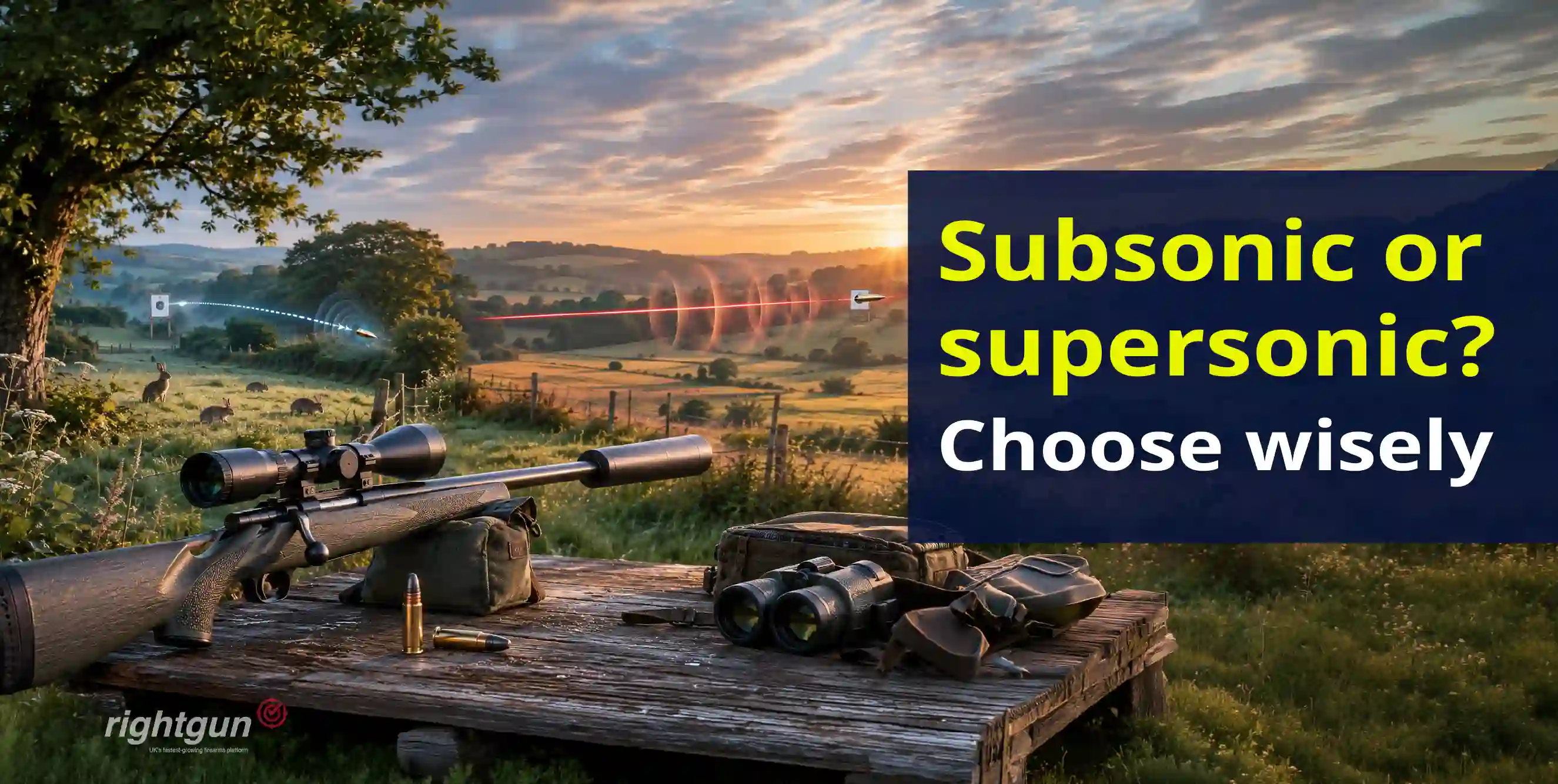
Walk into any UK gun shop and ask for .22LR ammunition and you will be asked a question that catches out plenty of newer shooters: subsonic or high velocity? It sounds like a simple choice between slow and fast, but the difference between subsonic and supersonic ammunition touches almost everything that matters in practical shooting — noise, accuracy, trajectory, terminal performance, and how well your moderator actually works.
In the UK, where sound moderators are commonplace on rimfire and centrefire rifles alike and where most shooting happens on farmland with neighbours to consider, understanding this distinction matters more than in almost any other shooting culture. This guide explains what subsonic and supersonic ammunition actually are, why the speed of sound is the dividing line that matters, and how to choose the right type for your shooting.
The physics: Why the speed of sound matters
The speed of sound at sea level in typical UK conditions is roughly 1,125 feet per second (about 343 metres per second), though it varies slightly with temperature, slower on a frosty winter morning, faster on a warm summer evening. Any projectile travelling faster than this is supersonic; anything slower is subsonic.
The reason this threshold matters is the sonic crack. A bullet travelling faster than sound creates its own miniature sonic boom, a sharp, whip-like crack that travels with the bullet all the way to the target and beyond. This crack is entirely separate from the muzzle report produced by the burning propellant gases. A moderator can do a great deal about the muzzle report, because it works by trapping and slowing those gases. It can do absolutely nothing about the sonic crack, because that noise is generated by the bullet itself, downrange, long after it has left the moderator behind.
This is the single most important thing to understand about the subject: a moderator suppresses the muzzle blast, not the bullet. Fire supersonic ammunition through the best moderator money can buy and you will still produce a loud, distinctive crack across the whole flight of the bullet. Fire subsonic ammunition through the same moderator and the dominant noise disappears, leaving only a muffled thump from the action and the residual muzzle report. The difference in the field is dramatic; it is the difference between rabbits at the far end of a paddock scattering at the first shot and carrying on grazing while you work through a warren.
Subsonic ammunition: How it works
Subsonic ammunition keeps the bullet below the speed of sound, typically launching at somewhere between 950 and 1,080fps depending on the load. Manufacturers achieve this in two ways: reducing the propellant charge, and often increasing the bullet weight, since a heavier bullet is naturally slower for a given charge and retains more energy at the reduced velocity.
The classic example, and by far the most common subsonic round in Britain, is subsonic .22LR. Standard-velocity .22LR is only marginally supersonic to begin with (around 1,200fps), so pulling it below the sound barrier costs relatively little. A typical subsonic .22LR load pushes a 40-grain hollow-point bullet at around 1,040fps, generating roughly 90ft-lb of muzzle energy. Through a moderated rifle, the result is famously quiet, often quieter than a spring air rifle, which is exactly why the moderated subsonic .22LR is the default rabbit and rat rifle across the UK.
The trade-offs are real, though. Slower bullets mean a more curved trajectory: a subsonic .22LR zeroed at 50 metres will drop around 15 to 20 centimetres by 100 metres, which demands accurate rangefinding and holdover for anything beyond modest distances. Slower bullets also carry less energy, and hollow-point designs that expand reliably at supersonic speeds may fail to open up at subsonic velocities. This is why subsonic .22LR is sensibly regarded as a 60-metre rabbit round rather than a 100-metre one, well within that range it kills cleanly with good shot placement, but it is not a long-range proposition.
In centrefire, subsonic loads exist for calibres such as .300 AAC Blackout, which was designed from the outset to run heavy 190- to 220-grain bullets at subsonic speeds through short-barrelled, moderated rifles. Subsonic centrefire is a niche interest in the UK; conditions on most FACs specify quarry and land in ways that make full-power supersonic loads the practical choice for deer and foxes, but the same physics applies throughout.
Supersonic ammunition: The standard choice
The overwhelming majority of centrefire rifle ammunition is supersonic, and for good reason. Velocity is what delivers the three things a hunting or target round needs at distance: a flat trajectory, retained energy, and reliable bullet expansion.
A typical .243 Winchester deer load leaves the muzzle at around 2,900 to 3,100fp, nearly three times the speed of sound. That velocity means the bullet drops only a couple of inches between 100 and 200 metres, arrives with ample energy to meet the legal minimum for deer (and, far more importantly, to kill cleanly), and strikes fast enough to make expanding bullets perform as designed. The same logic applies to .308 Winchester, 6.5 Creedmoor, .223 Remington for foxes, and every other mainstream centrefire calibre: speed is doing most of the useful work.
The costs of supersonic flight are noise and, at extreme range, a wrinkle in accuracy. The sonic crack cannot be moderated away, so even a well-moderated stalking rifle produces a substantial noise signature, the moderator takes the harsh blast off the shot and protects the shooter's hearing, but nobody within half a mile will mistake it for silence. And at very long range, every supersonic bullet eventually decelerates back through the sound barrier. This transonic transition buffets the bullet with unstable airflow and can disturb its flight, which is why long-range target shooters pay close attention to where their chosen load "goes transonic" and generally aim to keep engagements inside that distance. For a .308, that typically happens somewhere beyond 800 metres, irrelevant to stalking, but central to long-range target work.
The practical differences at a glance
The comparison comes down to a handful of trade-offs. Supersonic ammunition gives you a flatter trajectory, more retained energy, reliable expansion, and longer effective range, at the cost of a sonic crack that no moderator can remove. Subsonic ammunition gives you exceptional quietness through a moderator, minimal disturbance to quarry and neighbours, and gentler recoil, at the cost of a rainbow trajectory, reduced energy, and a much shorter effective range.
Noise deserves one more note, because the numbers surprise people. An unmoderated supersonic rifle shot can exceed 160 decibels at the muzzle, well into the range that causes instant, permanent hearing damage. A good moderator might bring the muzzle report down by 25 to 30dB, which is an enormous reduction but still leaves a loud noise, plus the crack for supersonic loads. A moderated subsonic .22LR, by contrast, can come in under 115dB, still not truly silent, whatever the films suggest, but quiet enough that the loudest sound you hear is often the bullet striking the target.
Which should UK shooters choose?
For rabbiting and ratting with a .22LR, subsonic is the near-universal answer, and with a moderator fitted it is one of the most effective pest-control combinations available. Keep shots inside 60 metres or so, learn your holdovers, and use a quality subsonic hollow-point. Eley Subsonic Hollow, Winchester Subsonic 42 Max, and CCI Subsonic HP are all proven choices with strong followings among UK shooters. It is worth buying a few boxes of each and testing them in your own rifle, because rimfire barrels are notoriously particular about which brand they shoot best.
For fox control and deer stalking, supersonic centrefire is the only realistic choice. Deer legislation across England, Wales, and Scotland sets minimum calibre and energy requirements that subsonic loads cannot meet, and the flat trajectory and terminal performance of full-power ammunition is precisely what clean, ethical shots at field distances require. Fit a moderator for hearing protection and recoil reduction, and accept the sonic crack as the price of doing the job properly.
For semi-auto .22LR owners, one practical warning: some subsonic loads generate insufficient energy to cycle a semi-automatic action reliably. If your Ruger 10/22 or similar starts short-stroking on subsonics, you will need to experiment with brands, some subsonic loads are specifically designed to cycle semi-autos, or accept manually cycling the action. Bolt-action rimfires have no such concerns and are the natural partner for subsonic ammunition.
For target shooters, the answer depends on the game. Standard-velocity .22LR match ammunition is actually subsonic or borderline by design, staying below the sound barrier avoids the accuracy disturbance of the transonic transition, which is why virtually all serious smallbore match ammunition runs at around 1,050 to 1,090fps. At the other end of the scale, centrefire long-range shooters want the fastest, most aerodynamically efficient loads they can shoot accurately, precisely to push that transonic zone as far away as possible.
A note on moderators and the law
Sound moderators for rifles are controlled items in Great Britain: a moderator must be authorised on your firearm certificate, typically as a condition attached to the relevant rifle. The good news is that UK police forces broadly recognise moderators as sensible good practice, they protect the shooter's hearing, reduce disturbance to livestock and neighbours, and are routinely granted for pest control and stalking rifles. Indeed, some forces have historically encouraged their use, and BASC's long-standing position is that a moderator should be regarded as a normal accessory for a working rifle.
The bottom line
Subsonic and supersonic ammunition are not competing products so much as tools for different jobs. The dividing line, the speed of sound, determines whether your bullet announces itself with a crack across the whole field or slips downrange with nothing but a muffled thump behind it. For close-range pest control with a moderated rimfire, subsonic ammunition is quiet, humane within its limits, and neighbour-friendly in a way nothing else matches. For deer, foxes, and any shooting at real distance, supersonic ammunition delivers the trajectory, energy, and terminal performance the job demands, and the noise is simply part of the bargain.
Know your quarry, know your distances, and match the ammunition to the task, and if you are running a moderated .22LR on subsonics, spend an afternoon on paper at 30, 50, and 70 metres learning exactly what that looping trajectory does. It is the cheapest accuracy upgrade you will ever make.
Looking for a rimfire for pest control or a stalking rifle for the season ahead? Browse the listings on Rightgun to find rifles, moderator-ready barrels, and everything in between from trusted UK sellers.
Read next:
Air Arms S510 review: The flagship sidelever that defines British PCP quality
Air Arms TX200 vs Pro-Sport: Choosing between the two great British underlevers
Which Air Arms is best for hunting? Choosing the right model for UK fieldwork
Dark Engine 'Blade' IR Illuminator review: The best IR torch for UK night shooting?
