
 01-Jul-2026
![Off the ticket at last: What the UK’s suppressor reform means [A view from Freyr & Devik]](https://d3lnrh258vsroc.cloudfront.net/blog/uk-suppressor-deregulation-freyr-devik.webp)
For as long as we have been building sound moderators, we have made the same simple argument to anyone who would listen: a suppressor is safety equipment, not a weapon. It protects your hearing, it cuts noise for everyone within a mile of the high seat, it makes communication on a stalk possible, and it makes for calmer, more responsible shooting. As of 29 June 2026, the law across England, Wales and Scotland has, at last, come round to that view.
If you have ever sat on your hands for weeks waiting for a variation to land so you could screw a fresh can onto a new rifle, today is a good day. Sound moderators and flash hiders are no longer treated as firearms in their own right. The slot on your ticket that used to govern them has, in effect, just disappeared.
We want to do two things in this piece. First, set out plainly what has changed, because there is a lot of half-information flying around. And second, because it is what we do, explain why this is the easiest moment in 58 years to finally retire a tired old can for something built properly.
What has actually changed
The change comes into force under Section 44 and Schedule 5 of the Crime and Policing Act 2026. Until today, a sound moderator for a Section 1 firearm was caught by the definition of a firearm in section 57(1)(d) of the Firearms Act 1968, which is why it had to sit on your certificate exactly like the rifle itself.
That requirement has now been removed. Moderators (and flash hiders) for Section 1 rifles are no longer Section 1 firearms. To put the scale of it in perspective: moderators made up roughly a third of every firearm logged on the national licensing system, so this clears an enormous amount of paperwork off police licensing desks at a stroke.
What it means in practice
In day-to-day terms, here is what the change delivers for the ordinary certificate holder.
No more variations. You no longer apply, pay and wait for a variation every time you buy or sell a moderator.
Your slot is obsolete. The conditioned moderator entries on your ticket simply fall away. The expectation is that there is nothing for you to do until your next renewal.
Buy online. With moderators no longer in Section 1, dealers can sell them online and post them to you, rather than every purchase being a face-to-face RFD transfer.
Store them anywhere sensible. A moderator no longer has to live in the gun cabinet. It can be kept like any other inert accessory.
No cap on numbers. There is no limit on how many moderators you may own.
Simpler disposal. Selling or scrapping a moderator no longer has to go through an RFD or be recorded against your certificate.
The catch: this is not a free-for-all
We will be honest with you, because cutting corners on the law helps nobody. Moderators have not been fully deregulated. The shooting bodies that campaigned for this were realistic about the limits, and so should you be.
You still need a certificate. To possess a moderator for a Section 1 firearm you must hold a valid firearm certificate or shotgun certificate. Doing so without one is now a separate offence, carrying a fine of up to £1,000.
Shotgun and air-rifle moderators are unchanged. Moderators for shotguns and for sub-12 ft/lb air rifles were already outside Section 1 and are not affected by this reform.
Scotland’s airguns are separate. Airguns and their moderators in Scotland sit under devolved law (the Air Weapons and Licensing (Scotland) Act 2015) and are not part of this change.
Fitting matters. If a moderator intended for an air weapon is fitted to a Section 1 rifle, you still need a valid certificate to possess it.
In short: the bureaucracy around acquiring and holding a moderator has gone, but the principle that only vetted, certificated shooters should have one remains. We think that is exactly the right balance, and it is the reason this reform was winnable in the first place.
The change at a glance
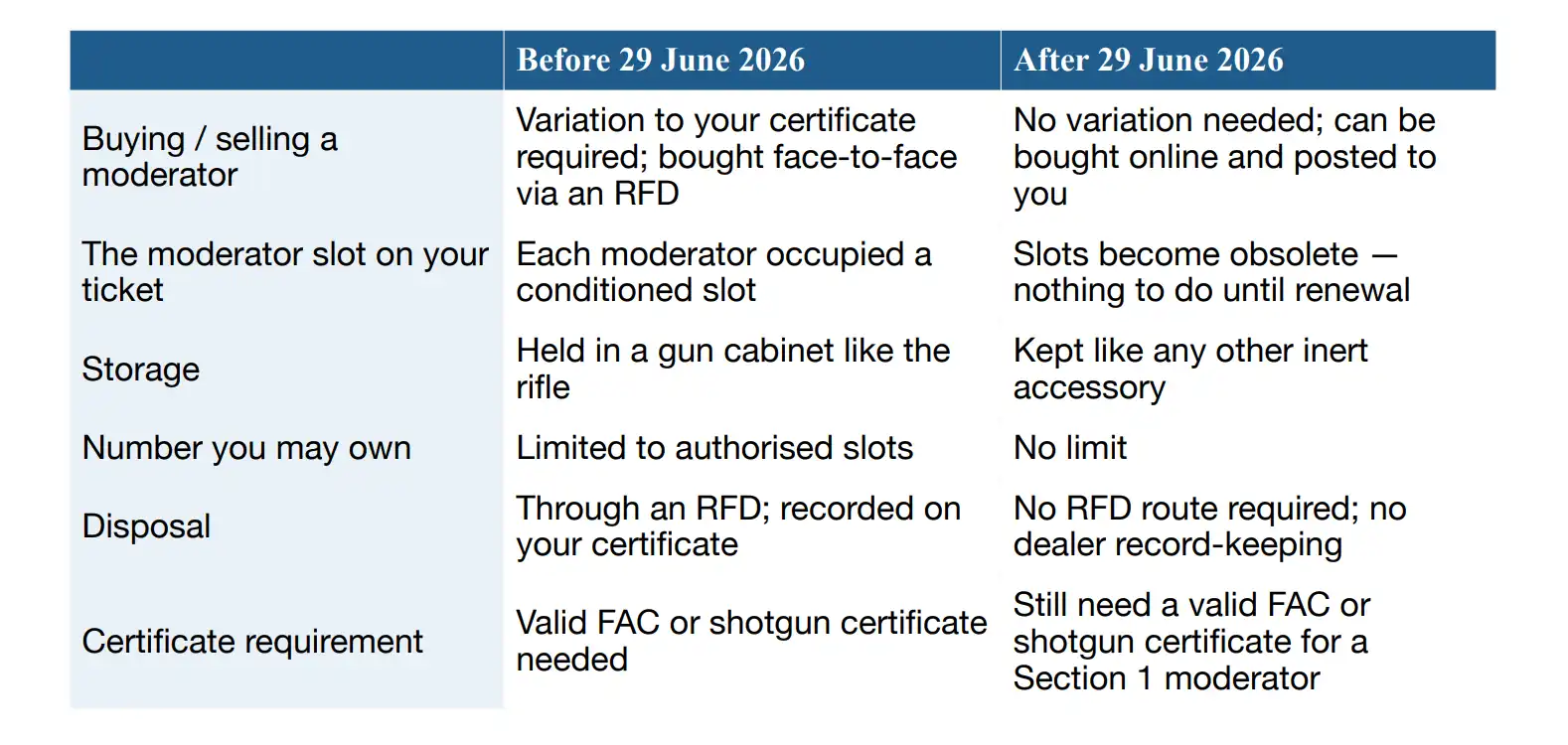
The headline is simple: the red tape around owning a moderator has gone. Here's what that actually looks like for each part of the process.
Buying and selling. Until 29 June 2026, getting hold of a moderator meant a variation to your certificate, and the transaction itself almost always had to happen face-to-face across an RFD's counter. From that date, none of that applies. No variation, no paperwork trail before you can take one home, you can order online and have it posted straight to your door.
Your certificate slot. Every moderator used to sit on its own conditioned entry on your ticket, just like the rifle it was fitted to. Those entries are now redundant. You don't need to write in, ring up, or do anything at all, the slot simply falls away the next time your certificate comes up for renewal.
Storage. A moderator no longer has to live inside a locked gun cabinet alongside the rifle. It can be kept wherever you'd keep any other piece of inert kit, a sling, a bipod, a cleaning rod. The legal obligation to store it as if it were the firearm itself has gone.
How many you can own. Previously, the number of moderators you could hold was capped by however many slots your certificate carried. That cap no longer exists. There is no legal limit on how many you own.
Selling or scrapping one. Getting rid of a moderator used to mean routing it through an RFD, with the disposal logged against your certificate. Now you don't need to use that route at all, and dealers are no longer obliged to keep records of moderator transactions.
Do you still need a certificate at all? Yes. This is the one thing the reform hasn't touched. The admin has gone, not the vetting: you still need a valid FAC or SGC to buy or possess a Section 1 moderator, and doing so without one is now a specific offence in its own right.
Why now is the time to upgrade
Here is the part we have waited years to be able to say without an asterisk. For decades, the friction of a variation, the fee, the form, the wait, the RFD transfer charge, was a genuine reason people limped along with whatever can they first bought, no matter how heavy, worn or wrong it was for the rifle. That friction has gone. Replacing a moderator is now about as simple as buying a sling.
We build across the full spectrum precisely because no single can is right for every shooter. So rather than sell you a model number, here is how we think about the choice, and these are the things genuinely worth weighing up before you buy anything, from us or from anyone else.
Thread and calibre rating come first
Thread size. Check your barrel’s thread before anything else. Common UK threads include 1/2˝ UNF, 1/2˝ UNEF, M14x1, M15x1 and M18x1. If you are unsure, your dealer can confirm it, and a good maker will offer the right thread option rather than make you adapt.
Calibre rating. Always match the moderator to your calibre or larger. A .30 can will happily run a .243, but a .243-bore can must never be used on anything bigger than its rating.
Material is a weight-versus-life trade-off
Steel / stainless. Toughest and usually cheapest, and the extra mass soaks up heat well for higher shot counts, but it is heavy.
Aluminium. Light and well-balanced for a stalking rifle, but less durable and generally not suited to magnum rounds or long strings.
Titanium. The best strength-to-weight ratio of the three, at a premium price. It is where we put most of our effort on the hunting side, because for stalkers, every gram on the muzzle matters.
Over-barrel (reflex) versus muzzle-forward
A muzzle-forward can sit entirely ahead of the muzzle, adding length but keeping things simple. An over-barrel (reflex) design slides back over the barrel, recovering internal volume while keeping the overall rifle short and well balanced, which is why reflex cans are so popular on woodland stalking rifles, and why so much of our hunting range is built that way.
Modular versus sealed
A modular, strippable can lets you replace worn baffles for a fraction of the cost of a new unit, and often swap thread or calibre sections between rifles. A sealed unit needs less fuss but cannot be serviced internally. For a high-round-count centrefire we will always steer you toward serviceability, a can you can maintain is a can you keep for decades.
Re-zero after fitting
Whatever you fit, expect a small point-of-impact shift and re-zero before you take it to the field. A moderator changes barrel harmonics; the bullet may print slightly high or low, and that is normal rather than a sign of a slower or faster load.
Where Freyr Devik fits
Everything Freyr Devik makes runs a grade 5 titanium core with a high-strength aerospace aluminium housing, hard-anodised to 35 microns, so the whole range is light for its suppression.
The split is between the two technologies. The Featherweight series is our tool-free line; it opens without tools, which makes it easy to clean, lets it cool fast between strings on the range, and dries quickly so you can leave it on the rifle in the wet without corrosion.
The Ultimate Silence 3D series is the newer flagship: a 3D-printed (laser-sintered) grade 5 titanium core and baffle stack with a patent-pending baffle design, giving a better suppression-to-weight ratio plus clever touches like a built-in wedge brake to cut recoil, a baffle geometry that spins the gas to keep the can tight on the barrel, and titanium thermal properties that slow heat build-up and speed cooling to reduce mirage.
Within our Featherweight centrefire range there are three options.
The FW 149 is the active, ultralight one at about 149 g, built for fast shots on driven hunts and stalking, ideal for small-to-medium calibres up to .308;
The FW 196 is the versatile all-rounder at 196 g, giving full-size suppression in a package light enough that it barely touches the rifle's balance
And finally, the FW 269 is the max-suppression option at 269 g and 32+ dB, killing muzzle flash and recoil, which matters at dawn and dusk.
There's also a dedicated rimfire option, the FW 88, an all-metal 6061-T6 design for .22 LR, .22 WMR and .17 HMR.
The Ultimate Silence 3D line is mostly about squeezing magnum-level suppression into less weight. The 131 is the ultra-light one at just 131 g for standard calibres up to .30, slim enough to barely intrude on a low-magnification scope picture and often usable with open sights.
Step up and the 231 (231 g, handles magnums up to .300 Win Mag) and 281 (281 g, 35+ dB, the best blend of weight and suppression even on magnums) cover most situations, while the 338 is the ultra-light big-magnum can, 338 g, 36+ dB, their own first pick for maximum suppression on the heaviest calibres.
So, what to go for, depending on the rifle and the job:
General UK stalking, one can to do everything: Featherweight 196, light, balanced, full suppression.
Lightweight rifle, driven/woodland work, fast handling, up to .308: Featherweight 149, or the UTS 3D-131 if you want the newest titanium tech and the smallest scope footprint.
Dawn/dusk flash and recoil your priority on standard calibres: Featherweight 269.
Magnum or long-range (up to .300 Win Mag and beyond): UTS 3D-231 or 281 for the weight/suppression balance; UTS 3D-338 if you're on big magnums and want maximum quiet for least weight.
Rimfire: Featherweight 88.
The verdict
Taking moderators off the ticket is the most sensible piece of firearms deregulation in a generation: it strips out a mountain of pointless admin without handing anything to anyone who could not already own a rifle. For the law-abiding shooter, it means less cost, less waiting and less paperwork, and, for once, a genuinely good reason to treat yourself to a better can.
As with any licensing change, detailed Home Office guidance will follow, and the shooting organisations are working through it now. If in doubt about your particular setup, check with your dealer or your force’s licensing department before you buy. And when you are ready to upgrade, Freyr & Devik would be glad to help you choose.
About the author:
Eggert Freyr, often referred to simply by his middle name, Freyr, or his nickname, Fra, he is the Icelandic co-founder and designer who started the company (Freyr & Devik) alongside Heidi Devik.
Read next:
