
 30-Oct-2026
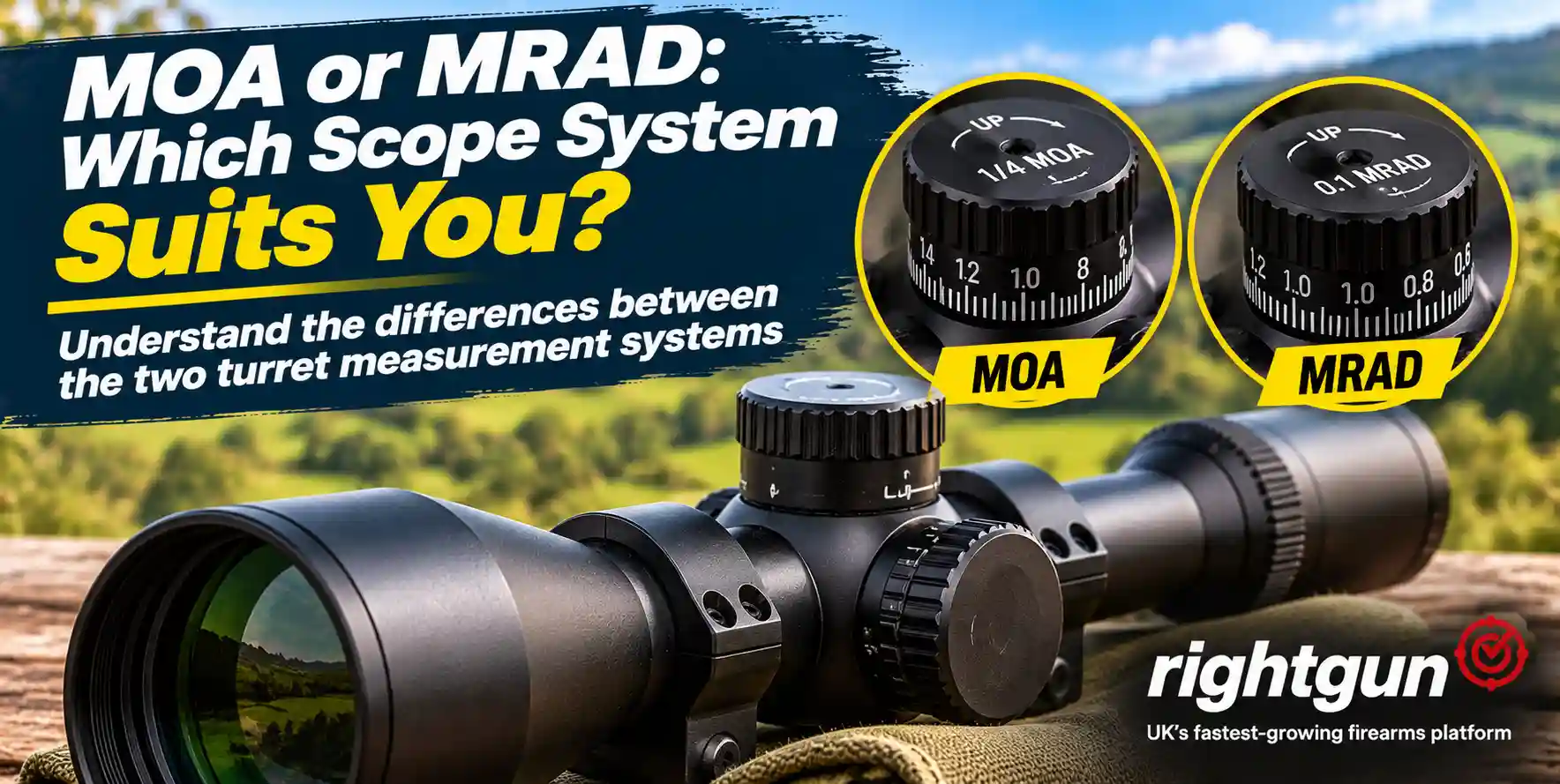
Pick up almost any serious rifle scope, and you will see one of two sets of letters on the box: MOA or MRAD. Both describe angles, both do the same job and both are perfectly capable of putting a bullet where you want it. Yet the choice causes more confusion than almost anything else when buyers move up to a better scope.
This guide explains the difference in plain English, shows who each system suits and gives you a simple way to choose. If you want the background on either unit, our guides to what MOA means in shooting and what MRAD means in shooting go through them in more depth.
What MOA and MRAD actually measure
MOA stands for minute of angle. MRAD, short for milliradian and often shortened to “mil”, is a different unit of angle. Both are used to describe how far your point of aim moves at a given distance.
Roughly speaking, one MOA covers just over an inch at 100 yards, while one MRAD covers a little over three and a half inches at 100 yards and ten centimetres at 100 metres. Because they are different sizes, a scope’s turret clicks will be a fraction of one or the other, and the reticle markings will use the same unit.
In simple terms, MOA is rooted in imperial units, while MRAD sits naturally with metric. That is why many UK shooters, who think in a mix of yards and metres, find themselves on either side of the debate.
Browse: Scopes and sights · Schmidt & Bender scopes · Nightforce scopes · Leupold scopes · GPO scopes
The one rule that matters: Match your reticle and turrets
Before you worry about which system is better, remember the rule that matters most. Your reticle and your turrets should use the same unit. If your reticle is marked in MRAD and your turrets click in MOA, you will end up converting numbers in your head, which is slow and invites mistakes.
Most modern precision scopes are sold as matched pairs, either MRAD/MRAD or MOA/MOA. Check the description carefully, especially when buying second-hand, because older or unusual scopes sometimes mix the two.
Consistency also applies across your kit. If you shoot with a spotter or a friend, using the same system means you can call corrections to each other without translating.
Browse: Rifle scopes · Nightforce scopes · Accuracy International rifles · Anschutz rifles · Rifles
Why many long-range shooters prefer MRAD
MRAD has become the default in a lot of precision rifle and military-style optics. The numbers are tidy because the unit is based on tenths, so reading a reticle, estimating range from a known target size and calling a correction all feel natural, particularly in metric.
Because one click is often 0.1 MRAD, it is easy to work out what a given adjustment does at distance. Many shooters who compete or train regularly say they find it faster once the system clicks in their head.
If you plan to shoot beyond typical stalking distances, practise ranging or join a precision rifle group, you will likely meet MRAD. Many reticles designed for holdovers are built around it.
Browse: Accuracy International rifles · Bergara rifles · Sauer rifles · Nightforce scopes · Schmidt & Bender scopes
Why plenty of shooters still choose MOA
MOA remains popular, especially among hunters and anyone who thinks in yards and inches. Many shooters learned MOA first, and the unit is closely tied to how people talk about accuracy. When someone says a rifle is capable of “sub-MOA” groups, they are describing a group that fits within about an inch at 100 yards.
If you shoot mostly at modest ranges, stalk with a rifle zeroed once and rarely touch the turrets, either unit will do the job. In that case the best choice may simply be whichever suits the scope you like and the way you already think.
MOA is also very common on traditional hunting scopes and a lot of second-hand stock, so it is easy to find.
Browse: Sako rifles · Marlin rifles · Winchester rifles · Leupold scopes · Rifles for sale
A quick worked example
Suppose your scope clicks in 0.1 MRAD, and you are shooting at 100 metres. Each click moves the point of impact by about one centimetre, so if your group is three centimetres low you dial up three clicks. With a quarter-MOA scope at 100 yards, each click moves the impact by roughly a quarter of an inch, so an inch low is four clicks.
The arithmetic is simple either way. What trips people up is mixing units: reading a correction in MRAD from the reticle and then dialling it on MOA turrets. Keep everything in one system, write your zero and your clicks in your notebook, and recheck at the range before you rely on them in the field. The same habit helps if you ever swap scopes between rifles.
Browse: Scopes and sights · Nightforce scopes · Schmidt & Bender scopes · Anschutz rifles · Rifles
Which should you choose?
Here is a simple way to decide. If you are new to precision shooting and have no strong preference, MRAD is a sensible choice because it is widely used and easy to calculate with. If you already think in MOA, or your club and friends use it, stay with MOA and save yourself the mental gymnastics.
If you mostly stalk or shoot small game at sensible ranges, you may never use more than one or two corrections, and the difference will be academic. Put your money into good glass and a solid mount rather than agonising over units.
Whichever you choose, commit to it. Practise with it, learn your own scope’s click values and write your data down. For help choosing the right optic for your style of shooting, see our guide to choosing the right scope for deer stalking.
Browse: Scopes and sights · Gun parts and accessories · Schmidt & Bender scopes · Nightforce scopes · Rifles
Frequently asked questions
Is MRAD better than MOA?
Neither is better in an absolute sense. MRAD is popular for its tidy, decimal-based numbers, while MOA is familiar to many hunters. The best system is the one you understand and that matches your scope.
What does sub-MOA mean?
Sub-MOA describes a rifle that can shoot groups smaller than one minute of angle, roughly an inch at 100 yards. It is a measure of rifle and ammunition accuracy, not of the scope itself.
What does MRAD stand for?
MRAD stands for milliradian, an angular unit often shortened to “mil”. It is used for reticle markings and turret adjustments.
Can I mix MOA turrets with an MRAD reticle?
You can, but it makes life harder because you will need to convert between units. Most shooters are better off choosing a scope where both use the same system.
Find a scope that suits you on Rightgun.uk
Once you have decided between MOA and MRAD, finding the right scope is the easy part. Browse scopes and rifles from UK sellers on Rightgun.uk, and if you have an optic you have outgrown, list it and reach shooters who are searching for exactly what you have.
Further reading: What is MRAD in shooting, What is MOA in shooting, Choose the right scope for deer stalking and How to choose the best sights.
