
 01-Apr-2026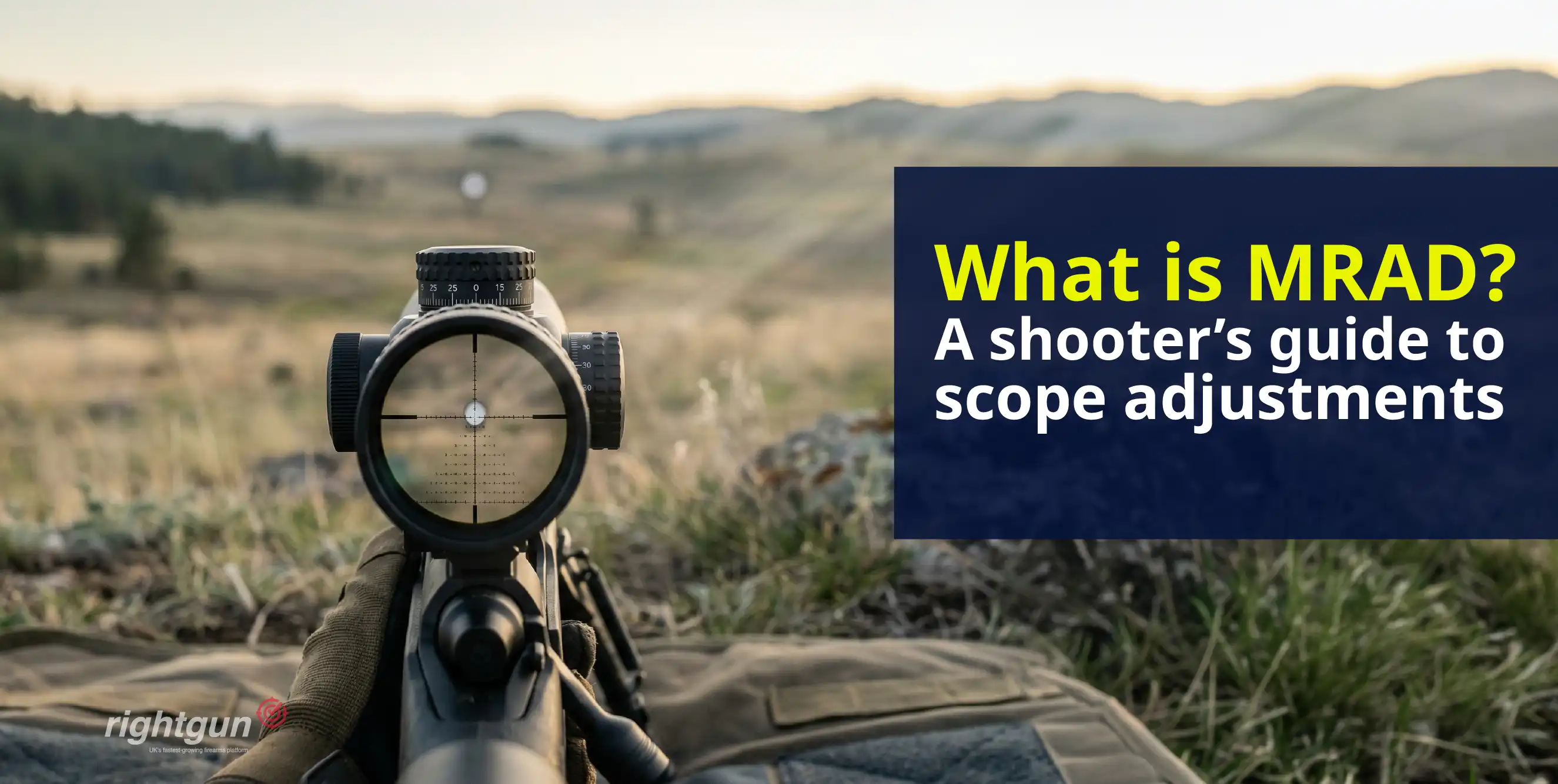
If you have ever looked through a modern riflescope and seen the word “MRAD” on the turrets or reticle, you are not alone in wondering exactly what it means. With more UK stalkers and target shooters moving to metric-based optics, MRAD (milliradian) has become the standard for serious long-range work. Here is a straightforward, practical guide to what MRAD actually is, how it compares to MOA, and which rifles and scopes deliver real-world performance with it.
What MRAD actually means?
MRAD stands for milliradian. Imagine you are standing at the centre of a huge circle. The target is out on the edge of that circle. A milliradian (1 MRAD) is simply a tiny fixed angle at your eye (or scope) that always produces the same size movement on the target for every 100 metres of distance.
The rule is dead simple and never changes:
At 100 metres, 1 MRAD equals exactly 10 centimetres on the target.
At 200 metres, 1 MRAD equals 20 centimetres.
At 300 metres, 1 MRAD equals 30 centimetres.
At 500 metres, 1 MRAD equals 50 centimetres.
It is always 10 cm per 100 metres. That is why MRAD is so popular with UK stalkers and long-range shooters – the numbers line up perfectly with metric rangefinders and the way we think in metres.
This clean, base-10 relationship makes MRAD intuitive once you switch your brain from imperial to metric. Unlike MOA, which is based on degrees and minutes of arc, MRAD works in simple multiples of ten – perfect for quick mental maths in the field.
Where the “radian” part comes from
If you really want the picture behind the name: picture a circle like a big round pizza. The radius is the straight line from the middle to the crust. If you take a piece of string exactly as long as that radius and lay it along the curved crust, the angle you create at the centre of the pizza is exactly one radian. A milliradian is just one thousandth of that angle – a tiny slice.
You do not need to remember any of that when you are in the hide. All you need to remember is the golden rule: 1 MRAD = 10 cm at 100 m. Everything else scales from there.
Why this matters in the field
Your rangefinder says 372 metres and your ballistic app tells you the bullet drops 3.7 MRAD. You dial 3.7 on the turret and hold dead centre. No awkward conversion, no guessing inches or fractions. The scope moves the crosshair by exactly the right amount so the bullet lands where you want it.
That is why modern premium scopes (Schmidt & Bender, Nightforce, Vortex Razor, Leica) now use 0.1 MRAD clicks – each click is only 1 cm at 100 metres. Tiny, precise, and repeatable.
If you are still dialling in MOA and it feels fiddly on longer shots, try an MRAD scope for one range session. Most stalkers who switch never go back. The system is simply built for the way we hunt in the UK today.
MRAD vs MOA – Quick comparison
Most UK shooters start with MOA because it feels familiar (roughly 1 inch at 100 yards). Here is how the two systems stack up:
- 1 MRAD ≈ 3.44 MOA
- 0.1 MRAD (common click value) ≈ 0.34 MOA
- At 100 metres: 1 MRAD = 10 cm (3.94 inches)
- At 100 yards: 1 MRAD = 3.6 inches
MOA is still excellent for short-range hunting and traditional British stalking. MRAD shines when you move beyond 200 metres, shoot in metres, or use ranging reticles that are calibrated in the same unit as your turrets. Once you learn the system, MRAD adjustments are faster and more precise for wind calls and elevation changes at extended ranges.
Why UK stalkers and hunters are switching to MRAD
British stalking distances are often shorter than in the USA or Europe, yet more shooters now practise at 300–500 metres on steel or zero at 100 metres and dial for roe or fallow on open ground.
The system also pairs perfectly with first focal plane (FFP) reticles, which are now standard on mid-to-high-end optics. The reticle sub tensions remain accurate at any magnification, so you can range a fox with the hash marks, then dial the exact correction without changing your zero.
Popular MRAD scopes and rifles that deliver
Entry level (reliable 0.1 MRAD clicks under £600)
Vortex Diamondback Tactical 4-12×40 or 6-24×50
Hawke Airmax 30 SF Compact (popular with air-rifle users)
Athlon Argos BTR Gen2
Mid-range sweet spot (most UK stalkers choose this bracket)
- Vortex Viper PST Gen II 5-25×50
- Bushnell Match Pro 6-24×50
- Element Optics Helix 6-24×50
Premium factory rifles with MRAD optics
- Blaser R8 Ultimate Silence Blackout paired with a Schmidt & Bender Polar T96 3-12×54 or Leica Amplus 6 2.5-15×56 – both in MRAD
- Tikka T3x or Sako 90 with a Nightforce NX8 4-16×50 FFP
- Accuracy International AT-X or Bergara B14 HMR Pro with a Vortex Razor HD Gen III
All of these combinations will hold sub-MOA (or better) groups and give crisp, repeatable 0.1 MRAD clicks that track perfectly.
Air rifle considerations
Modern PCP air rifles regularly reach 50–70 metres on rabbits and pigeons. An MRAD scope such as the Hawke Airmax or MTC Cobra F1 makes holdover corrections effortless. At 45 metres a 1.2 MRAD hold is simply 5.4 cm high – easy to visualise and far quicker than counting MOA clicks.
Choosing the right level for you
For woodland roe stalking under 150 metres, a good MOA scope is still perfectly adequate and often cheaper. If you regularly shoot beyond 200 metres, zero at 100 metres, or want a single optic that works for both centre fire and air rifle, MRAD is the smarter long-term choice.
The learning curve is short – one range session is usually enough. Most UK ammunition manufacturers now publish ballistic data in both MOA and MRAD, and every decent rangefinder displays milliradians.
Whatever optic you choose, remember the rifle and ammunition must first deliver accuracy. A sub-MOA rifle like a Blaser R8 or Tikka T3x fed match-grade ammunition will let you take full advantage of MRAD precision.
If you are upgrading your scope or building a new stalking rifle and want honest advice on MRAD versus MOA setups that actually work in UK conditions, the Rightgun team can match you to the right combination for your calibre, terrain and budget.
Must read:
