
 28-Aug-2026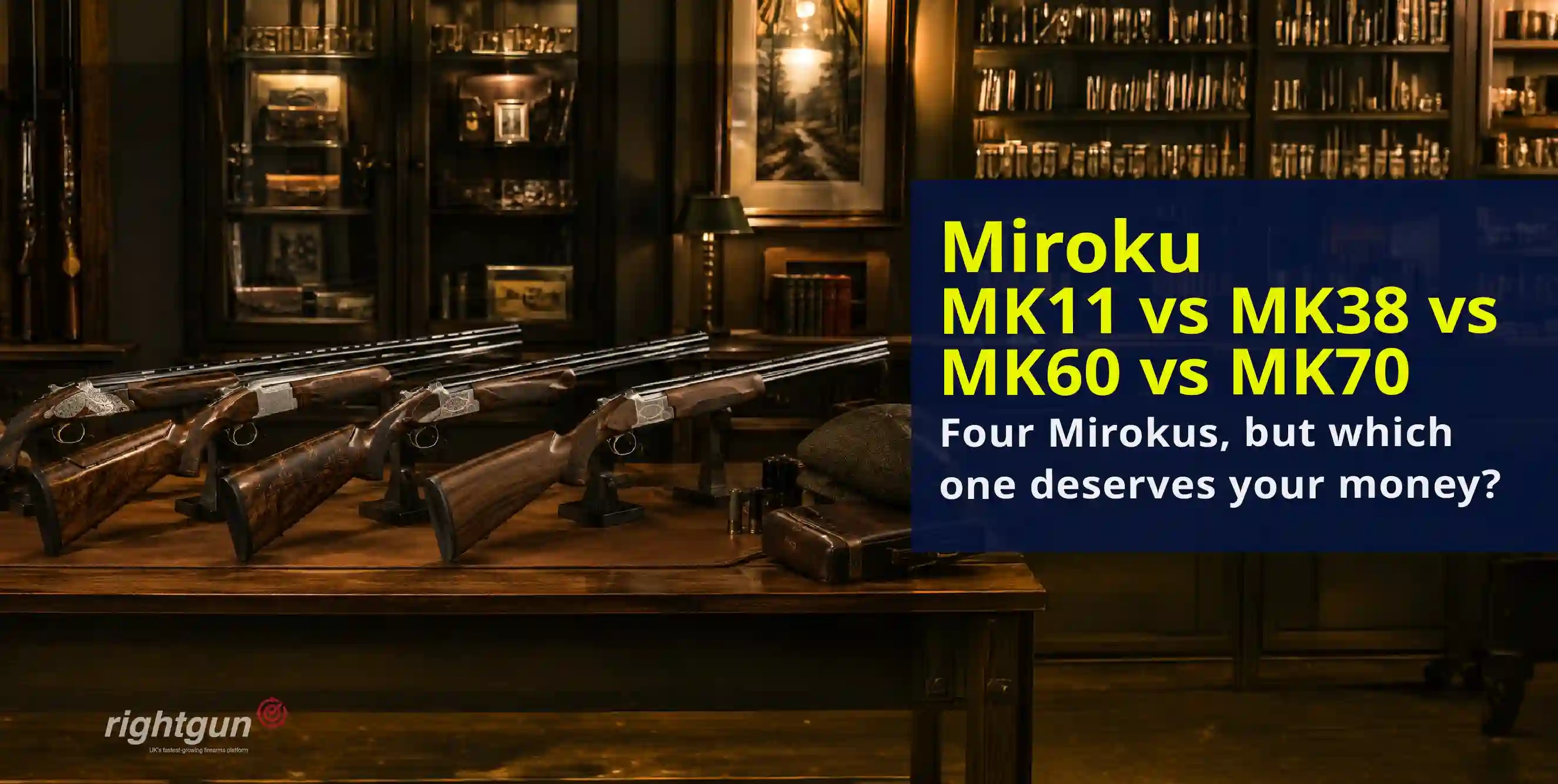
Few guns are as quietly ubiquitous in British shooting as the Miroku over-and-under. Walk any clay ground on a Sunday morning or stand in any line of guns and you will find them, often twenty or thirty years old, often on their second or third owner, and almost always still working perfectly.
The trouble for anyone shopping is the model numbering. MK11, MK38, MK60, MK70, plus a scattering of MK10s and grade suffixes, all built on closely related actions across several decades. The differences are real but they are not obvious, and sellers do not always describe them accurately. Here is how the main models actually differ and which one is likely to suit you.
The shared foundation
Before the differences, the similarity that matters most: Miroku over-and-unders are built in Japan on a low-profile boxlock action that has proven extraordinarily durable. The lockwork, the hinging arrangement and the general construction philosophy are shared with Browning; the two makers have a long-standing manufacturing relationship, and a Miroku action will feel immediately familiar to anyone who has handled a Browning B525 or B725.
What this means practically is that any of these models, properly looked after, will outlast most owners. Spares and gunsmithing knowledge are widely available in the UK. Second-hand values are stable. It is genuinely difficult to buy a bad one, which shifts the decision away from “is this model reliable” and towards “does this model suit my shooting”.
MK11: The classic all-rounder
The MK11 is the model most often described simply as “the Miroku”. It is the general-purpose gun in the family: typically 28in or 30in barrels, often fixed choke on earlier examples, with dimensions and weight that make it viable for both a clay layout and a game day.
Grades run from plain workmanlike finishes up to Grade 5 and above with considerably more engraving and better timber. The mechanical gun underneath is largely the same, so grade is a question of budget and taste rather than performance.
For a shooter who wants one gun for everything and does not want to overthink it, the MK11 remains an outstandingly sensible purchase, particularly on the used market, where they represent some of the best value in British shooting.
MK38: The competition gun
The MK38 is where Miroku aims squarely at the clay shooter. Expect longer barrels, 30in and 32in are common, heavier barrel profiles, multichokes, and stock dimensions cut for a deliberate, controlled swing rather than a snap-shot.
Trap, sporting and skeet specifications all exist within the MK38 designation, and they are not interchangeable. A trap-specced MK38 with a high rib and a tight-shooting stock will feel wrong on a low sporting target. Read the listing carefully and, ideally, shoulder the gun before buying.
The MK38 competes directly with the mid-range Beretta and Browning competition guns. It is heavier than an MK11 and less suited to being carried all day, but on a stand it rewards you for it. Our comparison of trap, skeet and sporting clays is worth reading if you are still deciding which discipline to commit to.
MK60: The sporting evolution
The MK60 sits alongside and slightly above the MK38 in the sporting bracket. Broadly, it brings a refined version of the same competition thinking, updated stock geometry, multichoke as standard, and specification options aimed at the sporting shooter who wants something a little more current than a 1980s MK38.
In practice, MK38 and MK60 buyers are often looking at the same guns and choosing on condition, price, and how the individual example feels rather than on model badge alone. We covered both in more detail in our Miroku MK38 and MK60 review.
MK70: The game-oriented option
The MK70 leans towards field use. Compared with the competition models it is generally lighter in the hand, more responsive, and dimensioned for driven and walked-up work where you are mounting quickly and carrying the gun for hours.
If your shooting is predominantly game and you find a heavy sporter tiring, the MK70, or a well-chosen MK11, is the more sensible direction. The “MK Game” designation you will see in listings and search results points at this same part of the range.
Which Miroku should you buy?
A rough guide:
Mixed shooting, one gun, sensible money — MK11. Look for 30in barrels and multichoke if you can find it.
Registered clays, weekly volume — MK38 or MK60 in the correct discipline specification.
Predominantly driven and walked-up game — MK70 or a lighter MK11.
Skeet specifically — a skeet-specced MK38; the dimensions genuinely differ.
Whatever you choose, condition and fit matter more than model number. A well-looked-after MK11 that fits you will out-shoot a tired MK38 that does not. Our guide to shotgun fit explains what to measure.
Barrel length, chokes and specification
One area where Miroku buyers regularly go wrong is fixating on model number while ignoring the specification that actually determines how a gun shoots.
Barrel length is the obvious one. A 28in gun points quickly and suits close, fast birds and woodland work. A 32in gun is steadier through the swing and more forgiving on long crossers, but it is slower to get moving and heavier at the muzzle. Thirty inches remains the sensible compromise and is why so many all-round Mirokus wear it.
Choke arrangement matters almost as much. Plenty of older MK11s and early competition guns came fixed choke, often quarter and half or half and full. That is not a fault, fixed chokes are simpler, and there is nothing to lose or damage, but it does commit you. If you shoot a variety of targets or quarry, multichoke is worth paying a premium for. If you shoot one discipline consistently, fixed choke in the right constriction is arguably better.
Finally, look at rib configuration. Trap-orientated guns often carry a raised or stepped rib producing a higher point of impact, deliberately, so the bird is not obscured. Fitted to a sporting shooter used to a flat-shooting gun, it will feel wrong until they adjust, and many never do. Match the gun to the shooting rather than assuming you will adapt. Our guide to cartridge selection covers the other half of that equation.
What to check on a used Miroku
Off the face. Close the gun and check for movement. Miroku actions wear slowly, but a hard-used competition gun will eventually need attention.
Barrel condition. Look for pitting, dents, and any sign of previous ribs work. Check the bores are clean and consistent.
Chokes. On multichoke guns, confirm the full set is present, and the threads are undamaged. Fixed-choke guns are fine but limit your flexibility.
Stock. Check behind the head of the stock for hairline cracks, particularly on older, heavily used examples.
Chamber length. Older guns may not be proofed for the cartridges you intend to use. Our guide to shotgun chamber lengths covers this properly.
Frequently asked questions
Are Miroku and Browning the same gun? Not the same, but closely related. Miroku manufactures in Japan and has a long-standing production relationship with Browning, and the actions share design lineage. Handling and build quality are comparable; the branding, styling, and some specification details differ.
Is a Miroku MK11 good for clay shooting? Yes, particularly at club level. A 30in MK11 handles sporting targets perfectly well. If you move into registered competition and want longer, heavier barrels and competition stock dimensions, an MK38 or MK60 is the natural step up.
What is the difference between the MK38 and the MK60? Both are sporting and competition models built on the same fundamental action. The MK60 is generally the later, more refined specification with updated stock geometry and multichoke as standard. Many buyers cross-shop them and decide on the individual example.
How long will a Miroku shotgun last? Properly maintained, a very long time; guns from the 1970s and 1980s are still in regular use across the UK. Round count matters more than age, and most wear points can be addressed by a competent gunsmith.
Browse Miroku shotguns on Rightgun.uk
New and used Miroku over-and-unders are listed by registered dealers and private sellers across the UK. Browse the full Miroku range, or go straight to the MK11, MK38, MK60 and MK70 if you already know what you are after.
Read next:
