
 27-Aug-2026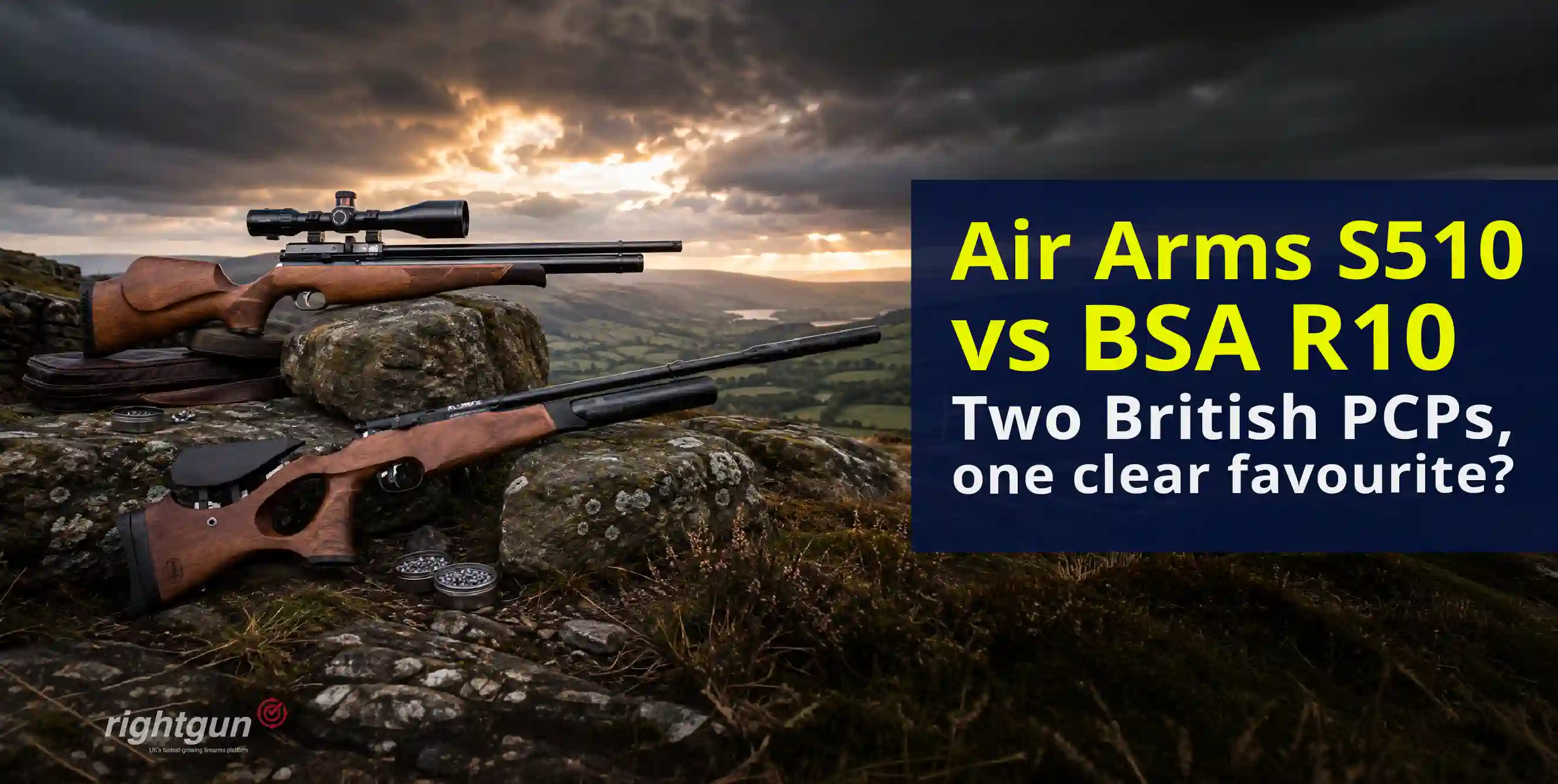
Ask a room full of British airgunners to name the two rifles that define the modern UK PCP market and you will hear the same two answers: the Air Arms S510 and the BSA R10. Both are British-made, both are regulated sporters aimed squarely at the hunter and the general shooter, and both have earned reputations that survive fashion cycles.
They are also, on paper, remarkably similar, which is exactly why the choice is difficult. This comparison looks at how the two rifles actually differ in the hand and in the field, and who each one suits best.
Two different design philosophies
The Air Arms S510 is the evolution of a lineage that runs back through the S410 and S400. It is a side-lever sporter built around a conventional cylinder, with Air Arms’ long-standing emphasis on stock quality, balance and traditional sporting looks. Over its production life, it has appeared in a wide range of guises, from classic walnut sporters through to the more adjustable Ultimate Sporter variants with laminate stocks and adjustable cheekpieces.
The BSA R10 takes a slightly more utilitarian route. BSA’s core asset is its cold-hammer-forged barrel, made in Birmingham, and the R10 is essentially a well-sorted regulated platform built around that barrel. Across its generations, including the widely admired SE and later Mk-series rifles, the emphasis has been on quiet, consistent, repeatable performance rather than on visual drama.
The short version: the S510 tends to feel like a sporting rifle that happens to be pre-charged, while the R10 feels like an engineered airgun system with a stock attached. Neither is a criticism.
Handling and ergonomics
This is where most buyers make their decision, and it is worth handling both before you commit.
The S510 generally carries a little more of the traditional sporter feel, a slimmer forend, a more classical grip and, in walnut form, a balance that many stalkers and roving hunters prefer. Air Arms stock work has long been one of the brand’s genuine strengths, and it shows.
The R10 tends to feel more substantial and slightly more forward-balanced, which some shooters find steadier off sticks or from a hide rest, and others find less lively when walking. The BSA’s magazine and loading arrangement is straightforward and well proven.
If you shoot mostly seated, from a rest, or off bipod, the R10’s balance is rarely a drawback. If you cover ground on foot and shoot standing more often than not, many people get on better with the S510.
Accuracy and barrel
Both rifles are capable of considerably better accuracy than most shooters can demonstrate in field conditions, so treat any claim that one is definitively “more accurate” with scepticism.
That said, the two get there differently. BSA’s cold-hammer-forged barrel has a long-standing reputation for pellet tolerance; R10s frequently shoot well with a wide range of pellet brands, which is a real practical advantage if your preferred pellet goes out of stock. Air Arms barrels, drawn from Lothar Walther stock, are equally well regarded and often reward a little more pellet experimentation with exceptional results.
In practice, both rifles will give you consistent groups at typical hunting ranges provided the rifle is regulated properly, the scope is mounted well, and you have found a pellet the barrel likes. Our guide to airgun slugs versus pellets is worth a read if you are considering moving beyond conventional diabolos.
Regulation, shot count and fill
Both rifles are regulated in their modern forms, and both deliver the flat velocity spread that regulation is meant to produce. Shot count varies by calibre, variant and cylinder size, so compare specific listings rather than relying on general figures.
Broadly, the S510 in its larger-cylinder and Ultimate Sporter forms tends to offer generous shot counts and a good amount of user adjustability. The R10’s shot count is competitive, and its reputation for shot-to-shot consistency across the usable fill is one of the reasons it retains such loyalty among hunters.
If you are cross-shopping more widely, we have compared both rifles against the German benchmark: Air Arms S510 vs Weihrauch HW100 and BSA R10 vs Weihrauch HW100.
Noise and field manners
Both rifles are civil enough for pest control around buildings when fitted with an appropriate moderator. The R10 in particular has a long-held reputation for being quiet out of the box, thanks to its integrated shrouding, which matters if you shoot on farms or near neighbours.
The S510’s manners are equally good in most configurations, and the differences between well-set-up examples of each rifle are smaller than internet debate would suggest.
Value, resale and the used market
Here the two diverge more meaningfully. Both hold value well by airgun standards, but they behave differently on the second-hand market.
Air Arms rifles, particularly walnut-stocked S510s and the Ultimate Sporter variants, have a strong following among buyers who want a rifle that looks and feels like a sporting gun, and this supports resale. BSA R10s, especially clean SE examples, have a devoted hunting following and tend to sell quickly when priced sensibly.
Both are among the most-searched air rifles on Rightgun.uk, and both appear regularly on the used market. If your budget is fixed, buying a well-kept used example of either almost always beats buying new further down the range, a point we cover in more detail in our spring versus PCP airgun comparison and the complete air rifle buyer’s guide.
Which should you choose?
Choose the Air Arms S510 if you want a traditional sporting feel, value stock quality and balance highly, shoot standing or walking more than from a rest, or want the broadest range of stock options and variants to choose from.
Choose the BSA R10 if you prioritise quiet, consistent field performance, want a barrel that is famously easy to feed, shoot mostly from a rest or hide, or simply prefer BSA’s more engineering-led approach.
Buy either with confidence if you find a clean, well-serviced used example at a fair price. Both rifles will comfortably outlast the enthusiasm of most owners.
Frequently asked questions
Is the Air Arms S510 better than the BSA R10? Neither is objectively better. The S510 generally suits shooters who prize handling and traditional sporting feel; the R10 suits those who prize quiet, consistent field performance and pellet tolerance.
Which holds its value better? Both hold value well. Walnut-stocked Air Arms rifles have particularly strong appeal on the used market, while clean BSA R10 SE examples tend to sell fast.
Are both regulated? Modern versions of both rifles are regulated. Older examples may not be, so check the specific listing and generation before buying second-hand.
Can either be used for FAC-rated shooting? Both have appeared in higher-powered forms. FAC-rated airguns require the appropriate certificate; check the listing carefully and confirm what you are legally permitted to hold. See our overview of UK air rifle laws and licensing.
See both rifles side by side
The best way to settle the argument is to compare what is actually available. Browse current Air Arms S510 listings and BSA R10 listings on Rightgun.uk, or widen your search across all air guns to see how both stack up against the rest of the market.
Read next:
