
 07-Jul-2026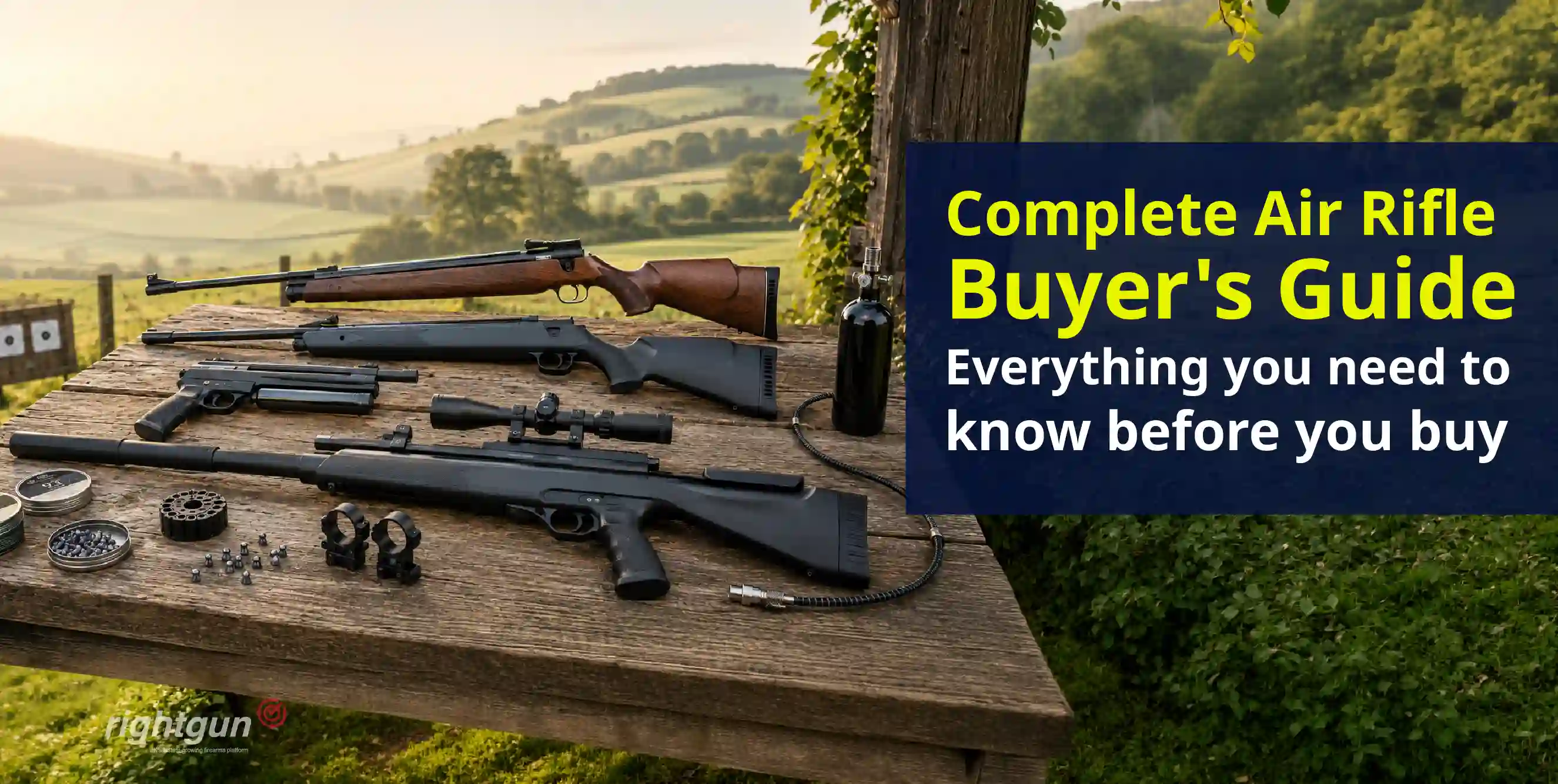
Buying an air rifle in 2026 is both more exciting and more potentially overwhelming than it has ever been. The market has expanded dramatically over the past decade, budget options have improved, mid-range choices have multiplied, and the premium PCP sector now offers technology that would have seemed extraordinary even fifteen years ago. Whether you are a first-time buyer trying to make sense of the terminology, an experienced springer looking to step up to a PCP, or a seasoned shooter reviewing the current landscape before a new purchase, this guide covers everything you need to know to make a confident, well-informed decision.
Air rifles in the UK are broadly divided into two categories by power: sub-12 ft/lb rifles, which can be bought and owned without any licence, and rifles exceeding 12 ft/lb, which require a Firearms Certificate (FAC). Unless you are an experienced shooter with specific requirements for higher power, the sub-12 ft/lb category covers the vast majority of legitimate hunting, pest control, and target shooting applications,, and it is by far the larger and more diverse market.
Understanding the action types
The most fundamental choice you will make when buying an air rifle is selecting the action type, the mechanism by which the rifle generates the compressed air that fires the pellet. There are four main types, each with distinct characteristics, advantages, and compromises.
Spring-piston rifles are the most traditional and widely owned type. Cocking the action, either by breaking the barrel downward or operating a separate lever, compresses a mainspring. When the trigger is released, the spring drives a piston forward, compressing a column of air that propels the pellet. Spring guns are self-contained (no external power source required), robust, economical to run, and available across a wide price range from entry-level to premium. The trade-off is that the firing cycle, spring release, piston travel, air compression produces a characteristic recoil that requires technique to manage. The artillery hold, where the rifle is supported lightly rather than gripped firmly, is essential for consistent accuracy.
Gas-ram (also called gas-strut or nitro-piston) rifles replace the coiled steel mainspring with a gas-filled cylinder. The benefits over a conventional springer include a smoother cocking action, reduced vibration on firing, better performance in cold weather (steel springs can stiffen significantly at low temperatures), and theoretically unlimited storage in the cocked position without spring fatigue. Gas-ram rifles are a popular upgrade from entry-level springers and represent excellent value in the mid-price bracket.
CO2 rifles use small CO2 cartridges (typically 12-gram Powerlets or 88-gram bulk cylinders) to power the action. CO2 guns offer very consistent shot-to-shot performance within a narrow temperature range, easy loading, and in multi-shot designs, a rapid firing capability that springers cannot match. The limitations are temperature sensitivity, CO2 pressure drops significantly in cold weather, affecting both power and reliability, and the ongoing cost of CO2 cartridges. CO2 rifles are popular for target practice, plinking, and semi-competitive shooting where conditions are controlled.
Pre-charged pneumatic (PCP) rifles are filled from an external high-pressure air source, either a hand pump or, more commonly, a scuba-type dive bottle or dedicated air reservoir. PCPs offer the best shot-to-shot consistency of any action type (especially when regulated), the lowest felt recoil, the highest achievable accuracy, and in multi-shot designs, the most practical field capability.
They are the choice of serious hunters, pest controllers, field target competitors, and anyone who demands the best performance their budget can provide. The investment includes not just the rifle but the filling infrastructure, which adds to initial cost but is essentially free to operate once in place.
Choosing your calibre
UK air rifles are most commonly available in .177 (4.5mm) and .22 (5.5mm), with .25 (6.35mm) and .30 (7.62mm) available in higher-powered FAC-rated PCPs. For sub-12 ft/lb rifles, the choice between .177 and .22 is the most important calibre decision you will make, and it has real consequences for how the rifle performs in your intended application.
.177 offers a flatter trajectory and higher velocity for a given power level, making it the calibre of choice for target shooting where holdover adjustments are undesirable. The smaller, lighter pellet travels faster and drops less over typical target distances, making holdover corrections simpler and more consistent. In field target competition, .177 dominates at the highest levels for exactly this reason.
For hunting and pest control, .177 is perfectly adequate at close ranges, but the lighter pellet is more susceptible to wind deflection and loses energy more rapidly than .22 over distance.
.22 produces a heavier pellet at lower velocity, but delivers more energy on target at typical hunting ranges, 20 to 40 metres for most UK quarry. The heavier pellet is also less affected by light crosswinds than .177, which matters more than many new shooters appreciate in the typical outdoor hunting environment. For rabbits, rats, squirrels, corvids, and other legal quarry, .22 is the most commonly recommended calibre and the choice of the majority of UK hunters and pest controllers.
Setting your budget
Air rifles are available across a wide price spectrum, and understanding what each price band offers helps set realistic expectations.
Under £200 covers entry-level spring and gas-ram break-barrel rifles from manufacturers including Gamo, Hatsan, Webley, and BSA's more accessible lines. These rifles are functional and suitable for garden plinking, basic pest control, and learning the fundamentals of shooting. Build quality reflects the price, plastic components are common, triggers are often serviceable but unrefined, and accuracy is adequate rather than exceptional. For a first air rifle where the primary goal is learning, this price band is entirely reasonable.
Between £200 and £500 is where the market becomes genuinely interesting. Weihrauch's spring-powered rifles, the Gamo Swarm series, quality gas-ram designs, and entry-level PCPs from BSA and Weihrauch all appear in this range. Build quality improves significantly, metal components where they matter, better triggers, more consistent barrels, and stock quality that begins to feel like a proper sporting rifle rather than a toy. For serious hunting or pest control use, this is the minimum bracket worth considering.
Between £500 and £1,000 covers the mainstream quality end of the market, Air Arms spring and PCP rifles, Weihrauch's premium springers, mid-range Brocock and BSA PCPs, and the entry-level FX range. Rifles in this bracket offer genuinely excellent accuracy, premium triggers, regulated actions in the PCP segment, and build quality that will last decades with appropriate care. This is the bracket where serious shooters find long-term satisfaction.
Above £1,000 represents the premium PCP segment, FX, Daystate, Air Arms S510/S400 range, Brocock's top variants, and fully custom builds. These rifles offer the finest materials, the tightest manufacturing tolerances, the most sophisticated regulation and tuning capability, and in many cases features, adjustable stocks, electronic triggers, onboard manometers, that go well beyond what the sub-£1,000 market provides. For competition shooters and enthusiasts who want the very best, this investment is justified. For hunters whose primary requirement is reliable accuracy at typical hunting ranges, rifles in the £500 to £1,000 bracket will often meet all practical needs.
Optics: Getting your sighting right
An air rifle fitted with poor or mismatched optics will not perform to its potential regardless of the quality of the underlying rifle. Scopes for air rifles must be specifically designed or rated for the double-recoil characteristic of spring-piston guns, firearm scopes are engineered for single-direction recoil and will fail rapidly when subjected to the back-and-forth motion of a spring-rifle firing cycle. If you are buying a spring or gas-ram rifle, confirm that any scope you purchase is air rifle rated.
For typical hunting and pest control at ranges up to 40 metres, a fixed 4x scope or a variable 3-9x or 4-12x scope covers all practical requirements. Higher magnification is not always better, at 12x magnification, the target image moves with any wobble in your hold, making it harder rather than easier to take accurate shots in field conditions. Variable magnifications between 4x and 10x cover the full range of air rifle hunting situations comfortably.
For PCP rifles used at longer ranges or in field target competition, higher magnification scopes become more useful, and side parallax adjustment, either via a side wheel or adjustable objective (AO) lens, becomes essential. Parallax error causes the apparent position of the crosshair to shift relative to the target as your eye position changes, and at air rifle hunting ranges it must be corrected at the correct distance for accurate shooting.
Allowance for quality mounts should be included in any optics budget. Cheap mounts allow scope movement that destroys the consistency of your zero and prevents the rifle from performing to its capability.
Pellets: The variable you cannot ignore
Every air rifle has a preferred pellet, a design and weight that it shoots more consistently than alternatives. Finding your rifle's preference is one of the most important and rewarding aspects of air rifle ownership, and it requires a systematic testing process. The basic approach is to purchase five or six different pellet types, including wadcutter, domed, and pointed designs in different weights, and shoot groups with each from a rested position at a consistent distance. The pellet that produces the tightest, most consistent groups is your rifle's preferred ammunition.
For hunting, domed pellets (also called round-nose) are the standard choice. They retain velocity better than flat-faced wadcutters over hunting distances and deliver consistent energy transfer on quarry. Pointed pellets are popular in some calibres for their perceived penetration but do not always produce the accuracy of a good domed pellet at hunting ranges. Hollow-point pellets expand on impact and are effective for humane pest control at appropriate ranges.
Pellet quality matters as much as design. Premium pellets from manufacturers including H&N, JSB, Air Arms, and RWS are manufactured to tighter dimensional tolerances than budget pellets, and the consistency of diameter and weight translates directly into more consistent accuracy. The cost difference between budget and premium pellets is modest in the context of an air rifle's overall running costs, and the accuracy improvement is often substantial.
First-time buyer recommendations
For a genuinely first air rifle where the primary goal is learning to shoot and enjoying the sport, a mid-range break-barrel springer from Weihrauch, Air Arms, or BSA in .22 calibre, paired with a basic 4x scope, represents the ideal starting point. It will teach you the correct technique, reward improving skill, and last for many years. If budget allows, stepping up to a PCP from the outset eliminates the technique challenges of spring shooting and delivers the consistency that makes progress easier, but springers teach habits and skills that make better shooters.
Whatever you choose, invest in proper training. Many UK shooting clubs offer introductory sessions, and the British Association for Shooting and Conservation (BASC) and other organisations provide resources for new air rifle shooters. The sport is more enjoyable, more rewarding, and more successful when you start with the right foundations.
Final thoughts
The air rifle market in 2026 is the strongest it has ever been. The range of options across every budget level, the quality of information available to buyers, and the breadth of the shooting community mean that making a good purchase decision has never been easier, provided you invest the time to understand your own requirements before spending your money. The questions to answer first are always the same: What will you primarily use it for? What budget are you working with? What level of infrastructure and ongoing investment are you comfortable with? Answer those questions honestly, and the right rifle will become clear. This guide exists to help you get there.
Read next:
