
 02-Oct-2026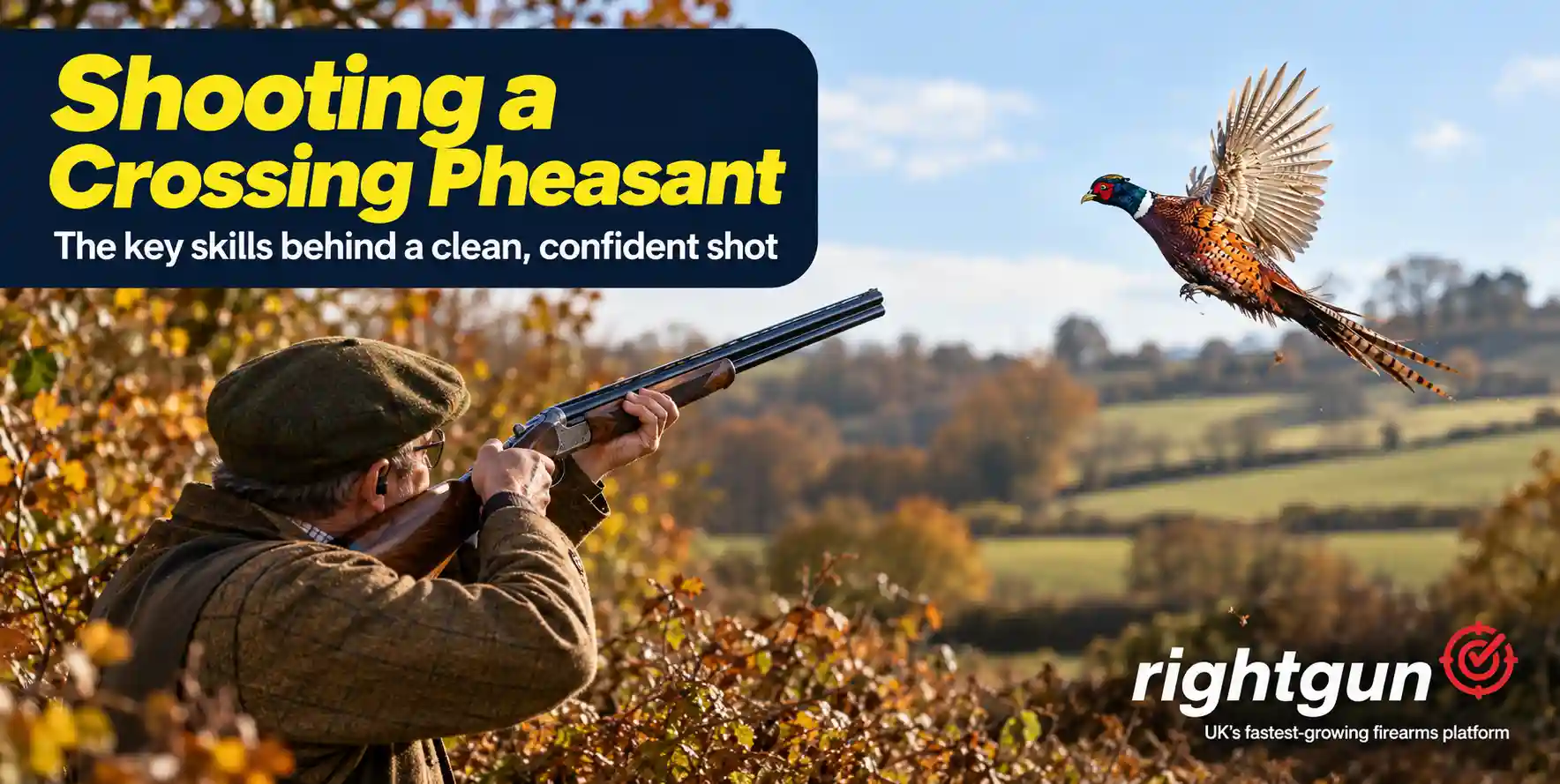
Yes, and the short answer is that a crossing pheasant is mostly about three things done in the right order: see the bird early, build your mount and footwork around where you will meet it, and keep the gun moving smoothly through the shot. Crossers feel intimidating because the bird is moving across your front rather than straight at you, but they reward a calm, rhythmic approach more than any clever trick. This guide explains the principles in plain English, with safety first, and points you to the kit worth looking at on Rightgun.uk. For the finer detail, such as exactly how much lead suits your gun and your cartridge, a coach or a session at a clay ground will do far more for you than any article can.
Safety comes before technique
Before a single bird is in the air, the most important part of shooting a crosser is knowing where you can and cannot safely shoot. Every driven day starts with a briefing from the shoot captain, and it is worth listening properly even if you have heard something similar before. Each day, each peg and each drive has its own arcs of fire, its own rules on ground game, and its own instructions about when to stop shooting at the end of a drive.
The principles are widely shared. Shoot only within your safe arc, and never swing through the line of the neighbouring guns, the beaters, the pickers-up or the dogs. Never shoot low birds. A bird crossing in front of you can easily bring the gun round towards the next peg if you chase it too far, so the discipline of letting a bird go is part of the skill, not a failure of it. If you are unsure, do not shoot, and if you are ever unsure of the rules on the day, ask the shoot captain or your host.
Browse: Shotguns · Beretta 686 · Browning B525 · Miroku MK38 · Edwards eyewear
What makes a crosser different
A pheasant coming straight over the top is relatively simple to read because its line is in front of you and its speed is mostly closing. A crosser asks a slightly different question: where will the bird be by the time the shot gets there? Because the bird is travelling across your front, you have to move the gun with the bird and place the shot where it is going, not where it is now.
Many shooters miss crossers behind, simply because the bird looks slower than it really is and the gun stops as the trigger is pulled. That is a very common experience and not a sign you are doing everything wrong. The fix is rarely a bigger lead. It is usually a better mount and a gun that keeps travelling.
Species and conditions matter too. A pheasant flying with a following wind can look completely different from one hanging in a stiff breeze, and a bird that has been flushed from a hill behaves differently from one coming off flat ground. Good shots watch the first few birds of a drive to get a feel for the speed on the day before they raise the gun.
Browse: Shotguns · Beretta A400 · Browning B725 · Fabarm shotguns · Caesar Guerini
Footwork and stance: Set up for where you will shoot
Good crossing shots begin with the feet. The usual coaching advice is to pick the spot where you expect to meet the bird, let your feet and hips point towards it, and then turn back to where you first see the bird and pick it up from there. That way, as the gun follows the bird, your body unwinds smoothly towards the point of the shot rather than running out of turn and forcing you to stop.
Stay balanced, with your weight slightly forward, and keep your knees soft rather than locked. Avoid a stance that twists you hard in one direction before you have even mounted, because that is what makes the gun stop mid-swing. Birds crossing in one direction tend to leave you short of room on one side more than the other, so a little time spent thinking about your footwork on the day, and on a clay ground beforehand, pays real dividends.
Browse: Shotguns · Miroku shotguns · Perazzi shotguns · Benelli shotguns · Gun parts and accessories
Mount, eyes and movement
A consistent mount is the foundation of every shot. Bring the gun up into your shoulder and cheek in one smooth movement while your eyes stay on the bird, with the muzzles sitting just underneath it rather than blocking your view. A gun that fits you well helps enormously here, because it points where you are looking. If you are shopping for a new or used gun, a proper fitting is one of the best investments you can make, and our piece on how to shoulder a shotgun is a good place to start.
Your eyes do most of the work. Focus on the bird, not the barrels, and let the gun follow your vision. Many people describe the right feeling as the gun being drawn through the bird by the eyes, almost without thinking. If you catch yourself aiming at the muzzles or checking where the bead is, the moment has usually already gone.
On the question of how much to allow in front of a crosser, the honest answer is that it varies with the bird, the speed, your gun, your cartridge and the conditions, which is why coaches avoid fixed numbers. Two common approaches are to swing through the bird and fire as you pass it, or to keep the gun ahead of the bird and maintain that gap. Try both with a coach on a clay ground and see which feels natural to you. We explain how the two compare in a separate piece in this series.
Browse: Shotguns · Beretta 686 · Browning Citori · Miroku MK60 · Gun parts and accessories
Practise away from the shoot
The best way to improve on crossers is to practise away from the shoot. A clay ground can set up crossing targets for you, and a good coach will spot problems with mount, footwork and eye position in a few shots. Short, regular sessions during the summer and early autumn tend to help more than a single long visit, and it is worth a visit before the season picks up momentum. Pheasant shooting in Great Britain generally runs from the start of October to the start of February, though individual shoots set their own days.
Do not forget the people and dogs around you either. A good guest keeps conversation to a minimum while the drive is on, marks where birds fall, and says thank you to the keepers, beaters and pickers-up at the end of the day. Gundogs do an enormous amount of hard work picking up, so keep yours steady on the peg, and respect other people’s dogs as you would your own. If you are thinking about training one, our guide to the gundog world is worth a read.
If your current gun does not suit you, a change of kit can make a real difference, and kit is also worth a look from a safety angle. Protective eyewear and hearing protection matter on every shoot day, and a well-fitted, comfortable shotgun helps you shoot more consistently. Non-toxic cartridges are available for those who wish to use them, and many shoots have their own rules on cartridge type, so check with the shoot before you buy anything.
Browse: Shotguns · Dogs and gundog kit · Hunting equipment · Browning clothing · Gun parts and accessories
FAQ
What is the hardest part of shooting a crossing pheasant? For most people, it is keeping the gun moving. Stopping the swing as the trigger is pulled is the classic cause of a miss behind the bird, so smooth movement matters more than raw speed.
Should I swing through or maintain lead on a crosser? Both methods are used by good shots, and the right one is partly personal. A coach can watch you shoot and help you decide, which beats trying to work it out from a book.
How can I practise crossing pheasants before the season? Book a lesson or a session at a clay ground that can set up crossing targets, and ask the instructor to look at your mount and footwork. Short, regular sessions are usually more useful than one long day.
Do I need to follow the shoot captain’s instructions on a crossing bird? Always. The briefing covers safe arcs, ground game and the end-of-drive signal, and it overrides anything you have read in a guide, including this one.
Ready to find your next gun?
Whether you are choosing a first game gun or upgrading to something that suits your shooting, browse the latest shotguns for sale on Rightgun.uk and compare listings from UK sellers in one place. Looking to sell a gun that no longer fits? List it where shooting enthusiasts are already searching.
Browse: Shotguns for sale · Beretta shotguns · Browning shotguns · Miroku shotguns · Gun parts and accessories
Further reading: Pheasant shooting, the pheasant season, shooting glasses and gundogs.
