
 21-Aug-2026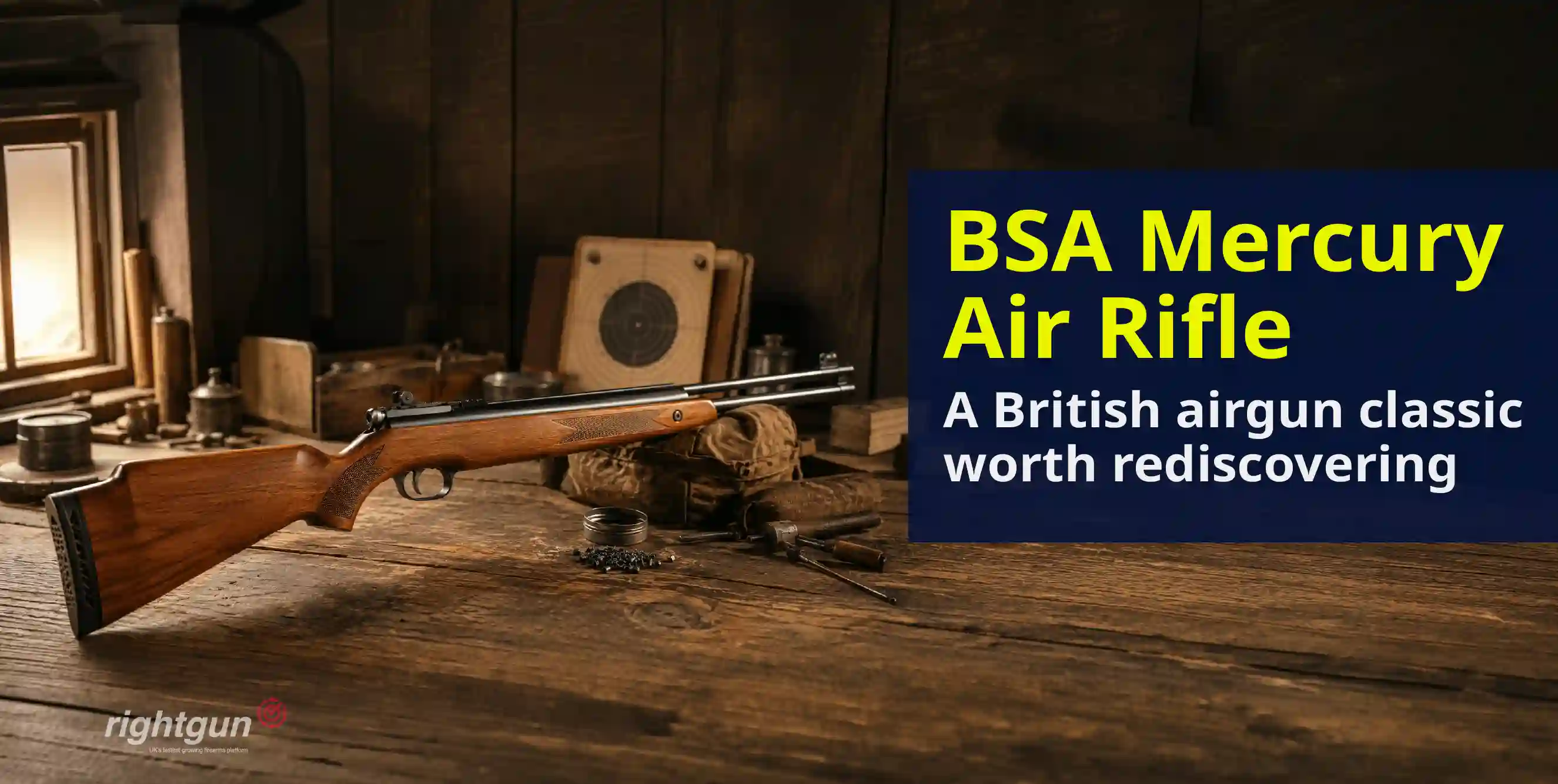
Few air rifles say “British airgunning” quite like a BSA Mercury. Built in Birmingham during BSA’s golden era of spring-gun manufacture, the Mercury was the sensible shooter’s rifle: a full-size break-barrel that sat between the junior Meteor and the flagship Airsporter, offering adult power and handling at a working man’s price. Half a century on, clean Mercurys have become firmly collectable, and interest in vintage BSA rifles among UK buyers keeps climbing, with searches for classic Birmingham guns rising steadily on Rightgun.uk.
Here’s the Mercury story, the variants to know, and what to look for when buying one today.
A Birmingham classic: Where the Mercury fits
BSA, the Birmingham Small Arms Company, was once the biggest name in British airguns, and its 1970s range had a clear ladder: the Meteor for youngsters and beginners, the Mercury as the full-power break-barrel for adult shooters, and the underlever Airsporter as the range-topper. Launched in the early 1970s, the Mercury gave shooters Airsporter-class performance in a simpler, lighter break-barrel format, with the pride of a “Made in England” roll-mark on the cylinder.
That Birmingham heritage matters to collectors. Like the Airsporter, whose history we cover in our BSA Airsporter listings, the Mercury represents an era when BSA machined its guns from solid, and it shows in how many survive in shootable condition today.
The variants: Standard, S, and Challenger
Over its production life the Mercury appeared in several forms, and knowing which is which helps you price a used example fairly.
The standard Mercury is the rifle most commonly found: a full-length break-barrel in .177 or .22 with a beech stock and BSA’s characteristic clean lines. The Mercury S arrived later as the hotter version, tuned for higher muzzle energy in response to the magnum-power race of the late 1970s and early 1980s. The Mercury Challenger rounded off the family towards the end of production with cosmetic and detail changes. Between these, collectors also distinguish early and late production by sight fittings, safety details, and stock profile, small differences that matter more to the cabinet collector than the shooter.
Condition, originality, and bore state count for far more than variant when it comes to value: a tidy, original standard Mercury is worth more than a rough S.
What a Mercury is like to shoot today
Set expectations correctly, and a Mercury is a delight. This is a vintage springer: the firing cycle is more agricultural than a modern Weihrauch, and the trigger, while perfectly usable, predates the units fitted to today’s rifles. But the handling is lovely, slim, quick to the shoulder, with iron sights that make it a superb garden and plinking rifle. In .22 with fresh seals, a healthy Mercury still makes proper vermin-gun power for close-range work.
Most examples on the market will benefit from a service. Springs and seals are consumable items on any vintage airgun, and a re-seal transforms a tired Mercury; our guide to why an air rifle loses power explains the symptoms of worn internals to listen for when trying a gun.
Buying a used BSA Mercury: The checklist
When you’re looking at a Mercury, in the metal or in a listing, work through the essentials. Check the breech lock-up: the barrel should snap shut positively with no side-to-side play at the jaws. Look at the cylinder finish, because Birmingham bluing is deep and even, and heavy pitting is expensive to put right. Inspect the stock for cracks behind the trigger guard and at the forend screws. Fire it if you can: a healthy Mercury should crack cleanly, not twang or smoke; persistent dieseling suggests it’s been over-oiled. Finally, confirm the serial number and roll-marks are crisp, since originality drives collector value.
None of these checks require specialist tools, and honest sellers will happily describe them. Vintage air rifles under 12 ft·lb need no licence in England and Wales, which keeps buying simple, one reason classic BSAs make such an easy entry into gun collecting.
Values: What should you pay?
Mercury prices vary widely with condition, from project guns needing seals and bluing through to unfired, boxed examples that command genuine collector money. Rather than quote figures that date quickly, watch the live market: comparing current BSA air rifle listings gives you a real-time picture of where Mercurys, Airsporters and Meteors are actually trading. As a rule, .177 target-ish examples and boxed late Challengers attract premiums, and an honest service history adds more value than any accessory.
Mercury, Airsporter or Meteor: Which vintage BSA should you buy?
If you’re new to classic BSAs, it helps to see the three staples side by side. The Meteor is the lightweight of the family; millions were made, prices are the friendliest of the three, and it’s the perfect low-risk first vintage gun, though power and presence are modest. The Mercury is the sweet spot: full-size, adult-power, still affordable, and less common than the Meteor without being rare enough to command silly money. The Airsporter is the prestige piece; its underlever tap-loading action is wonderfully engineered, and it was the rifle every 1970s shooter aspired to, which is reflected in what good examples fetch today.
There’s a practical difference too. The Mercury’s break-barrel action is the simplest of the three to service and the easiest to check when buying: lock-up, bore, and seals tell you nearly everything. The Airsporter’s loading tap adds a wear point that needs assessing, while Meteors, often the survivors of hard teenage use, vary enormously in condition.
Collectors tend to end up with all three eventually, but if you’re buying one vintage BSA to own and shoot rather than shelve, the Mercury’s blend of usability, character and value is hard to argue with. Later BSA models like the Super 10 and today’s R10 show where the firm went next, but the spring-era guns are where the romance lives.
FAQ
When was the BSA Mercury made? The Mercury was produced by BSA in Birmingham from the early 1970s, running through several variants, including the higher-powered Mercury S, into the 1980s.
Do I need a licence to own a BSA Mercury in the UK? No, like other air rifles up to 12 ft·lb, a Mercury can be owned without a certificate in England and Wales. Scotland requires an air weapon certificate, and normal age-limit rules apply.
Is the BSA Mercury worth collecting? Yes. As a Birmingham-built springer from BSA’s classic era, clean and original Mercurys are increasingly sought after, sitting alongside the Airsporter and Meteor in most vintage BSA collections.
Can a BSA Mercury still be serviced? Easily. Springs, seals, and breech washers are widely available, and any competent airgun smith can re-seal a Mercury; a serviced example shoots remarkably well.
Find vintage BSA air rifles on Rightgun.uk
Whether you’re after your first classic springer or the missing piece in a BSA collection, Rightgun.uk is where the UK’s vintage airgun market meets. Browse current BSA Mercury listings, explore the wider BSA range, or cast the net across all air guns for sale to see what Birmingham built.
Read next:
