
 21-Aug-2026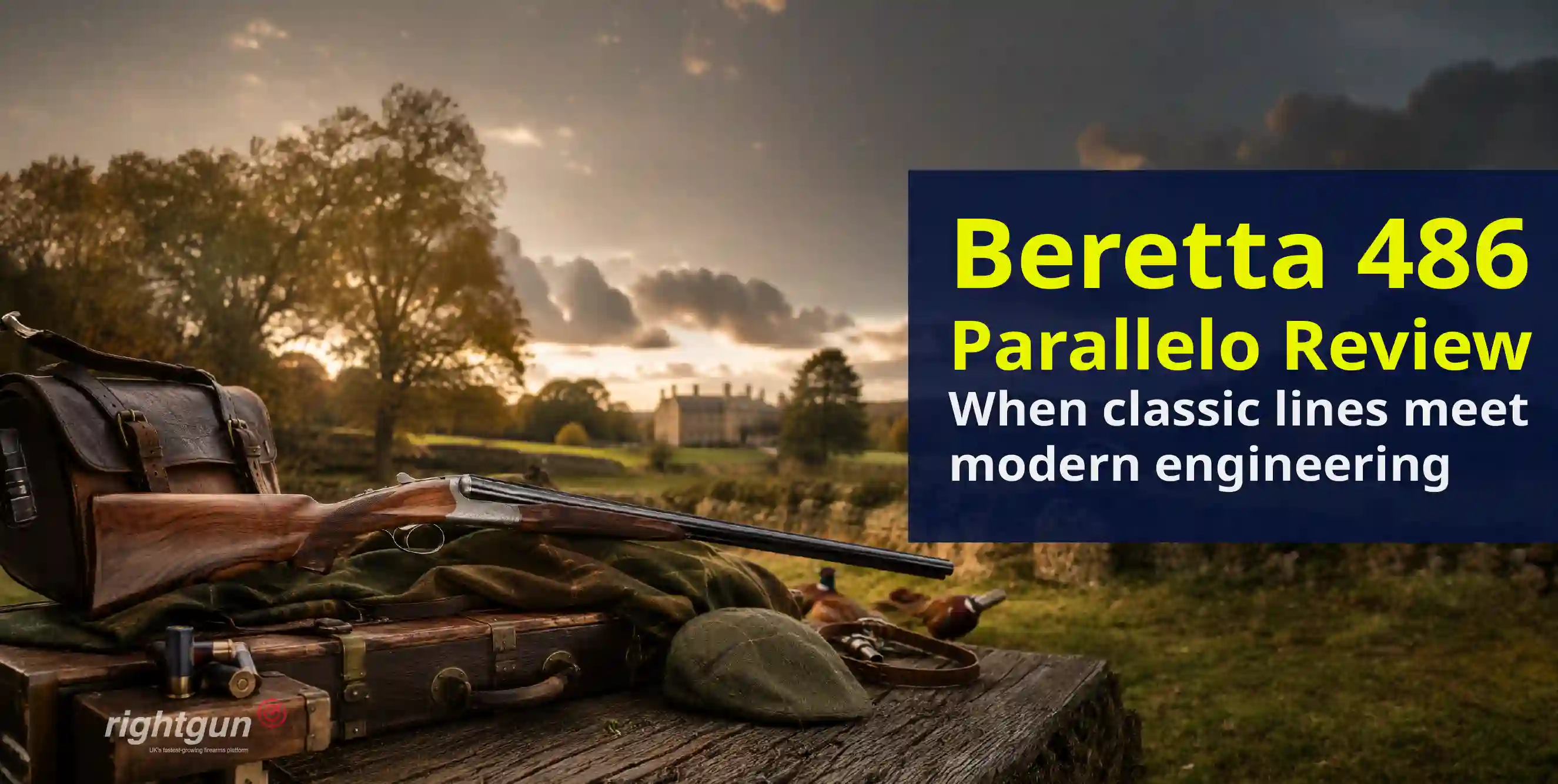
The side-by-side occupies a special place in British shooting. It’s the silhouette of the traditional game day, the gun your grandfather swore by, and, for a long time, a configuration the big Italian makers largely left to the English and Spanish trade. The Beretta 486 Parallelo changed that. Here was the world’s oldest gunmaker applying modern manufacturing to the classic English pattern, and the result has quietly become one of the most searched-for side-by-sides on Rightgun.uk. This review looks at what the 486 offers UK shooters, how it handles in the field, and what to consider before buying one.
What is the Beretta 486 Parallelo?
The 486 Parallelo is Beretta’s premium side-by-side, introduced as the successor to the earlier 471 Silver Hawk. The heart of the gun is its rounded-body action, a graceful, scaled design that flows into the stock in the manner of the best English round-bodies, decorated with restrained scroll engraving. The receiver houses a reliable boxlock-style mechanism engineered with Beretta’s customary precision, paired with a single selective or double-trigger configuration depending on specification.
It’s offered in game-appropriate configurations, typically 12, 20, and 28 bore, with English-style straight-hand stocks and splinter fore-ends for the traditionalist or pistol-grip options for those who prefer them. A notable footnote: Beretta commissioned industrial designer Marc Newson to create a special edition of the 486, a rare example of a major gunmaker treating the side-by-side as a canvas for contemporary design. Standard guns, though, are resolutely classical in appearance.
Handling and field performance
The reason to buy a side-by-side in 2026 is the way it carries and mounts, and this is where the 486 earns its keep. The rounded action sits low in the hands, the gun balances just ahead of the hinge, and the sight picture, that broad, twin-barrel plane the side-by-side devotee loves, encourages an instinctive, unfussy style of shooting. It feels like a game gun in a way no over-and-under quite manages.
Where the 486 departs from the vintage English guns it stylistically honours is durability. This is a modern gun, built with modern steels and proofed for modern cartridges, including steel-shot-appropriate specifications in current production, an increasingly important consideration as the UK transitions away from lead for live quarry. You get the traditional silhouette without nursing hundred-year-old barrels, and servicing is supported by Beretta’s UK network rather than depending on specialist vintage-gun smiths.
Recoil behaviour is typical of the configuration: side-by-sides deliver a slightly livelier feel than a comparable over-and-under, but the 486’s weight and stock geometry keep it comfortable through a driven day with sensible game loads.
The 486 against the alternatives
For UK buyers, the 486 sits in an interesting middle ground. Below it, the Spanish trade, AYA’s sidelocks and boxlocks chief among them, offers hand-built traditional guns, often second-hand at attractive prices. Above it, the English names command five and six figures. The 486’s pitch is Beretta engineering, warranty and consistency at a price far below a new English gun, with the fit and finish you’d expect from Gardone’s premium workshops.
Against its own stablemates, the question is usually 486 versus a premium over-and-under such as the 686 Silver Pigeon or 687 EELL. The over-and-unders are more versatile, happier on the clay ground, more familiar to most modern shots, but they can’t offer the side-by-side’s character or its rightness on a formal game day. Plenty of owners run both: an over-and-under for clays and pigeons, the Parallelo for pheasants. If you’re weighing the broader Beretta range, our guides to the Beretta 682 and DT10 and DT11 cover the competition side of the family.
Prices and the second-hand market
New, the 486 Parallelo sits in the upper-mid tier of Beretta’s catalogue, meaningfully above a Silver Pigeon, well below the SO sidelocks. On the UK second-hand market, examples appear steadily rather than frequently, and clean guns hold their value well because supply is thin and the side-by-side buyer tends to be patient and particular.
When buying used, the drill is the standard one for any quality gun: confirm the barrels are original and unmarked internally, check the action closes tightly, look for honest wear on the action flats, and favour guns with their original stock dimensions unless an alteration happens to fit you. Our second-hand shotgun buying checklist walks through the full inspection. Because 20-bore and 28-bore guns are scarcer, expect them to command a premium over the 12.
Who is the 486 for?
Three buyers stand out. The driven-game shooter who wants a proper side-by-side for formal days but prefers modern reliability and steel-shot capability to a vintage gun. The Beretta loyalist adding the one configuration missing from their cabinet. And the shooter graduating from an older or cheaper side-by-side who wants the pattern’s charm without its usual compromises. If your shooting is mostly clays, an over-and-under remains the more rational tool, but rationality was never really the point of a side-by-side.
Living with a 486: Cartridges, care, and fit
Day to day, the 486 asks little of its owner. Standard game loads suit it perfectly, 28–30 gram loads in the 12 bore for driven birds, stepping down appropriately in the smaller bores, and our guide to cartridge selection covers the choices in depth. As the UK’s transition away from lead continues, check your gun’s specification against the ammunition you intend to use, especially with steel; our piece on alternatives to lead ammunition explains the current landscape.
Fit deserves particular attention with a straight-hand stock. The English-style grip changes hand position relative to a pistol grip, and shooters coming from an over-and-under sometimes need a fitting session to get the best from it. A competent fitter can adjust cast and length on the 486’s walnut stock in the normal way, money well spent on a gun of this quality, and a topic we’ve covered in our shotgun fit guide. Cleaning and maintenance are conventional: the action needs no more than routine care, and Beretta’s UK dealer network handles servicing.
Frequently asked questions
Is the Beretta 486 suitable for steel shot? Current-production 486 guns are built and proofed with modern non-lead ammunition in mind, but always check the proof marks and chamber/choke specification of the individual gun, particularly on earlier examples, before shooting steel through it.
Beretta 486 or an English side-by-side? A sound vintage English boxlock can cost less than a 486; a comparable-quality English gun in equivalent condition usually costs more. The 486 wins on warranty, spares, and steel compatibility; the English gun wins on provenance and hand-finish. It comes down to whether you want a working modern gun or a piece of history.
What bores does the 486 Parallelo come in? The gun has been offered in 12, 20 and 28 bore over its production life, with various barrel lengths and trigger configurations. Availability of each varies on the second-hand market, so set up an alert if you’re after a small bore.
Does the 486 have ejectors? Yes, automatic ejectors are standard, as you’d expect at this level.
Find a Beretta 486 on Rightgun.uk
Side-by-sides of this quality don’t hang around. Browse the current Beretta shotguns for sale on Rightgun.uk, including the 486 and the wider Beretta side-by-side family, and if you’re moving one on, listing it in front of the UK’s dedicated shooting audience takes minutes.
Read next:
