
 10-Jul-2026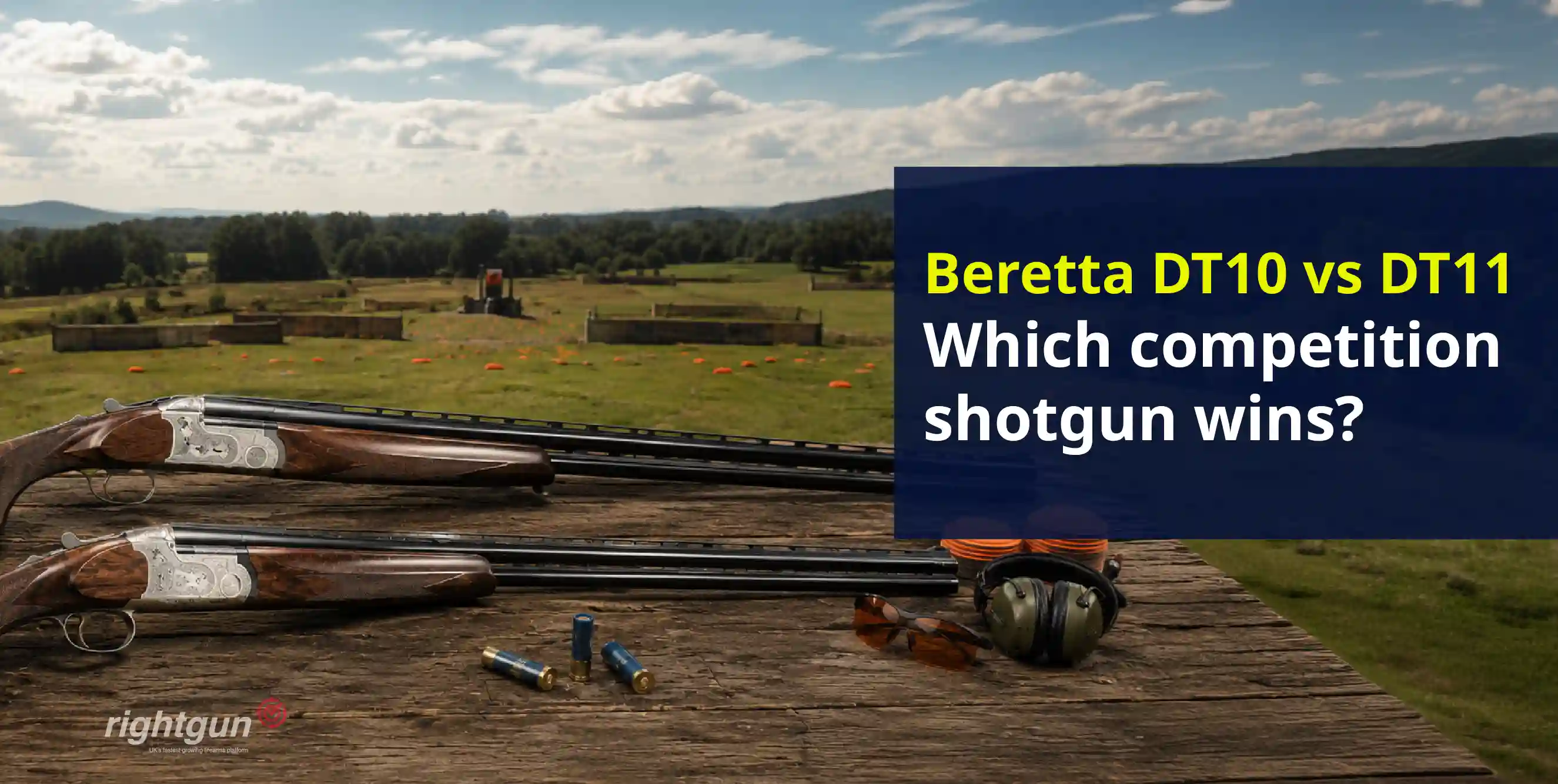
Few comparisons in the world of competitive shotgun shooting generate as much debate as the Beretta DT10 versus the Beretta DT11. Both guns sit at the pinnacle of Beretta's competition range, both have won World Championships and Olympic medals, and both command serious money whether bought new or second-hand.
The DT10 was the gun that established Beretta's dominance in top-level competition shooting, and the DT11 is the gun that was supposed to replace it. Yet more than a decade after the DT11's introduction, the DT10 retains a passionate following, and the question of which is genuinely better remains a live one. This guide examines both guns in the detail they deserve, so you can make an informed choice rather than relying on brand loyalty or received wisdom.
A brief history
The DT10 was launched in 2000 as Beretta's flagship competition shotgun, replacing the ageing SO series as the gun of choice for serious clay shooters. It was a clean-sheet design that introduced several features that were genuinely innovative at the time, including a cross-bolt locking system with replaceable trunnion shoulders, a detachable trigger group, and Beretta's Optima Bore barrel system. The gun was an immediate success in competition circles, and within a few years it was the dominant gun on the FITASC and Olympic circuits.
The DT11 arrived in 2012 as a comprehensive evolution of the DT10 rather than a revolutionary replacement. Beretta refined virtually every aspect of the design, from the action geometry and barrel profile to the trigger mechanism and stock ergonomics. The DT11 was designed to address the few criticisms that had emerged over a decade of hard use of the DT10, and it introduced Beretta's Steelium barrel technology and the B-Fast adjustable stock system. The DT11 has since become the standard bearer for Beretta in competition, but the DT10 was never a gun that needed replacing, it was a gun that Beretta chose to surpass.
Action design and locking
Both guns use Beretta's low-profile action with a cross-bolt locking system, but the execution differs in important ways. The DT10 features a single conical locking lug that engages with replaceable hinge pins (trunnion shoulders). This design was considered a significant improvement over the bifurcated lumps used in Beretta's lower-range guns, offering a more consistent lockup and the ability to replace worn surfaces without re-machining the action body. The action walls are slightly thicker than those of the DT11, contributing to the DT10's reputation as a gun that can absorb enormous round counts without showing wear.
The DT11 refined this system with a wider cross-bolt and revised action geometry that creates a slightly lower bore axis. The practical effect is a marginally more compact action that positions the barrels fractionally closer to your hands. This is a subtle difference, but at the elite level subtle differences matter. The DT11's action also features improved surface finishes on the internal bearing surfaces, which contributes to the smoother opening and closing action that most shooters notice immediately when handling both guns back to back.
In terms of durability, both actions are essentially competition-proof. DT10s with well over 200,000 rounds through them remain tight and functional, and there is no reason to expect any less from the DT11. The replaceable wear surfaces in both designs mean that action tightness can be restored by a competent gunsmith without the cost of a full re-build, which is a significant advantage over competitors that require more invasive work at similar round counts.
Barrel profiles and steelium technology
This is where the DT11 makes its most tangible improvement. The DT10 uses Beretta's Optima Bore system, which featured overbored barrels with a bore diameter of 18.6mm (compared to the standard 18.4mm). The Optima Bore system delivered excellent patterns and reduced perceived recoil, and it remains a highly effective barrel design. The barrel walls are slightly thicker than those of the DT11, particularly towards the muzzle, which gives the DT10 a subtly different weight distribution with marginally more mass towards the muzzle end.
The DT11 introduced Steelium barrels, which Beretta developed using a combination of tri-alloy steel, vacuum relief processes during manufacturing, and lengthened forcing cones. The Steelium barrel profile is tapered differently from the Optima Bore, with a slimmer profile through the mid-section that shifts weight marginally towards the action. The bore diameter remains at 18.6mm, but the internal surface finish is demonstrably smoother, which Beretta claims reduces friction and improves pattern consistency.
In practical terms, the Steelium barrels do pattern slightly more consistently at longer distances, particularly with lighter loads. The difference is measurable on a pattern plate but marginal in competition results. What most shooters notice more readily is the difference in handling. The DT11's barrel profile creates a slightly livelier, more responsive swing, while the DT10's heavier muzzle end encourages a smoother, more deliberate swing. Which you prefer is a matter of personal style, and neither is objectively superior.
Recoil characteristics
Both guns are remarkably soft-shooting for over-and-unders, and both benefit from the weight and mass distribution that Beretta builds into its competition guns. The DT10, at a typical weight of around 8lb 6oz to 8lb 10oz in sporting configuration, uses its mass to absorb recoil effectively. The slightly muzzle-heavy balance also contributes to a sense of stability during and after the shot. Shooters who fire high volumes — and competition shooters routinely fire 200 to 500 cartridges in a day — generally report that the DT10 is comfortable even over extended sessions.
The DT11 weighs similarly but distributes its mass differently, and Beretta incorporated specific recoil-management features into the design. The revised forcing cone geometry and the Steelium barrel construction both contribute to a slightly softer initial recoil pulse, and the stock geometry was redesigned to direct recoil more consistently into the shoulder pocket. In practice, the DT11 does feel fractionally softer to shoot than the DT10, particularly with heavier trap loads. The difference is not dramatic, but over the course of a long competition day it is noticeable.
Neither gun will punish you the way a lightweight game gun will. If recoil sensitivity is a significant concern, either gun will serve you well, though the DT11 has a slight edge that becomes more apparent with heavier loads and higher volumes.
Trigger quality
The detachable trigger group is a feature of both models, and both use Beretta's inertia-operated single selective trigger. The DT10's trigger is excellent — crisp, consistent, and with a pull weight that can be adjusted by a competent gunsmith. It was widely regarded as one of the best triggers available in a production competition gun at the time of its release, and it remains a strong performer today.
The Beretta DT11 improved on the DT10's trigger in several ways. The trigger blade itself is adjustable for length of pull and angle without removing the trigger group, which allows fine-tuning at the shooting ground rather than on the workbench. The trigger pull on the DT11 is typically a touch lighter and crisper out of the box, with a shorter reset that some shooters find improves their timing on report pairs. The trigger group housing was also revised to reduce the possibility of debris ingress, which is a practical benefit for shooters who compete in all conditions.
Both triggers are outstanding, and neither will hold back any shooter at any level of competition. The DT11's adjustability is a genuine convenience, but the DT10's trigger has proven itself over millions of rounds fired in competition worldwide.
Stock options and ergonomics
The DT10 was originally supplied with a conventionally dimensioned competition stock in select walnut. While the wood quality varies between grades, the basic stock geometry is well-considered and suits a wide range of shooters. Aftermarket stock options are plentiful, with custom stockmakers like Wenig, Precise Stocks, and numerous UK-based specialists offering bespoke alternatives. The DT10's stock bolt pattern and action interface are well-documented, making custom fitting straightforward.
The DT11 introduced the B-Fast adjustable comb system as a standard feature on most variants. This allows the shooter to adjust comb height and cast using Allen keys, without removing the stock or visiting a gunsmith. For a competition shooter who needs to fine-tune their gun fit between disciplines or who is still dialling in their ideal stock dimensions, the B-Fast system is genuinely useful. The DT11's stock geometry was also revised with a slightly more open grip angle and a redesigned palm swell that many shooters find more comfortable during extended sessions.
The quality of the walnut on both guns varies by grade. Standard DT10s and DT11s come with Grade 3 wood, which is functional but unremarkable. Higher grades are available at additional cost, and both guns look spectacular in top-grade walnut. From a purely practical standpoint, the DT11's adjustable stock system is a clear advantage, though many DT10 owners have retrofitted adjustable combs from aftermarket suppliers.
Which discipline suits which gun?
For sporting clays, both guns excel, but their different handling characteristics suit different shooting styles. The DT11's livelier handling and slightly quicker response make it popular with shooters who favour a reactive, target-driven style. The DT10's more deliberate swing suits shooters who prefer a smooth, controlled approach. Neither gun is wrong for sporting, and the choice often comes down to personal preference.
For trap (DTL, ABT, Olympic Trap), the DT10's muzzle-heavy balance and rock-solid stability make it a superb choice. Trap shooting rewards a smooth, consistent swing, and the DT10's weight distribution promotes exactly that. The DT11 Trap models are also excellent, with higher ribs and adjusted weight distribution for the discipline, but many experienced trap shooters who have tried both prefer the DT10's feel.
For skeet, the DT11's quicker handling gives it an edge. Skeet demands fast, precise gun movement on close, fast targets, and the DT11's balance encourages the snap-shooting style that wins at the highest level. The DT10 is perfectly capable in skeet, but it requires a shooter who is comfortable with a slightly heavier feel.
The second-hand market
This is where the comparison becomes particularly interesting for UK buyers. The DT10 was discontinued when the DT11 launched, but it remains readily available on the second-hand market. Prices for clean, well-maintained DT10s typically range from £3,500 to £5,500 depending on grade, condition, and variant. Exceptional examples in high-grade wood or limited editions can command more, but a standard sporting DT10 in good condition represents extraordinary value for money given its competition pedigree.
The DT11 commands significantly higher prices. New DT11s retail from approximately £7,500 for a standard sporting model, rising to well over £10,000 for higher grades. Second-hand DT11s are available from around £5,000 to £7,500 depending on age and condition. The gap between a second-hand DT10 and a second-hand DT11 is typically £1,500 to £3,000, which raises the question of whether the DT11's incremental improvements justify that premium.
For the shooter who wants a world-class competition gun and is prepared to buy second hand, the DT10 offers arguably the best value in competition shotguns today. You are getting a gun that has won at the highest level, that will last for hundreds of thousands of rounds, and that can be bought for roughly half the price of a new DT11. For the shooter who wants the latest refinements, the adjustable stock, and the assurance of buying current production, the DT11 justifies its price, but it does not make the DT10 obsolete.
The verdict
The Beretta DT11 is objectively the more refined gun. Its barrels pattern more consistently, its trigger is more adjustable, its stock system is more versatile, and its recoil characteristics are marginally softer. If you are buying new and money is not the primary concern, the DT11 is the logical choice. It is the better gun, and Beretta's engineers earned the improvements through careful, thoughtful development.
But the Beretta DT10 is not merely a cheaper alternative. It is a proven, championship-winning shotgun that many top shooters still prefer for its handling characteristics, its bomb-proof durability, and its slightly more deliberate shooting style. At second-hand prices, it represents one of the most compelling propositions in UK competition shooting. If you find a well-maintained DT10 that fits you, there is absolutely no reason to spend more, the gun will not hold you back at any level of competition.
Browse the latest Beretta competition shotguns on Rightgun to see what is currently available.
Must read:
