
 13-Jul-2026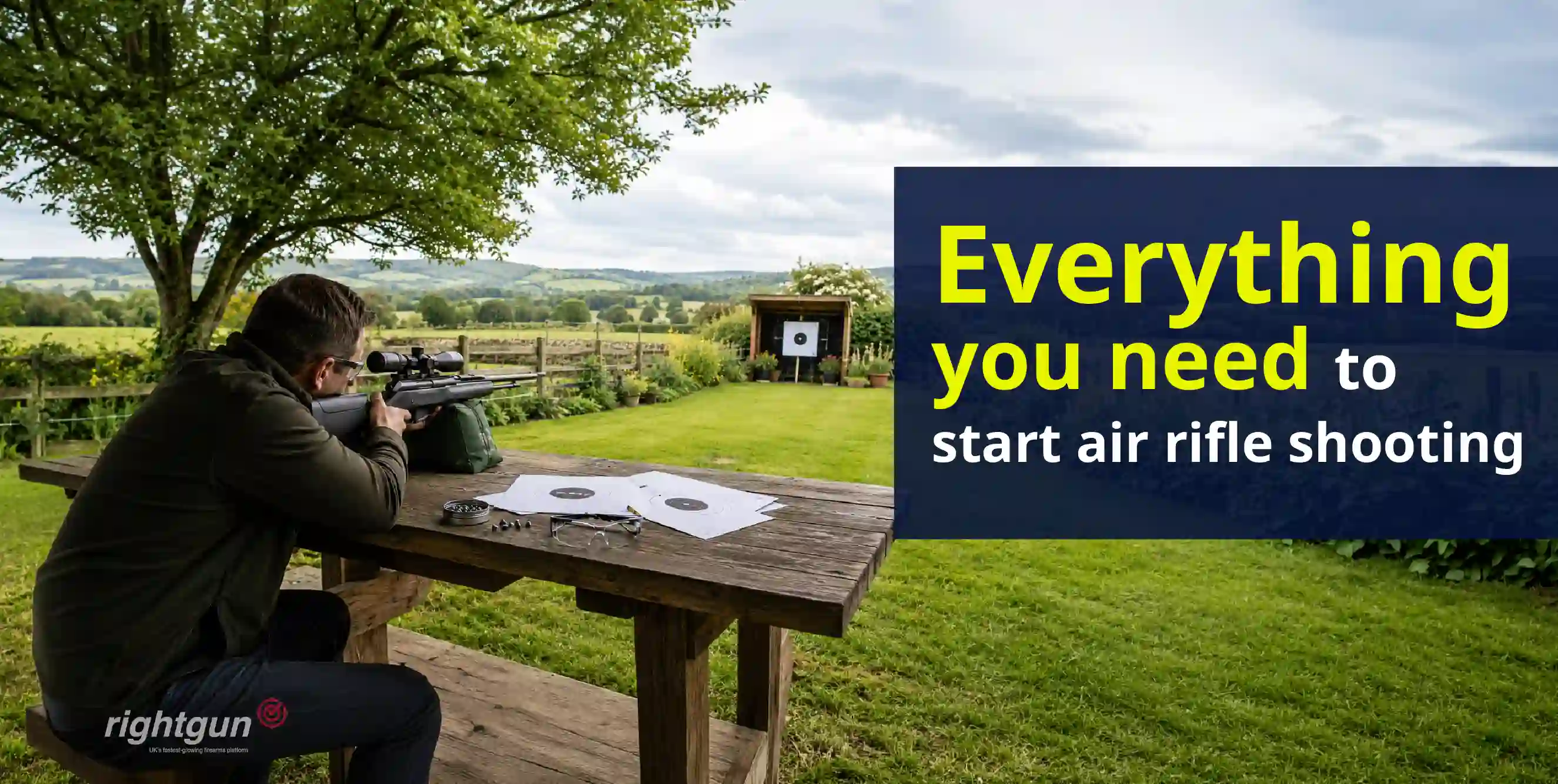
Air rifle shooting is one of the most accessible entry points into the shooting sports in the UK. With no certificate required for sub-12ft/lb rifles in England and Wales, relatively low ammunition costs, and the ability to shoot safely in your own garden with sensible precautions, it is little wonder that air rifles account for a significant proportion of all firearms owned in this country. Whether you are drawn to backyard plinking, competitive target shooting, or small-game hunting, this guide covers everything you need to know to get started on the right foot.
The legal framework
Understanding the law before you pick up an air rifle is not optional, it is essential. In England and Wales, air rifles producing less than 12ft/lb of muzzle energy can be purchased and owned without a firearms certificate, provided you are aged 18 or over. You can use one on private land with the landowner's permission, and there is no requirement to register the rifle or notify the police. Air pistols follow the same principle but with a lower limit of 6ft/lb.
Scotland operates under different rules, and this catches people out regularly. Since the Air Weapons and Licensing (Scotland) Act 2015 came into force, all air weapons in Scotland require an air weapon certificate issued by Police Scotland. The application process is similar to a shotgun certificate application, requiring a genuine reason, secure storage, and a background check. If you live in Scotland or plan to shoot there, you must hold the appropriate certificate before possessing any air weapon.
Northern Ireland treats air rifles as firearms regardless of power, and they require a firearm certificate. Anyone planning to shoot in Northern Ireland should contact the PSNI firearms licensing branch for current guidance.
For the rest of the UK, air rifles exceeding 12ft/lb are classified as Section 1 firearms and require a firearm certificate. These higher-powered rifles, often called FAC-rated air rifles, are popular among serious hunters and long-range target shooters but fall outside the scope of this beginner's guide.
It is worth noting that while you do not need a certificate for a sub-12ft/lb air rifle in England and Wales, all the usual laws about safe use apply. Shooting beyond the boundary of your permission, allowing pellets to leave your property, or using an air rifle to cause fear or distress are all criminal offences. Treat your air rifle with the same respect you would give any other firearm.
Action types explained
Air rifles come in three main action types, and understanding the differences will help you make a sensible first purchase.
Spring-Piston
The spring-piston action is the traditional air rifle mechanism that most people picture when they think of an air gun. Cocking the barrel or an underlever compresses a powerful spring inside the cylinder. When you pull the trigger, the spring drives a piston forward, compressing air that propels the pellet. Spring-piston rifles are mechanically simple, require no external power source, and are extremely reliable. They do produce a characteristic two-way recoil, with the piston moving forward and the gun jumping backward, which takes some getting used to. Brands like BSA and Weihrauch have built legendary reputations on their spring-piston rifles. The BSA Airsporter, first produced in the 1940s, is one of the most iconic air rifles ever made and remained in production for decades, establishing BSA's name in the air rifle world.
Gas-Ram (Gas Strut)
Gas-ram rifles replace the coiled spring with a sealed gas strut, similar in principle to a car tailgate strut. The advantages are reduced vibration, no spring fatigue over time, and a slightly smoother shooting cycle. Gas-ram rifles can also be left cocked for extended periods without any degradation in performance, which is useful when hunting. The disadvantage is that if the gas strut fails, it typically requires a return to the manufacturer rather than a simple spring swap. Many modern rifles from BSA and other manufacturers now use gas-ram technology as standard. The shooting characteristics are similar to spring-piston rifles, and the same hold techniques apply.
Pre-Charged Pneumatic (PCP)
PCP rifles use compressed air stored in an onboard reservoir to propel the pellet. They offer several significant advantages over spring and gas-ram actions: virtually no recoil, consistent shot-to-shot velocity, excellent accuracy, and the ability to fire multiple shots before needing a refill. The trade-off is complexity and cost. You will need a charging system, either a hand pump (hard work but portable) or a diving bottle (more convenient but an additional expense). PCP rifles dominate the competition scene and are the preferred choice of most serious hunters. The Air Arms S510 and BSA R-10 are among the most popular PCP rifles in the UK, offering outstanding accuracy and build quality.
Choosing your first air rifle
Your first air rifle should match your intended use, your budget, and ideally your physique. A rifle that is too long or too heavy will quickly become tiresome and will not encourage good shooting habits.
For general plinking and informal target shooting, a spring-piston or gas-ram rifle in .177 calibre is hard to beat. The Weihrauch HW97K is widely regarded as one of the finest spring-piston rifles ever made, offering superb accuracy and build quality at a price that, while not cheap, represents genuine value. The BSA Lightning offers a more affordable entry point without sacrificing too much in terms of performance. Both are available in full-length and carbine versions, with the carbine being more practical for younger or smaller-framed shooters.
If your budget stretches further and you want the multi-shot convenience and recoilless shooting of a PCP, the Air Arms S200 has long been the go-to recommendation for beginners stepping into pre-charged territory. It is accurate, affordable by PCP standards, and light enough to carry comfortably. As your skills develop, you can always upgrade to something more sophisticated.
Regardless of action type, pay attention to stock fit. An air rifle that does not come up naturally to your eye will always be harder to shoot well. Visit a dealer, handle several options, and if possible try before you buy. Many shooting grounds and clubs have air rifle ranges where you can test different models.
You can browse the current selection of air rifles on Rightgun to see what is available.
Pellet selection
Pellet choice has a bigger impact on accuracy than most beginners realise. The two main calibres for sub-12ft/lb air rifles are .177 and .22, and each has its strengths.
The .177 calibre shoots a lighter pellet at higher velocity, producing a flatter trajectory that makes range estimation more forgiving. It is the standard calibre for formal target shooting and an excellent choice for general use. The .22 calibre fires a heavier pellet at lower velocity, delivering more energy on target, which makes it the preferred choice for hunting where clean, humane kills are the priority. If you plan to do any amount of pest control or small-game hunting, .22 is the sensible choice. If target shooting is your primary interest, .177 is the way to go.
Within each calibre, pellet design matters. The standard domed or round-nose pellet, such as the Air Arms Diabolo Field or the JSB Exact, is the best all-round choice for both accuracy and hunting. Pointed pellets offer marginal penetration advantages but are typically less accurate. Wadcutter pellets, with their flat heads, are designed for paper target shooting and cut clean holes for easy scoring but are not suitable for hunting. Avoid novelty pellets, exploding pellets, and anything marketed with dramatic claims about knockdown power. Good-quality domed pellets from a reputable manufacturer are all you need.
Every air rifle has pellet preferences. Buy a selection of quality pellets in your chosen calibre and test them at the range. You will likely find that your rifle groups one or two brands noticeably better than others. Once you find what works, stick with it.
Setting up a backyard range safely
One of the great advantages of air rifle shooting is the ability to practice at home, provided you take safety seriously. The law requires that no pellet leaves the boundary of your property, and this means you need a proper backstop and clear consideration of what lies beyond your target.
A commercial steel pellet trap positioned against a solid wall or fence is the safest option and will contain pellets reliably at air rifle energies. Keep your shooting lane clear of obstructions and ensure no one can walk into it while you are shooting. While air rifle shooting is legal in your garden, doing so at anti-social hours or in a way that causes alarm is likely to generate complaints and potentially police attention. A quiet conversation with immediate neighbours before you start shooting is always advisable. The minimum sensible range for practice is about 10 metres, though 25 metres is the standard HFT competition distance and gives a much better test of your abilities.
Progressing to hunting
Air rifle hunting is a legitimate and effective form of pest control in the UK. Rabbits, rats, squirrels (grey only), woodpigeons, and several other species can be legally taken with an air rifle, provided you have the landowner's permission and observe all relevant close seasons and general licences.
Hunting with a sub-12ft/lb air rifle demands discipline and skill. The limited energy available means you must place your shots precisely to achieve clean, humane kills. For rabbits, the standard recommendation is head shots only at ranges no greater than 30-35 metres, and considerably closer until your skills and confidence are well established. At these energies, there is very little margin for error, and taking speculative shots at excessive range is both unethical and likely to wound rather than kill.
Fieldcraft is at least as important as marksmanship. Learning to read the wind, to move quietly, to use cover effectively, and to identify the right moment to take a shot are skills that come only with experience. Consider joining a local hunting club or finding a mentor who can show you the ropes in the field. The learning curve is steep but immensely rewarding.
Competition shooting
Air rifle competition in the UK is well organised and welcoming to newcomers. The two main disciplines are Hunter Field Target (HFT) and Field Target (FT), both involving metal knock-down targets at varying distances in woodland or open settings. HFT is the more accessible of the two, with targets set between 8 and 45 yards, and it places a premium on practical skills that translate directly to hunting. Indoor 10-metre air rifle shooting follows international ISSF rules and demands extraordinary precision, with many Olympic shooters having begun their careers on club ranges. Joining a local club is the best way to get into competitive shooting, as most welcome beginners, offer coaching, and can lend equipment while you find your feet.
Popular brands and heritage
The UK has a proud heritage in air rifle manufacturing. BSA (Birmingham Small Arms) has been making air rifles since 1905, and the BSA Airsporter, Meteor, and Mercury are names that resonate with generations of shooters. Modern BSA rifles like the R-10 and Ultra continue this tradition with contemporary PCP technology.
Air Arms, based in Sussex, produces some of the finest PCP air rifles available anywhere in the world. The TX200, a spring-piston underlever, is widely considered one of the most accurate air rifles ever made and enjoys a cult following among target shooters.
Weihrauch, though German rather than British, has an enormous presence in the UK market. The HW77, HW97, and HW100 are staples of the UK air rifle scene and are renowned for their build quality and longevity.
Theoben deserves special mention as a pioneering British manufacturer. Theoben air rifles, produced in Cambridgeshire, were among the first to use gas-ram technology and earned a devoted following for their innovative designs and superb accuracy. Though the company ceased production, Theoben rifles remain highly sought after on the second-hand market and command strong prices. If you encounter one in good condition, it is worth serious consideration both as a shooter and a collectable.
Budget considerations
Air rifle shooting can be as affordable or as expensive as you choose to make it. A decent spring-piston rifle can be had for 150 to 300 pounds, and a tin of quality pellets costs around 5 to 8 pounds for 500. Add a basic scope for 40 to 80 pounds and you have a complete setup for well under 500 pounds.
PCP shooting requires a larger initial outlay. A good entry-level PCP will cost 400 to 700 pounds, a scope another 100 to 250 pounds, and a charging solution 40 to 80 pounds for a hand pump or 150 to 250 pounds for a diving bottle and adaptor. Running costs remain low once you are set up, as pellets are the same price regardless of action type and a single bottle fill will last hundreds of shots.
The second-hand market for air rifles is active and offers excellent value. A well-maintained spring-piston rifle loses relatively little value over time, and PCP rifles from reputable manufacturers hold up well provided they have been serviced regularly. Buying second-hand is a perfectly sensible strategy for a beginner, particularly if you are still working out which type of shooting appeals to you most.
Must read:
