
 23-Oct-2026
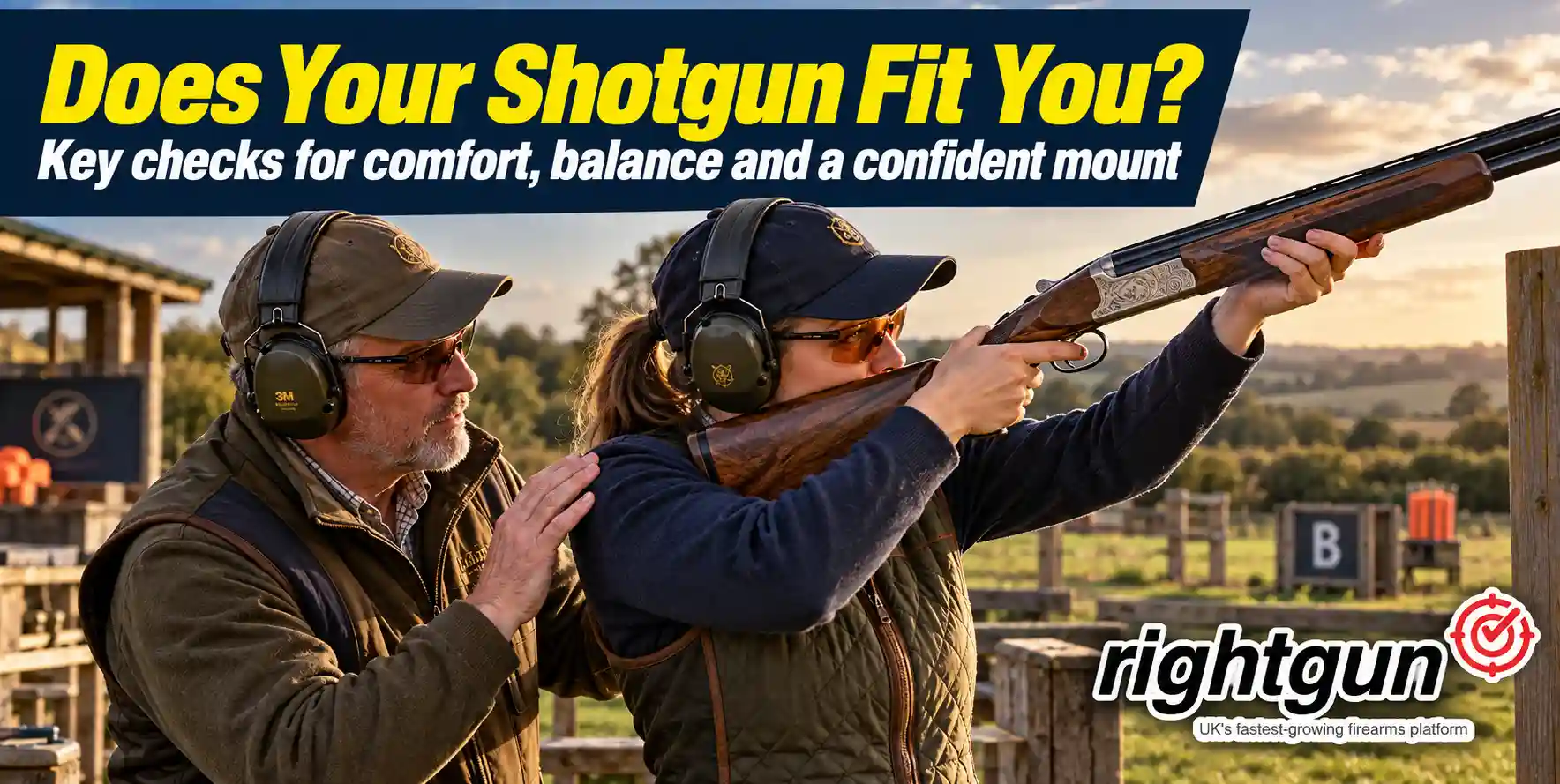
You can, and it is easier than most people expect. A well-fitting shotgun is one that points where you are looking the moment you mount it, without you having to hunt for the target or force your head into position. In short: check the length of the stock, the height of the comb under your cheek, and how the gun sits against your shoulder, then confirm it with a few mounts and, ideally, a session with a qualified fitter. This guide walks through the checks you can do in a gun shop or at a private viewing, and when it is worth paying for professional help.
Why does shotgun fit matter so much?
A rifle is aimed through a sight. A shotgun is pointed, and you do it with both eyes open, looking at the bird and not at the barrel. That only works if the gun brings your eye, the rib, and the target into line as you mount. If the stock is too long, too short, too high or too low for you, the shot will not go where your eye is looking, however good your technique.
Fit also matters when you buy: a cheaper gun that fits you can outperform a more expensive one that does not.
Browse: Shotguns for sale · Beretta 686 · Browning B525 · Miroku MK38 · Winchester shotguns
What are the main parts of shotgun fit?
Fitters talk about a handful of measurements, and it helps to know the words. Length of pull is the distance from the trigger to the centre of the butt, and it decides how far the gun sits from your face and how comfortably you can reach the trigger. Drop describes how far the stock falls away below the line of the rib at the comb and the heel, and it controls how high or low your eye sits behind the barrel. Cast is the slight sideways offset of the stock, to the left or right, which helps the gun line up with your dominant eye and the shape of your face and shoulders. Pitch is the angle of the butt relative to the barrels and affects how the gun sits in the shoulder.
You do not need to know exact figures to check a gun sensibly. Measurements vary with the gun and the person, and a good fitter works from how you actually mount and move. What matters is understanding what each one does, so you can tell what feels wrong.
Browse: Browning B725 · Beretta 692 · Beretta DT11 · Perazzi shotguns · Krieghoff shotguns
How can you check fit in a shop or at a viewing?
Start with an empty, safe gun and follow the seller’s lead on handling. Always treat every gun as loaded, keep it pointed in a safe direction, and check it is clear before you start. Then try a few simple things.
Stand naturally, look at a fixed spot on the far wall, and bring the gun up to your shoulder with your eyes on that spot, not on the barrel. Do this with your eyes shut for the first part of the movement if you like, then open them once the gun is mounted. When you open your eyes, the rib should be pointing at your spot, with the muzzle end looking like a clean, flat line and not tilted off to one side. If you see a lot of the rib, the comb may be too low. If you see very little, it may be too high. If the barrels seem to point off to one side, cast could be involved.
Next, notice what your face and shoulder are doing. Your cheek should rest on the comb without you pushing your head down onto it, and the butt should sit into the shoulder pocket without catching on clothing or digging into the arm. You should be able to reach the trigger without stretching and still have room for your thumb. Do several mounts in a row. A gun that fits tends to feel the same each time, and one that does not will keep landing in different places.
Browse: Shotguns for sale · Beretta A400 · Browning Maxus · Fabarm shotguns · Local gun shops and dealers
What should you wear and check on the day?
Fit changes with what you wear and how you stand. Try a gun in the clothing you will actually shoot in, as a thick jacket on a cold, driven day can add noticeably to the effective length of pull compared with a shirt in a warm shop. If you shoot clays in light clothing and game in heavy layers, you may want a compromise, or even a spacer you can add and remove.
Check the practical points too. Make sure the stock is in sound condition, with no cracks around the wrist or the head of the stock, and that any adjustable parts lock firmly. Ask whether the stock has been altered, shortened, or bent before, because a stock that has already been shortened cannot always be lengthened again without adding a pad or a new piece of wood.
It is also worth noticing balance. Hold the gun out and swing it gently between two points. A gun that feels lively in the hand to one person may feel whippy to another, and weight and balance are part of the way a gun fits you, even though they are not measurements on the stock. Our guide to shotgun fit goes into more detail on the principles.
Browse: Gun parts and accessories · Beretta 687 · Browning B25 · Franchi shotguns · Benelli shotguns
When is it worth seeing a professional gun fitter?
If you are spending serious money, shooting regularly, or struggling with bruising and misses, a session with a qualified fitter is usually money well spent. A fitter will watch you mount, may use a try gun that adjusts in many directions, and often asks you to shoot at a pattern plate or at clay targets to see where the shot actually lands. They can then recommend changes, or tell you whether a particular gun is worth buying at all.
Clay grounds, shooting schools and gunsmiths across the UK offer fittings, and a search for a fitter near you, or for a local gun shop, is a good first step.
Alterations are usually possible, but they have limits. A gunsmith can often shorten a stock, add a pad, adjust the cast or change the comb, and the work is easier on some guns than others. Speak to a qualified gunsmith before buying a gun you plan to alter.
Browse: Local gun shops and dealers · Beretta 682 · Beretta A301 · Beretta 486 · Shotguns for sale
Buying a used gun for fit: What to ask
When you buy privately or from a dealer, ask whether the stock has been altered and when. Ask what the previous owner used the gun for, how tall they were, and whether it was fitted to them. A gun fitted to a very different person may not suit you without work. Ask about the length of pull, the barrel length and the chambers, and ask for photos from the side showing the stock lines.
If you cannot handle the gun before you buy, ask about viewing arrangements and whether it can be tried first. For more on choosing your first gun, see buying your first shotgun. If you are selling, mention any adjustability and any alterations, and include a clear side-on photograph of the stock. Buyers look for this information.
Browse: Shotguns for sale · Browning B425 · Beretta A303 · Winchester 101 · Local gun shops and dealers
FAQ
What part of your body should fit snugly against the stock? Your cheek should rest lightly against the comb of the stock, with the butt seated in the pocket of your shoulder. The gun should feel secure without you pressing your head down or straining to keep it in place.
How do I know if a shotgun is too long for me? If the butt catches on your clothing as you mount, if your trigger hand feels stretched, or if your face sits far back from the comb, the stock may be too long. A fitter or gunsmith can confirm and advise on shortening.
Does shotgun fit really matter for clay shooting? Yes. Fit affects where the gun points and how comfortable you are across a long round, so it matters for clays and for game. A fitting session or a coach can help.
Can a shotgun stock be altered to fit me? Often, yes. Gunsmiths can usually shorten a stock, adjust cast or comb height, or fit a pad, though it depends on the gun. Ask a qualified gunsmith before you buy a gun you plan to alter.
Ready to find a shotgun that fits?
Fit is easier to judge when you can compare real guns. Browse the latest shotguns for sale on Rightgun.uk, find a local gun shop or dealer who can help you handle one, or look through gun parts and accessories for recoil pads and spacers. If you are selling a gun, list it on Rightgun.uk and reach UK shooters looking for exactly what you have.
Further reading: Shotgun fit, Buying your first shotgun in the UK and Shotgun chamber lengths explained
