
 03-Jun-2026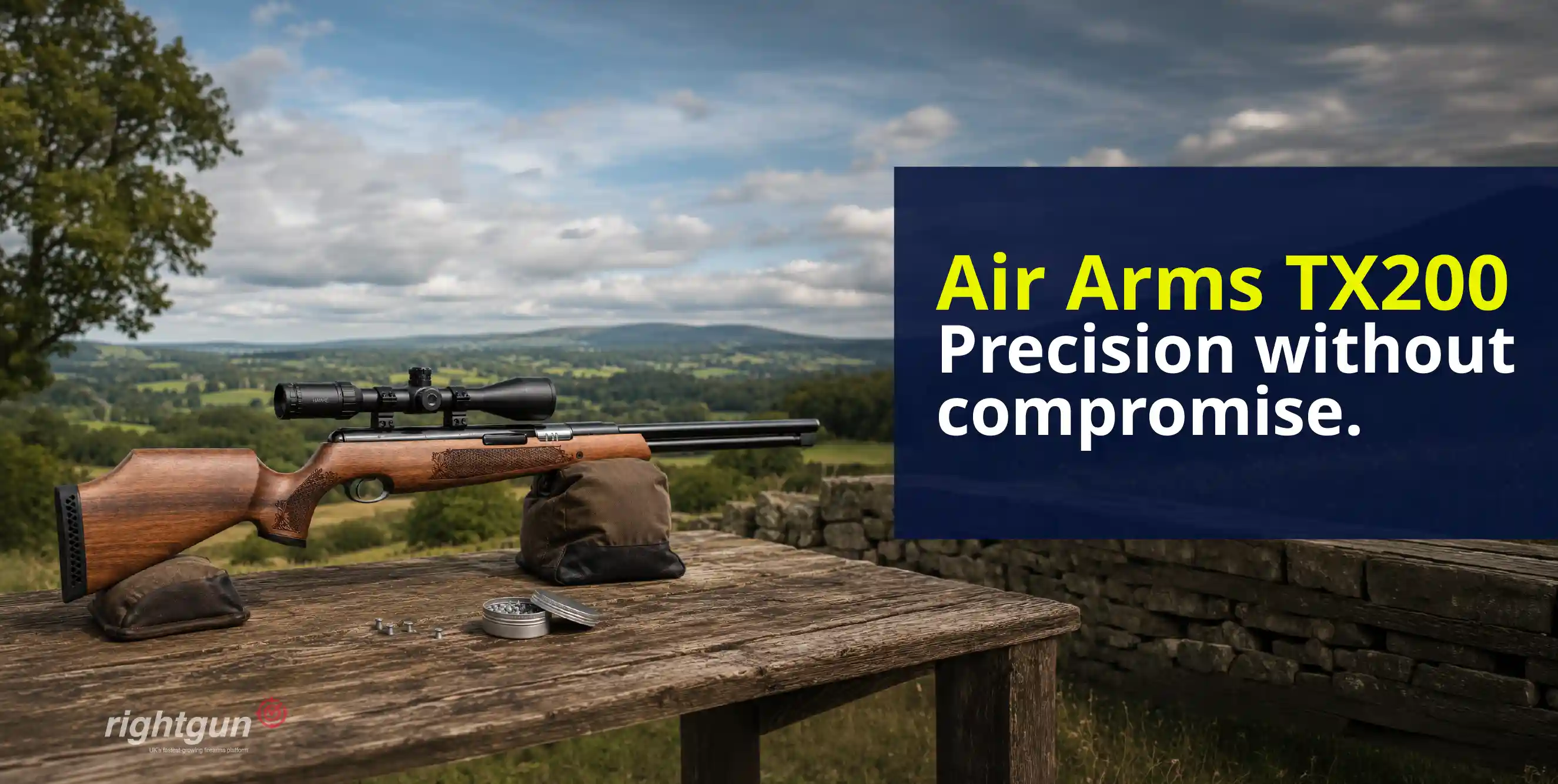
There are products that define a category, and then there are products that transcend it entirely. The Air Arms TX200 is one of the latter. Introduced in 1990 and still in production today with only incremental refinements, the TX200 has held its position as the finest spring-powered underlever air rifle available for well over three decades, a claim that very few manufactured products of any kind can make. In an industry where models come and go, where budget rivals appear constantly promising equivalent performance at a fraction of the price, the TX200 has remained the benchmark. Understanding why requires looking closely at what Air Arms built, and why it has proven so difficult to improve upon.
The underlever advantage
Most spring-powered air rifles use a break-barrel design, the barrel itself tilts forward to cock the mainspring, and the pellet is loaded directly into the exposed breech. It is a simple, proven design, but it has an inherent structural limitation: every time the barrel is broken, the join between barrel and receiver flexes slightly.
Over time and with heavy use, this can introduce subtle inconsistencies in barrel alignment that affect accuracy. The underlever design eliminates this issue entirely.
On the TX200, the barrel is fixed. A separate lever under the forend is pulled down and forward to cock the mainspring, and the pellet is loaded through a sliding breech that seals against the fixed barrel. The result is a rigid, consistent lockup every single shot. The barrel never moves. The relationship between the bore and the receiver is permanent and unchanging, and for accuracy, this matters enormously.
Combined with a sliding compression cylinder that moves independently from the piston, the TX200 delivers a firing cycle that is not merely smooth but genuinely recoilless in any meaningful sense. Experienced spring-rifle shooters who pick up a TX200 for the first time often describe the shot cycle as closer to a PCP than to other spring guns, and that comparison is only a slight exaggeration.
Build quality: What 'made in England' actually means
Air Arms manufactures the TX200 in Hailsham, East Sussex, and the provenance matters. Every component of the TX200 reflects a level of engineering care and manufacturing quality that you simply do not find at this price point from overseas competitors. The receiver is machined from solid aluminium to tolerances that are immediately apparent when you operate the action, there is no play, no rattle, no looseness anywhere. The trigger is a two-stage design that is adjustable and, in standard factory form, one of the finest spring-rifle triggers available.
The walnut stock on classic variants is shaped, finished, and fitted to a standard that would not embarrass a custom rifle builder.
The TX200 is available in two stock configurations, the standard variant and the MkIII Carbine, which offers a shorter, more compact profile that suits younger or smaller-framed shooters without sacrificing any of the mechanical quality. Both are offered in walnut or synthetic stock options, and both are available in .177 and .22 calibre. The .22 is generally preferred by hunters and pest controllers for its superior energy retention at typical garden ranges; the .177 is the choice of target shooters who value the flatter trajectory and higher velocity that the lighter calibre provides.
Strip the TX200 down, a satisfying exercise in itself, and the internals reflect the same attention to quality as the exterior. The mainspring is precision-wound and properly pre-tensioned. The piston seal is a custom-moulded parachute seal that beds consistently against the cylinder walls. The tolerances throughout the powerplant are designed to produce a consistent, repeatable firing cycle shot after shot after shot.
Accuracy: The TX200's defining achievement
Spring-powered air rifles present a unique accuracy challenge. Unlike PCP rifles, which simply release a metered charge of pre-stored compressed air with every shot, spring guns produce a violent, complex firing sequence, spring release, piston compression, air column formation, and pellet acceleration, all within milliseconds. Managing that sequence consistently requires a technique called the artillery hold, where the rifle is rested lightly in the hands and allowed to move freely during firing rather than being gripped tightly.
The TX200 rewards this technique more consistently than almost any other spring rifle. Its smooth, vibration-free firing cycle makes the artillery hold easier to execute correctly, and its fixed barrel ensures that good technique translates directly into tight groups rather than being undermined by mechanical inconsistency. Experienced TX200 shooters regularly achieve group sizes at 30 metres that would be considered respectable on a decent PCP, and at the sort of hunting ranges at which a sub-12-ft/lb air rifle is both legal and ethical in the UK, the TX200 is as accurate as any spring gun you will find.
This accuracy has made the TX200 a perennial favourite in field target competition, where air rifle accuracy is tested at precisely marked distances against small metal targets. At the highest levels of UK field target competition, the TX200 competes and wins against the full spectrum of PCP equipment. That achievement alone speaks to the depth of engineering underpinning this rifle.
Thirty-five years and still the standard
What is perhaps most remarkable about the TX200 is not what it has achieved, but how long it has maintained that achievement. The air rifle market has changed enormously since 1990. PCP technology has become accessible to mainstream shooters. Budget imports have proliferated. Chinese manufacturers have invested heavily in improving their products. And throughout all of that change, the TX200 has remained the answer that experienced spring-rifle shooters give when asked what the best spring-powered underlever air rifle in the world is.
Minor refinements have been made over the years, trigger improvements, stock updates, seal material upgrades, but the fundamental design has not changed because it does not need to. Air Arms recognised in 1990 that they had built something that could not be significantly improved upon without becoming a different type of gun entirely, and they have had the discipline to refine rather than reinvent.
Who is the TX200 for?
The Air Arms TX200 appeals to a wide range of shooters, but it earns its deepest appreciation from those who take spring-rifle shooting seriously. For the dedicated garden shooter who wants maximum accuracy from a self-contained, maintenance-light platform, the TX200 is the obvious answer. For field target competitors who want to compete at the highest spring-rifle level without moving to PCP, it is almost the only answer. For hunters and pest controllers who prefer the simplicity of a spring gun, no filling equipment, no pressure gauges, no tank management, but refuse to compromise on accuracy and quality, the TX200 delivers in a way that no other spring rifle can match.
New shooters discovering the TX200 often describe a moment of recognition, an understanding of what a spring-powered air rifle is genuinely capable of when everything is built to the right standard. It is a formative experience for many airgunners, and it has made lifelong Air Arms customers of a significant proportion of those who try it.
Final verdict
The Air Arms TX200 is one of the finest air rifles ever manufactured, by any mechanism, at any price. It is more expensive than break-barrel alternatives and more demanding than PCPs in terms of the technique required to extract its full potential, but for shooters willing to invest both the money and the practice time, it rewards them with an accuracy and shooting experience that has no equal in spring-powered airguns. Thirty-five years of production and an unbroken position at the top of the market is not a marketing claim. It is a fact, and it speaks for itself.
Also read:
