
 31-Jul-2026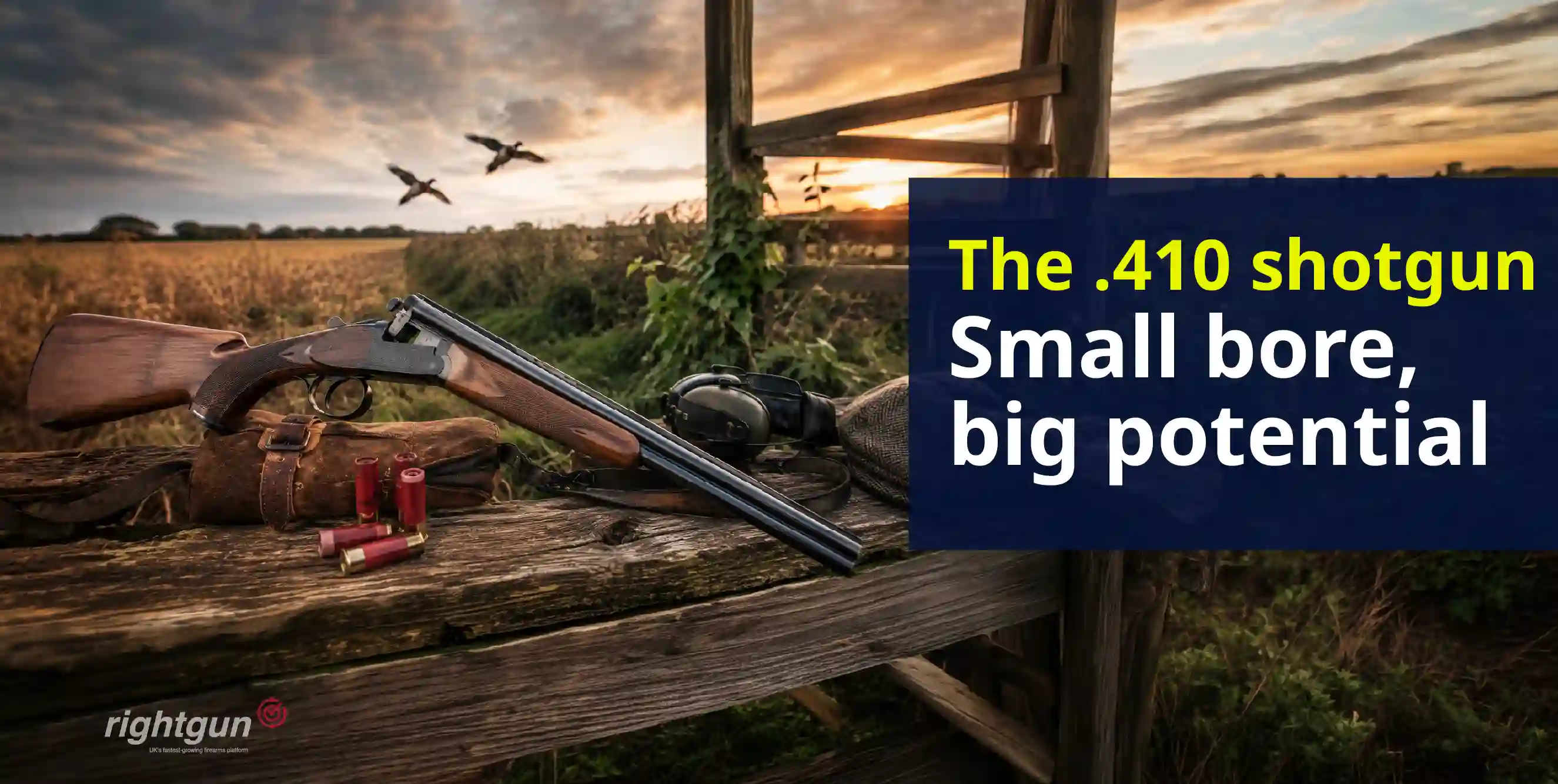
The .410 occupies a curious place in British shooting. It is the bore most of us started on as youngsters, the gun kept behind the kitchen door on farms for rats and squirrels, and in recent years, the subject of a genuine revival among experienced shots who fancy a new challenge on clays and game. Yet it is also one of the most misunderstood guns you can buy, routinely dismissed as a toy or wrongly recommended as a beginner’s gun on the basis of its size alone. If you are weighing up a .410 shotgun, this guide covers what it genuinely does well, where it struggles, and what to look for on the second-hand market.
What exactly is a .410?
Unlike every other common shotgun designation, the .410 is not a gauge but a calibre; the bore measures roughly .410 of an inch, which would translate to something like 67-bore in traditional gauge terms. It is the smallest shotgun chambering in general use, sitting below the 28-bore in the progression from 12-bore downwards.
Cartridges come in 2, 2½ and 3 inch lengths, and this matters more in the .410 than any other bore: a 3-inch magnum .410 cartridge carries a respectable payload, while a 2-inch cartridge carries very little indeed. Always check what your chamber accepts; plenty of older English .410s are chambered for the shorter cartridges only.
What the .410 does well
The .410’s virtues are real. The guns are light, often wonderfully so; a .410 game gun can weigh little more than 4 lb, which makes it the natural choice for a walking-round gun, a hedgerow gun, and for pest control around buildings where a full-size gun is unwieldy. Recoil is gentle, noise is modest, and for close-range vermin work- rats, feral pigeons, grey squirrels, it is arguably the perfect tool.
It is also, increasingly, a connoisseur’s challenge. The small payload leaves no margin for sloppy technique, which is precisely why good shots enjoy it: a 25-straight at skeet with a .410 means something. Several makers now build dedicated .410 over-and-unders for exactly this market, and small-bore days have become a fixture at many shooting grounds.
Where it falls short, and the beginner question
The .410’s limitation is simple physics: a light payload means a sparse pattern, and a sparse pattern means clean kills demand precision and restraint in range. This is why the old habit of handing a .410 to a novice deserves scrutiny. A beginner gets a gun that is easy to carry but genuinely harder to hit with than a 20-bore or 28-bore, which risks teaching frustration rather than confidence. For a young or slight shooter, a well-fitted 28-bore or a light 20-bore is very often the better first gun; the .410 shines either as a true starter for closely supervised small-frame youngsters at short range, or as a specialist’s gun for those who already shoot well.
For driven game, the .410 in experienced hands accounts for birds cleanly within sensible range, but honesty about that range is the whole game.
Popular .410 models in the UK
The second-hand market splits into a few camps. At the workhorse end, single-barrel folding guns and bolt-action .410s from makers like Webley and BSA turn up constantly and remain the classic farm gun, cheap, simple and endlessly useful. English side-by-side .410s from provincial makers occupy the middle ground and make charming hedgerow guns.
Modern over-and-unders are where the revival is happening: Beretta and Browning both catalogue .410 versions of their standard sporting models, and Yildiz’s affordable .410 over-and-unders have introduced a new generation to the bore. At the top end, best English small-bores, including .410s from the London houses, are collector territory and priced accordingly. Moderated options exist too: the Hushpower .410, covered in our recent guide to silenced shotguns, has become a favourite for discreet pest control.
Buying a .410: What to check
Three checks matter more with the .410 than with larger bores. First, chamber length: confirm whether the gun takes 3-inch, 2½-inch or only 2-inch cartridges, because it dictates both performance and your ammunition options. Second, on older guns, condition and proof: many .410s led hard outdoor lives as knockabout farm guns, so look carefully at bores, actions and stock cracks, and confirm the gun is in nitro proof if you intend to use modern cartridges. Third, cartridge availability and cost: .410 ammunition is dearer per shot than 12-bore and stocked in less variety, so factor that into a gun that will see heavy use.
Remember the licensing position is identical to any other shotgun: a conventional .410 is a Section 2 shotgun held on a Shotgun Certificate, with the same storage requirements as your 12-bore.
FAQs
What is a .410 shotgun good for? Close-range pest control, ratting and squirrel work, walking-round shooting where weight matters, introducing supervised youngsters at short range, and as a genuine challenge gun for experienced shots on clays and game.
Is a .410 good for a beginner? Often not, despite tradition. Its sparse pattern makes hitting harder than with a 28 or 20-bore. It suits small-framed juniors at very close range under supervision, but most newcomers progress faster with a slightly larger bore.
Do you need a licence for a .410 in the UK? Yes, a standard Shotgun Certificate, exactly as for any other conventional shotgun. See our guide to UK firearm categories for how the certificate system works.
How far can you shoot with a .410? Kept within sensible limits, it kills cleanly at close to moderate range; the constraint is pattern density rather than power. Experienced .410 shooters treat restraint in range as part of the discipline.
Browse .410s and small-bores on Rightgun.uk
From folding farm guns to small-bore over-and-unders built for serious clay work, the .410 market in the UK is broader than it has been in decades. Discover the current shotguns for sale on Rightgun.uk, including Hushpower moderated .410s, or list your own small-bore in front of a dedicated UK shooting audience in minutes.
Read next:
