
 12-Oct-2026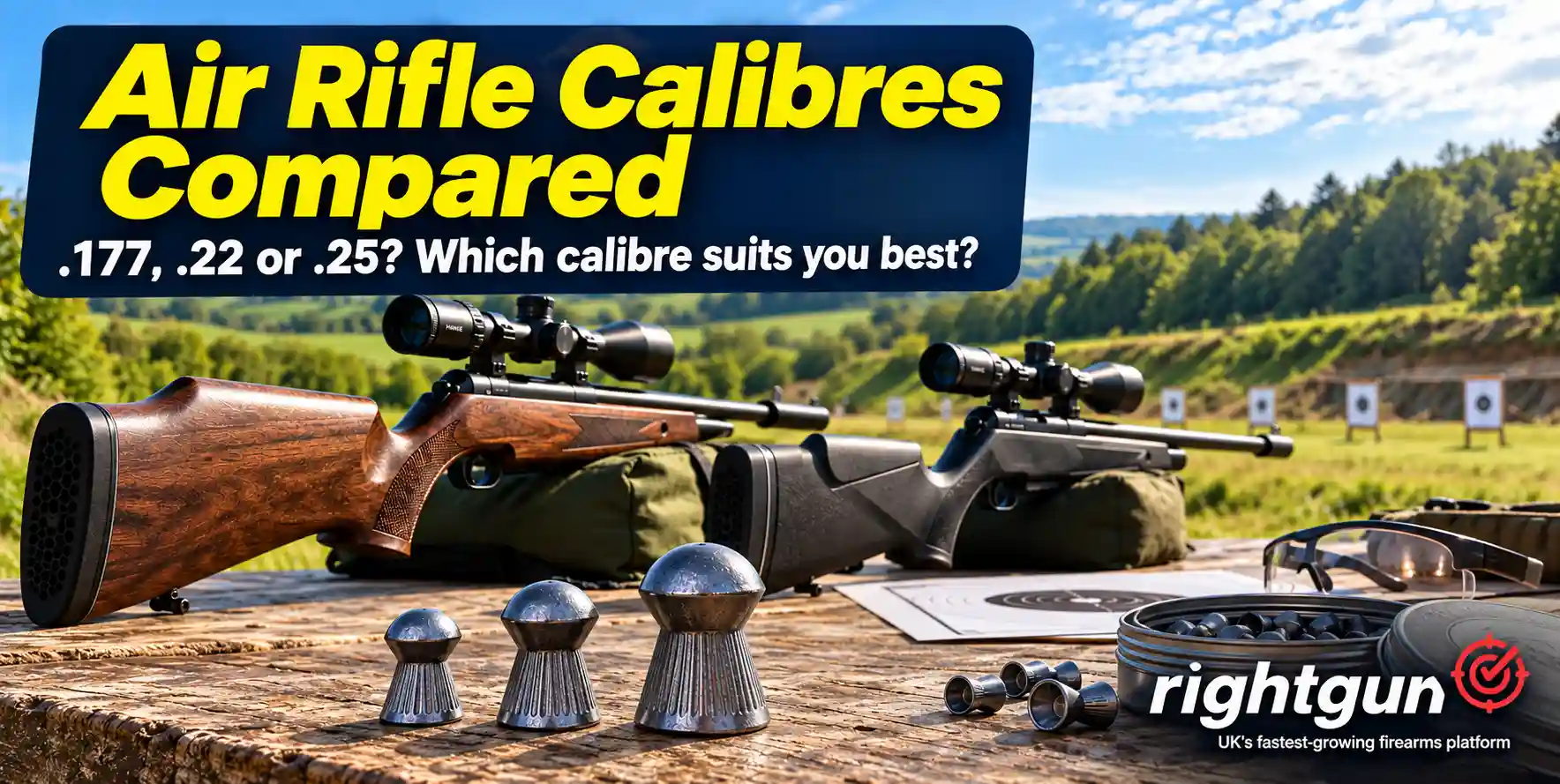
Choosing an air rifle usually starts with the make and model, but one decision shapes how the rifle shoots more than almost any other: the calibre. Pick the wrong one for your purpose, and you will notice it every time you pull the trigger, whether that is a pellet dropping short of the target or a rabbit that deserved a cleaner shot.
This guide compares the three calibres you will meet most often on the UK market, .177, .22 and .25, and explains which suits target shooting, pest control and the legal power limit. We have kept the numbers general because pellet weights, velocities and ranges vary between models and ammunition, so always check the specification of the rifle you are considering.
The basics: What calibre actually means
Calibre describes the diameter of the pellet and the bore it travels through. In imperial terms, .177 is roughly 4.5mm, .22 is roughly 5.5mm, and .25 is roughly 6.35mm. Larger pellets are usually heavier, and heavier pellets behave differently in flight from lighter ones.
Because a rifle’s power is capped by law in the UK, calibre is really a trade-off. At the same energy, a lighter .177 pellet flies faster and flatter, while a heavier .22 or .25 pellet travels more slowly but carries its weight and hits with more authority on impact. Neither is better in every situation; each has a job it does best.
Calibre is not fixed for a given model. Many popular rifles are offered in several, so you can often choose when you buy new or look for the right one on the second-hand market.
Browse: Air Arms S510 · Air Arms S410 · BSA R10 · Weihrauch HW100 · FX air rifles
.177: Accuracy, flat trajectory and target work
The .177 is the standard for target shooting and a firm favourite for general-purpose use. Its lighter pellet travels quickly and follows a flatter path, which makes judging distance easier and gives you a little more margin for error at longer range. Pellets are also widely available, with a huge range of types, and they tend to be inexpensive.
For plinking, field target, and informal practice, .177 is hard to beat. For pest control, it works well on small quarry such as rats and squirrels at sensible ranges, as long as you place the shot carefully. Many experienced shooters trust it for head shots precisely because of its accuracy.
Its limitation is energy on impact. A light pellet carries less weight than a larger calibre, so it rewards precise shot placement and is less forgiving of a marginal hit on larger quarry.
Browse: Air Arms TX200 · Weihrauch HW97 · Weihrauch HW80 · BSA Airsporter · Anschutz 9015
.22: The all-rounder for pest control
The .22 is the calibre many UK pest controllers reach for. Its heavier pellet retains more energy downrange and delivers a firmer, more dependable result on rabbits, pigeons and similar quarry. The trajectory is a little more of an arc than a .177, so range estimation matters more, but a well-sighted rifle and some practice make that manageable.
Pellets are readily available, and the calibre is well supported across hunting-oriented rifles. If your main aim is to take quarry cleanly in the field, .22 is a sensible default, particularly for rifles at the legal limit.
Remember that effective hunting depends on ethics and technique, not just calibre. Know your quarry, your range and your backstop, and never take a shot you are not confident about.
Browse: Theoben Rapid · Daystate Huntsman · BSA Ultra · BSA Scorpion · Weihrauch HW100
.25: Heavier pellets and where they make sense
The .25 is less common, and it makes the most sense when paired with a rifle that has plenty of power to push a heavy pellet. Under the legal limit, the advantages over .22 are smaller, and the greater drop makes accuracy harder to achieve. Pellet choice is also narrower.
Where .25 shines is on powerful PCPs that sit above the legal limit and require a firearms certificate. In that territory, the heavy pellet carries serious energy, but it is a specialist choice. If you are new to air rifles, it is not where to begin.
If you are curious, ask the seller about the rifle’s tuning and what shooters typically use it for, and speak to an experienced owner before committing.
Browse: Daystate rifles · FX Crown · Brocock air rifles · Air Arms · Moderators
The legal limit and how it shapes your choice
In Great Britain, an air rifle that stays at or below the legal energy limit does not need a firearms certificate, while more powerful rifles do. That limit is why you will see so many rifles advertised as sub-12 ft lb, and why the decision between calibres is really about getting the most from a fixed amount of energy.
Under the limit, .177 and .22 are both excellent. Choose .177 if you value accuracy, flat trajectory and cheap practice, and .22 if clean results on pests matter most. If you are not sure, think about what you will shoot 80 per cent of the time and choose for that.
Rules differ in Northern Ireland, so check the local position if you live there. Whichever rifle you choose, make sure you understand the law on where and how you can shoot.
Browse: BSA Lightning · BSA Mercury · Weihrauch HW35 · Weihrauch HW30 · Gun parts and accessories
A quick decision guide
If you shoot mainly at paper targets, knock-down targets or in the garden, choose .177. If you shoot mainly at pests in the field, .22 is the safer all-round choice. If you want one rifle to do both reasonably well, .22 is the compromise many shooters settle on, while .177 suits those who put accuracy first.
Also think about the rifle’s action. Spring-powered rifles can be fussy about pellet weight and are often happiest in a particular calibre, while PCPs are more flexible and often offered in several. Whatever you choose, test a few pellet brands, because every rifle has favourites and the right pellet can tighten groups dramatically.
Browse: Air Arms S510 · BSA R10 · Weihrauch HW100 · Air Arms TX200 · Theoben Rapid
FAQ
Is .177 or .22 better for pest control? Many UK shooters prefer .22 for its heavier pellet and firmer impact, while others favour .177 for its accuracy and flatter trajectory. Both work with careful shot placement.
What calibre is best for target shooting? .177 is the usual choice, thanks to its flat trajectory, wide pellet range, and low running costs.
Can I use different calibres in the same rifle? No. A rifle is built for a specific calibre, so you need the matching barrel and pellets. Some models are sold in more than one calibre.
Does calibre affect whether I need a licence? The legal power limit, not the calibre, decides whether you need a firearms certificate. Always check the rules before you buy.
Find your calibre on Rightgun.uk
Browse air rifles in .177, .22 and more from UK sellers and dealers on Rightgun.uk. Compare new and second-hand listings side by side, and list your own rifle if it is time to move on.
Further reading: Airgun slugs vs pellets, Spring vs PCP air guns, Best air rifles for pest control by budget, Most powerful legal air rifles in the UK, and Beginner’s guide to air rifle shooting.
