
 23-Feb-2026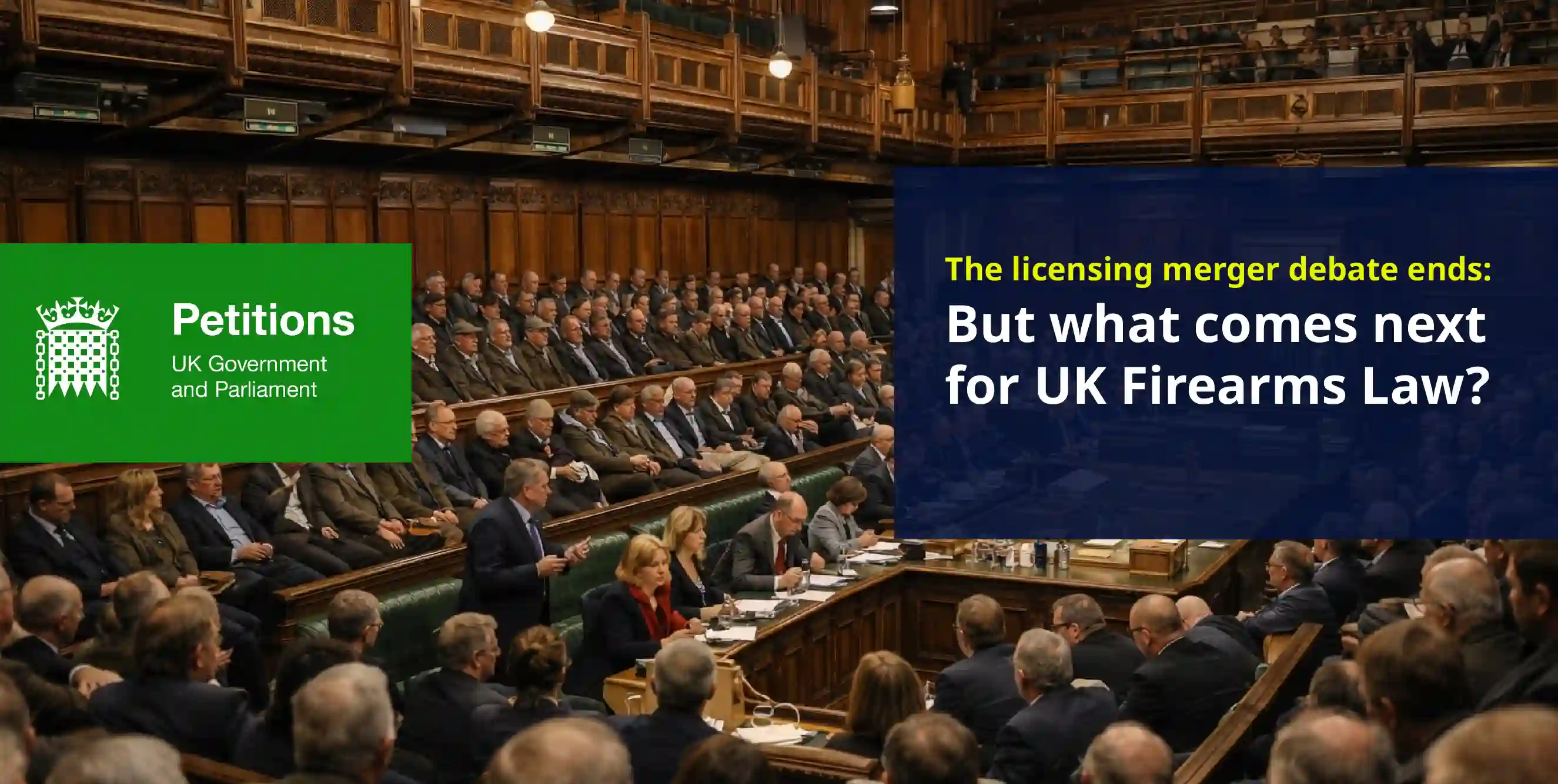
Outcome of the February 2026 Parliament Debate
23 February 2026 | Westminster Hall, House of Commons
In a remarkable display of cross-party unity, Members of Parliament delivered a decisive and unambiguous rejection of Government proposals to merge shotgun and firearms licensing on Monday 23 February — and not a single MP spoke in favour of the plans.
The Westminster Hall debate was triggered by a public petition that had gathered over 121,000 signatures in a remarkably short space of time, making it one of the fastest-growing petitions the Petitions Committee had seen in years. The petition called on the Government to keep Section 1 firearm licensing and Section 2 shotgun certificates separate, arguing that any merger would harm law-abiding owners, damage rural communities, and burden the shooting industry without delivering any meaningful public safety benefit.
What Was Being Proposed?
The backdrop to the debate was the Government's long-signalled intention to consult on bringing shotgun licensing closer in line with the stricter controls that apply to Section 1 firearms — such as rifles. Ministers have argued this is a proportionate public safety response, pointing to tragic incidents including the Plymouth shootings of 2021, the Epsom College shooting of 2023, and recommendations made by coroners and the Independent Office for Police Conduct in their aftermath.
At present, obtaining a shotgun certificate (Section 2) requires a lower evidential threshold than a full firearms licence (Section 1). Critics of the merger argue that this distinction exists for good reason — shotguns serve a fundamentally different role in rural life, land management, pest control, and sport, and are already subject to meaningful controls.
The Debate: 24 MPs, Zero in Favour
Twenty-four MPs took to the floor to speak against the proposed merger, representing constituencies from across England, Scotland, and Wales, and spanning the Conservative, Liberal Democrat, Labour, and other parties. The breadth of opposition was striking. This was not a partisan skirmish; it was a united front.
A significant number of BASC members were present in the public gallery for the debate, filling it to capacity and demonstrating the depth of feeling within the shooting community. Contributions from across the chamber made clear that MPs had been inundated with correspondence ahead of the debate, with many directly citing the strength of views expressed by their constituents.
Voices From the Chamber
Three quotes in particular captured the mood and the substance of the debate:
"One hundred and twenty one thousand people have signed this petition, and I believe it has been one of the fastest signed petitions that the Petitions Committee has received for a long period of time. Many farmers, land managers, pest controllers, those participating in game shoots and clay pigeon shoots, turned up to express their level of concern about the government's aspiration to merge section 2 and section 1 under the Firearms Act 1968. I think it is widely recognised that firearms licensing is effective at protecting public safety."
— Robbie Moore, Conservative MP for Keighley and Ilkley
"Gun controls should only be strengthened when there is a clear necessity to protect public safety."
— Sarah Dyke, Liberal Democrat MP for Glastonbury and Somerton
"For many, this proposal represents a far-reaching regulatory shift with consequences that may not have yet been fully understood. The anxiety that's been expressed to myself and other members is not rooted in resistance to safety. They want dangerous individuals to be prevented from accessing firearms. What they question is whether creating a larger, potentially more congested system will achieve these outcomes — or whether it risks the opposite, by overwhelming the very departments responsible for ensuring public safety."
— Julie Minns, Labour MP for Carlisle
These three quotes — from a Conservative, a Liberal Democrat, and a Labour MP respectively — illustrate just how complete the cross-party consensus was. Across the political spectrum, the message was the same: this proposal is not grounded in evidence, and the rural communities who depend on lawful shotgun ownership deserve better.
Concerns About Policing and Bureaucracy
A recurring theme throughout the debate was the pressure that merging the two licensing regimes would place on police forces. Firearms licensing departments across England and Wales are already stretched, with backlogs a well-documented problem.
Several MPs warned that subjecting hundreds of thousands of shotgun certificate holders to the more rigorous Section 1 process would not only be unworkable in practice but could paradoxically undermine the very public safety it claims to serve, by overwhelming the system with administrative burden.
Some MPs went further, echoing calls from the British Association for Shooting and Conservation (BASC) for the establishment of a single, dedicated national firearms licensing authority — a structural reform that could improve consistency and efficiency rather than simply layering more complexity onto local police forces.
What Happens Next?
The Government has not abandoned its consultation plans. Ministers maintain their commitment to publishing a consultation on strengthening shotgun controls, and the debate itself does not force any change in policy — Westminster Hall debates are, by their nature, opportunities for Parliament to make its voice heard rather than to legislate directly.
However, the political signal sent on 23 February is hard to ignore. When not a single elected MP rises to defend a Government proposal during a dedicated parliamentary debate, that is a moment ministers note. The shooting community, rural lobby groups, and farmers will be watching closely to see whether the consultation — when it eventually arrives — reflects any of the evidence and argument laid before the House.
BASC, which had briefed MPs in advance and mobilised its members to contact their representatives, called the result a significant victory: "Their support in Parliament matters deeply to the hundreds of thousands of law-abiding certificate holders who expect and depend on a fair and workable licensing system."
The Bigger Picture
This debate sits within a wider and genuinely complex conversation about firearms regulation in the United Kingdom. Nobody in Westminster Hall was arguing that public safety is unimportant — quite the opposite. The disagreement is about whether this particular policy change is the right tool for the job, grounded in evidence rather than reaction.
With over 480,000 shotgun certificates currently in issue in England and Wales alone, any reform to the licensing regime would be one of the most significant changes to shooting law in a generation. MPs are right to scrutinise it carefully. The question now is whether the Government will listen.
Also read:
